
Trie (Prefix Tree)
A branching tree of characters supporting prefix insertion and search in O(length). The unlock for autocomplete, dictionary search, word puzzles, and IP routing.
TL;DR — Trie
Use when: many strings share prefixes and you need to query by prefix, OR you need to check word membership in O(word length).
Trigger phrases: "implement trie", "word search", "auto-complete", "longest common prefix", "longest word in dictionary", "design dictionary with wildcard", "stream of characters".
The data structure: a tree where each edge is labeled with a character. A path from root to a marked node spells out a word. Sibling-prefixed words share the same path.
Complexity: O(L) per insert, search, prefix lookup — where L is the word length. Independent of how many words are in the trie.
The problem that motivates this pattern
Implement Trie (Prefix Tree) (LC 208). Implement a class with three methods:
insert(word),search(word)(exact match),startsWith(prefix)(does any word start with this prefix).
You could use a hash set. insert and search are O(1). But what about startsWith("pre")? A hash set doesn't support prefix queries — you'd have to scan every word, O(N · L). Brutal for autocomplete on a dictionary of millions of words.
A trie shines here. Walk character-by-character from the root, following edges that match each character of the query. Operations are O(L) — completely independent of how many words are stored.
class Trie:
    def __init__(self):
        self.children = {}                            # char → Trie
        self.is_end = False

    def insert(self, word):
        node = self
        for c in word:
            if c not in node.children:
                node.children[c] = Trie()
            node = node.children[c]
        node.is_end = True

    def search(self, word):
        node = self._walk(word)
        return node is not None and node.is_end

    def starts_with(self, prefix):
        return self._walk(prefix) is not None

    def _walk(self, s):
        node = self
        for c in s:
            if c not in node.children: return None
            node = node.children[c]
        return node
That's it. O(L) per operation, regardless of how many words you've inserted. Insert "apple", "app", "application", "apply" — all share the prefix "app", so storage is roughly proportional to total unique character paths, not to the sum of word lengths.
This is why tries dominate autocomplete: searching "pre" finds every word starting with "pre" by walking 3 nodes and then enumerating descendants. Hash maps can't do this.
The core insight
A trie compresses shared prefixes into shared structure. Operations are O(word length), not O(dictionary size).
The invariant we maintain:
Every word stored in the trie corresponds to a path from the root to some node marked
is_end = True. Sibling words share their common prefix.
After inserting "app", "apple", "apply":

         (root)
           │
           a
           │
           p
           │
           p ← is_end (for "app")
          / \
         l   l
         │   │
         e   y ← is_end (for "apply")
         │
        end (for "apple") ← is_end
The path a → p → p is shared across all three words. This is why:
- Memory scales with unique character paths, not with sum of word lengths.
- Prefix queries are trivially fast — walk to the prefix node, then descend.
- Sorted enumeration is automatic — depth-first traversal yields words in lexicographic order.
The trade: each node stores a child map (often a hash map or fixed-size array of 26). That's typically more memory than a hash set of strings for random words. The trie wins when prefixes are highly shared — exactly the autocomplete and word-puzzle scenarios.
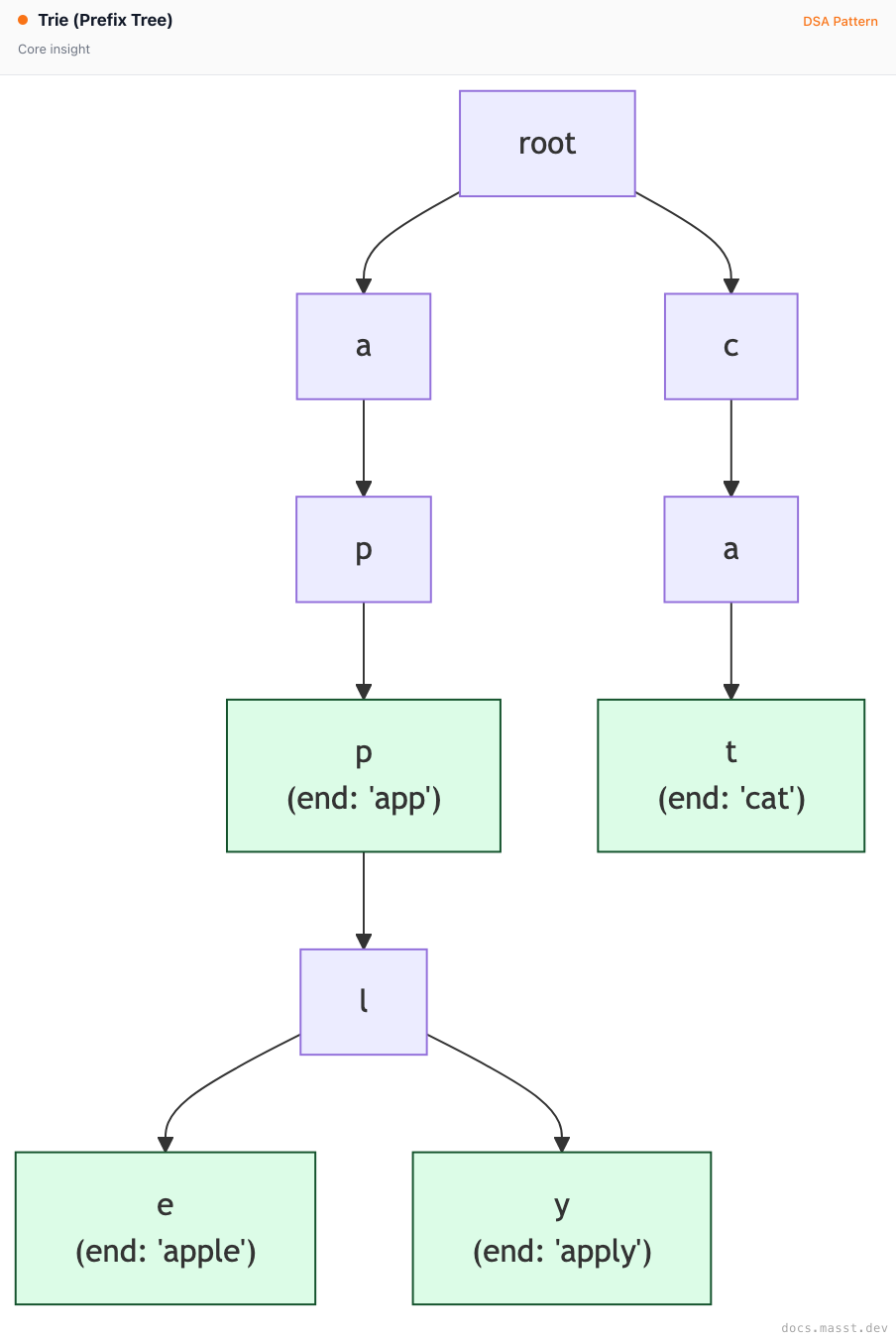
Visual walkthrough — insert and search
Trace inserting "app", "apple", "ape" then searching "apply".
Initial: root = {}, is_end = False

Insert "app":
  walk 'a' → not in children, create. node = root.a
  walk 'p' → create. node = root.a.p
  walk 'p' → create. node = root.a.p.p
  mark is_end = True
  Tree: root → a → p → p(end)

Insert "apple":
  walk 'a' → exists. node = root.a
  walk 'p' → exists. node = root.a.p
  walk 'p' → exists. node = root.a.p.p (is_end already!)
  walk 'l' → create. node = root.a.p.p.l
  walk 'e' → create. node = root.a.p.p.l.e
  mark is_end = True
  Tree: root → a → p → p(end) → l → e(end)

Insert "ape":
  walk 'a' → exists.
  walk 'p' → exists.
  walk 'e' → not in children of root.a.p, create.
  mark is_end = True
  Tree: root → a → p → { p(end) → l → e(end), e(end) }

Search "apply":
  walk 'a' → exists. walk 'p' → exists. walk 'p' → exists.
  walk 'l' → exists. walk 'y' → NOT in children. return False.

Search "app":
  walk 'a', 'p', 'p'. Final node has is_end = True. return True.

startsWith "ap":
  walk 'a', 'p'. Reached node successfully. return True (regardless of is_end).
Note the difference between search and startsWith: both walk to a node; only search requires the node to be marked is_end.
The template
Template A — Trie with dict (the dynamic version)
class TrieNode:
    def __init__(self):
        self.children = {}                            # char → TrieNode
        self.is_end = False

class Trie:
    def __init__(self):
        self.root = TrieNode()

    def insert(self, word: str) -> None:
        node = self.root
        for c in word:
            if c not in node.children:
                node.children[c] = TrieNode()
            node = node.children[c]
        node.is_end = True

    def search(self, word: str) -> bool:
        node = self._walk(word)
        return node is not None and node.is_end

    def starts_with(self, prefix: str) -> bool:
        return self._walk(prefix) is not None

    def _walk(self, s: str):
        node = self.root
        for c in s:
            if c not in node.children: return None
            node = node.children[c]
        return node
Template B — Trie with fixed-size array (faster for known alphabets)
class TrieNode:
    __slots__ = ['children', 'is_end']
    def __init__(self):
        self.children = [None] * 26                   # for lowercase a-z
        self.is_end = False

    def child_idx(self, c):
        return ord(c) - ord('a')
The array is faster (O(1) lookup, no hashing) and uses less memory per node — but only works if the alphabet is small and fixed. For Unicode or arbitrary characters, use the dict version.
Template C — Trie with word storage (for "longest match" problems)
class TrieNode:
    def __init__(self):
        self.children = {}
        self.word = None                              # store full word at terminal nodes

# Insert:
node.word = word  # at the final node instead of just is_end = True
Useful when you want to return the matching word, not just say yes/no. Used in Word Search II.
Template D — Trie with wildcard support (. matches any)
def search_with_dots(self, word):
    return self._search_helper(self.root, word, 0)

def _search_helper(self, node, word, i):
    if i == len(word):
        return node.is_end
    c = word[i]
    if c == '.':
        return any(self._search_helper(child, word, i + 1)
                   for child in node.children.values())
    if c not in node.children: return False
    return self._search_helper(node.children[c], word, i + 1)
Used in 211 Design Add and Search Words Data Structure.
Worked example: Word Search II (LC 212)
Problem. Given an
m × nboard of letters and a list of words, return all words found on the board. A word is found if it can be constructed from sequentially adjacent (horizontally/vertically) cells, with no cell used twice.Example: board =
[["o","a","a","n"],["e","t","a","e"],["i","h","k","r"],["i","f","l","v"]], words =["oath","pea","eat","rain"]→["eat", "oath"].
The naive approach. For each word, run DFS from every cell to check if the word can be traced. O(W · M · N · 4^L) where W = number of words, L = max word length. Too slow.
The trie insight. Insert all words into a trie. Now do one DFS from each cell, walking the trie in parallel. At each cell, only continue if the trie has a matching child. When you hit a node marked word, record that word. The trie prunes the DFS aggressively — many words share prefixes, so a single DFS handles them collectively.
This drops complexity to O(M · N · 4^L) — independent of the number of words (within memory limits).
def find_words(board: list[list[str]], words: list[str]) -> list[str]:
    # Build trie
    root = {}
    for w in words:
        node = root
        for c in w:
            node = node.setdefault(c, {})
        node['#'] = w                                 # terminal marker holds the word

    m, n = len(board), len(board[0])
    found = set()

    def dfs(r, c, node):
        ch = board[r][c]
        if ch not in node:
            return
        next_node = node[ch]
        if '#' in next_node:
            found.add(next_node['#'])
            del next_node['#']                        # prevent duplicate adds

        board[r][c] = '*'                              # mark visited
        for dr, dc in [(-1,0),(1,0),(0,-1),(0,1)]:
            nr, nc = r+dr, c+dc
            if 0 <= nr < m and 0 <= nc < n and board[nr][nc] != '*':
                dfs(nr, nc, next_node)
        board[r][c] = ch                               # restore

    for r in range(m):
        for c in range(n):
            dfs(r, c, root)

    return list(found)
Why the trie crushes the naive approach. The trie lets us explore the board once and check all words in parallel via shared prefixes. If two words share the prefix "ea", DFS only walks the path once. The terminal markers tell us which words are completed, even mid-traversal.
Two optimizations (in code above):
del next_node['#']after a word is found prevents adding duplicates and slightly prunes the trie.- Marking visited in-place (
board[r][c] = '*') avoids a separate visited set.
Dry-run conceptually: starting from (1,1)='t'. Trie path: t → not in root (since words start with 'o', 'p', 'e', 'r'). Skip. Try (1,0)='e'. Trie has e (from "eat"). DFS continues looking for 'a' next, then 't'. Found "eat". And so on for (0,0)='o' which finds "oath".
Complexity. Time: O(M · N · 4^L) where L = max word length. Space: O(total length of all words) for the trie.
Variants
Variant 1 — Basic Trie (insert / search / startsWith)
The canonical implementation. Template A.
Canonical problems: 208 Implement Trie, 1804 Implement Trie II (with prefix count and word count).
Variant 2 — Wildcard Trie
Support . matching any single character. Template D — recursive DFS into all children on ..
Canonical problem: 211 Design Add and Search Words Data Structure.
Variant 3 — Trie + DFS for board search
The "find all words from a dictionary on a board" pattern. Template C.
Canonical problems: 212 Word Search II (this page's worked example), 79 Word Search (single word — DFS without trie is simpler).
Variant 4 — Replace Words / Longest Prefix Match
Find the shortest prefix in the dictionary that matches a given word, OR the longest word in the dictionary that is a prefix of the given word.
def replace_word(word, trie):
    node = trie
    for i, c in enumerate(word):
        if c not in node.children: return word
        node = node.children[c]
        if node.is_end: return word[:i+1]              # found a root
    return word
Canonical problems: 648 Replace Words, 1268 Search Suggestions System, 720 Longest Word in Dictionary.
Variant 5 — Compressed / Radix Trie
When most nodes have only one child, collapse chains. Used in production routers (IP address tries, where memory matters) and many key-value stores.
For interviews, just mention it exists — the implementation is more complex.
Variant 6 — Bit Trie (Binary Trie)
For integers represented in binary. Each node has at most 2 children (bit 0 and bit 1). Used for:
- "Find maximum XOR of two numbers" — bit trie lets you greedily pick opposite bits.
- IP routing.
class BitTrie:
    def __init__(self):
        self.children = [None, None]

    def insert(self, num):
        node = self
        for i in range(31, -1, -1):                   # MSB first
            bit = (num >> i) & 1
            if node.children[bit] is None:
                node.children[bit] = BitTrie()
            node = node.children[bit]

    def max_xor_with(self, num):
        node, result = self, 0
        for i in range(31, -1, -1):
            bit = (num >> i) & 1
            want = 1 - bit                            # opposite for max XOR
            if node.children[want]:
                result |= (1 << i)
                node = node.children[want]
            else:
                node = node.children[bit]
        return result
Canonical problems: 421 Maximum XOR of Two Numbers in an Array, 1707 Maximum XOR With an Element From Array.
Variant 7 — Streaming Trie
Implement a class that processes characters one-at-a-time and returns whether any complete word has been "spelled out" by recent characters.
Canonical problem: 1032 Stream of Characters (reverse the words; insert into trie; on each new char, walk back from current position to check matches).
Variant 8 — Suffix Trie / Aho-Corasick
For multi-pattern string matching. Mostly competitive programming territory — rare in FAANG interviews. Mentioned for completeness.
Common pitfalls
| Trap | Fix |
|---|---|
Confusing search (exact match) with startsWith (prefix) | search requires is_end; startsWith doesn't |
Using a set thinking it's just as good for prefix queries | Sets don't support prefix lookup in O(L). Use a trie |
Forgetting is_end and getting false positives | E.g., if "apple" is inserted, searching "app" should return False unless "app" was also inserted |
Using {} as default for children but mutating during iteration | Standard Python pitfall — iterate over list(node.children.items()) if mutating |
| Recursion depth on long words (~10⁴) | Use iterative _walk for the common operations; reserve recursion for wildcard/DFS |
| Mutating the trie during DFS (e.g., Word Search II) without restoring | Either deep-copy or restore on backtrack |
| Storing the entire word at every node (instead of just at terminals) | Wastes memory. Only mark terminals |
| Forgetting to handle empty string | Some problems want "" to count as a valid prefix of everything |
Slow performance from dict.get() vs direct lookup | Direct lookup node.children[c] is faster than node.children.get(c) for hot paths |
| Memory blowup on a huge dictionary | Use fixed-size arrays if alphabet is small; consider radix trie for production |
Complexity
Per operation (insert / search / startsWith): O(L) where L is the word length. Independent of the number of words in the trie.
Space: O(total characters across all words) worst case. With shared prefixes, it's much less in practice.
For a 200k-word English dictionary: ~1-2 MB of trie. Tiny. Used in production by every major search engine and code editor.
When NOT to use a Trie
- You don't need prefix queries. If you only need exact match, a hash set is simpler and faster (no tree overhead).
- The alphabet is huge and unbounded. Each node has an entry per child character. For Unicode with no structure, memory blows up. Use a hash map of full strings instead.
- Memory is more constrained than time. A hash set uses less memory for random strings (no prefix overlap to compress).
- You need range queries on the keys (e.g., "all words between 'apple' and 'banana'"). Use a balanced BST or sorted array.
- You need fuzzy matching with arbitrary edits. A trie supports wildcards efficiently but not "within 2 edits." Use BK-tree or Levenshtein automaton.
Decision rule
| Symptom | Likely pattern |
|---|---|
| "Implement Trie / autocomplete / prefix search" | Trie |
| "Word search on a board with a dictionary" | Trie + DFS |
| "Wildcard / dot-pattern search" | Trie with recursive DFS on dots |
| "Replace word with shortest matching prefix" | Trie + walk-until-end |
| "Longest common prefix of N strings" | Trie (or horizontal scan — both O(L)) |
| "Maximum XOR pair" | Binary Trie |
| "Stream of characters → match dictionary" | Reverse-trie of words |
| "Exact match only, no prefix" | Hash set (not trie) |
| "Range / sorted queries on strings" | BST / sorted array |
Real-world applications
- Autocomplete / autosuggest. Google search, IDE code completion, mobile keyboards — all use tries (often compressed radix tries).
- IP routing. Routing tables use compressed bit tries to find the longest matching prefix for an incoming packet's destination IP.
- Spell checkers. Dictionary + trie + edit-distance traversal for "did you mean?" suggestions.
- Search engine query suggestions. Trie of past queries with frequency at terminals.
- DNS resolution. Hierarchical structure naturally mirrors trie depth.
- Bioinformatics — DNA matching. Suffix arrays and tries are foundational for genome assembly and read alignment.
- Word games. Scrabble, Boggle, Word Hunt — dictionary lookups during play use a trie for speed.
Curated practice problems
| # | Problem | Difficulty | Variant | Note |
|---|---|---|---|---|
| 1 | ★ 208 Implement Trie | Medium | Basic | The canonical |
| 2 | 1804 Implement Trie II (Prefix Tree) | Medium | + countWordsStartingWith / + erase | Adds counters per node |
| 3 | ★ 211 Add and Search Words | Medium | Wildcard | Recursive DFS on dots |
| 4 | ★ 212 Word Search II | Hard | Trie + DFS on board | This page's worked example |
| 5 | 648 Replace Words | Medium | Walk-until-end | Find shortest prefix |
| 6 | 1268 Search Suggestions System | Medium | Trie + DFS for top-3 | Sort and prune at each node |
| 7 | 720 Longest Word in Dictionary | Medium | All prefixes must exist | BFS or DFS through trie |
| 8 | 14 Longest Common Prefix | Easy | Trie or horizontal scan | Trie is overkill but works |
| 9 | 421 Maximum XOR of Two Numbers | Medium | Binary Trie | Greedy bit selection |
| 10 | 1707 Max XOR With Element ≤ M | Hard | Binary Trie + offline queries | |
| 11 | 1032 Stream of Characters | Hard | Reverse-trie + walk back | Each char appends to recent buffer |
| 12 | 745 Prefix and Suffix Search | Hard | Combined trie keys | Index as suffix#prefix |
| 13 | 642 Design Search Autocomplete | Hard | Trie with frequency + top-K | Heap or sort at terminals |
| 14 | 425 Word Squares | Hard | Trie + backtracking | Match column prefixes |
Related patterns
- DFS / BFS / Islands — Word Search II composes Trie + DFS
- Binary Tree Traversals — Trie is a tree; traversal patterns apply
- Hashing — alternative when you don't need prefix queries
- Backtracking — Trie + backtracking is the pattern for board-search puzzles
Quick-reference card
# Trie with dict-based children
class Trie:
    def __init__(self):
        self.root = {}                                # nested dicts

    def insert(self, word):
        node = self.root
        for c in word:
            node = node.setdefault(c, {})
        node['#'] = True                              # terminal marker

    def search(self, word):
        node = self.root
        for c in word:
            if c not in node: return False
            node = node[c]
        return '#' in node

    def starts_with(self, prefix):
        node = self.root
        for c in prefix:
            if c not in node: return False
            node = node[c]
        return True

# Binary trie for max XOR
def insert_num(root, num):
    node = root
    for i in range(31, -1, -1):
        bit = (num >> i) & 1
        node = node.setdefault(bit, {})

def max_xor(root, num):
    node, result = root, 0
    for i in range(31, -1, -1):
        bit = (num >> i) & 1
        want = 1 - bit
        if want in node:
            result |= (1 << i); node = node[want]
        else:
            node = node[bit]
    return result
Triggers: "implement trie", "autocomplete", "word search II", "wildcard search", "max XOR pair". Complexity: O(L) per op.
Finished reading?
Mark it done to track your progress in Interview.