
DP — Linear / 1D
dp[i] depends on a constant number of previous indices. The foundation of dynamic programming — climbing stairs, house robber, longest increasing subsequence, decode ways.
TL;DR — DP — Linear / 1D
Use when: the state is a single index into an array or sequence, and the answer at i depends on a constant number of previous values (usually dp[i-1] and/or dp[i-2]).
Trigger phrases: "climbing stairs", "house robber", "decode ways", "longest increasing subsequence", "min/max with one decision per step", "fibonacci-like recurrence".
The shape: dp[i] = some_function(dp[i-1], dp[i-2], ..., arr[i]).
Two views:
- Top-down with memo — write the recursion naturally, add
@cache. - Bottom-up tabulation — explicit loop from
0ton, often with O(1) rolling space.
Complexity: O(n) time, O(n) or O(1) space depending on rolling.
The problem that motivates this pattern
Climbing Stairs (LC 70). You're climbing a staircase with
nsteps. Each time you can climb either 1 or 2 steps. How many distinct ways can you reach the top?Example:
n = 3→3(1+1+1, 1+2, 2+1).
Naive brute force: enumerate every sequence of 1s and 2s summing to n. Exponential — for n = 45, it's billions of combinations.
The insight: to reach step n, you either came from step n-1 (took a 1-step) or from step n-2 (took a 2-step). So ways(n) = ways(n-1) + ways(n-2). It's Fibonacci.
Each subproblem depends only on the previous two. We can solve them all in one pass:
def climb_stairs(n):
    if n <= 2: return n
    prev2, prev1 = 1, 2
    for i in range(3, n + 1):
        prev2, prev1 = prev1, prev1 + prev2
    return prev1
O(n) time, O(1) space. From exponential to linear, no extra memory.
This is the canonical 1D DP. Once you see the "depends on a few previous indices" structure, the algorithm writes itself.
The deeper insight: 1D DP is the simplest shape of dynamic programming. It teaches the two core ideas — overlapping subproblems and optimal substructure — without any of the index gymnastics that come with 2D DP. Master this and you have a foothold for everything else.
The core insight
1D DP is when the state is a single index, and each state depends on a constant number of previous states.
The invariant we maintain:
By the time we compute
dp[i], the value ofdp[j]for everyj < ihas already been computed correctly.
That's the entire structure. Build dp[] left-to-right. Each cell's recurrence references only earlier cells.
Three things to identify in any 1D DP problem:
- State: what does
dp[i]mean? "Number of ways to reach stepi." "Maximum money robbed up to housei." "Length of longest increasing subsequence ending ati." - Transition: how do you compute
dp[i]from earlierdpvalues? - Base case: what's
dp[0]?dp[1]?
If those three are clear, the implementation is trivial. If they're murky, the implementation will be a mess.
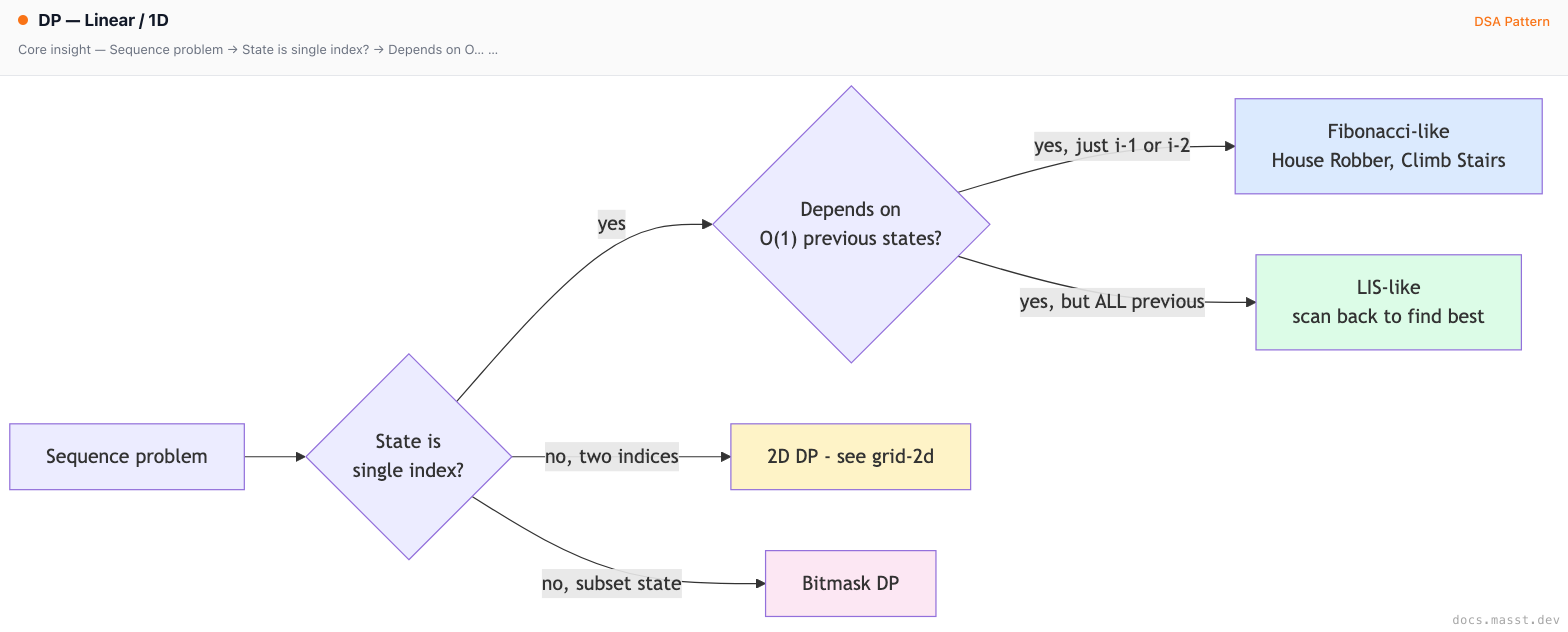
Two sub-flavors
- Fibonacci-style —
dp[i] = f(dp[i-1], dp[i-2]). O(n) time, O(1) rolling space. - LIS-style —
dp[i]requires scanning all previousdp[j]forj < i. O(n²) time, O(n) space. The "best" answer atidoesn't come from just the immediate neighbors.
Both are 1D, but the inner loop's complexity differs.
Visual walkthrough — Climbing Stairs
For n = 5:
Base:   dp[1] = 1  (one way: [1])
        dp[2] = 2  (two ways: [1,1], [2])

dp[3] = dp[2] + dp[1] = 2 + 1 = 3
        Ways: [1,1,1], [1,2], [2,1]

dp[4] = dp[3] + dp[2] = 3 + 2 = 5
        Ways: [1,1,1,1], [1,1,2], [1,2,1], [2,1,1], [2,2]

dp[5] = dp[4] + dp[3] = 5 + 3 = 8
        Ways: 8 distinct sequences.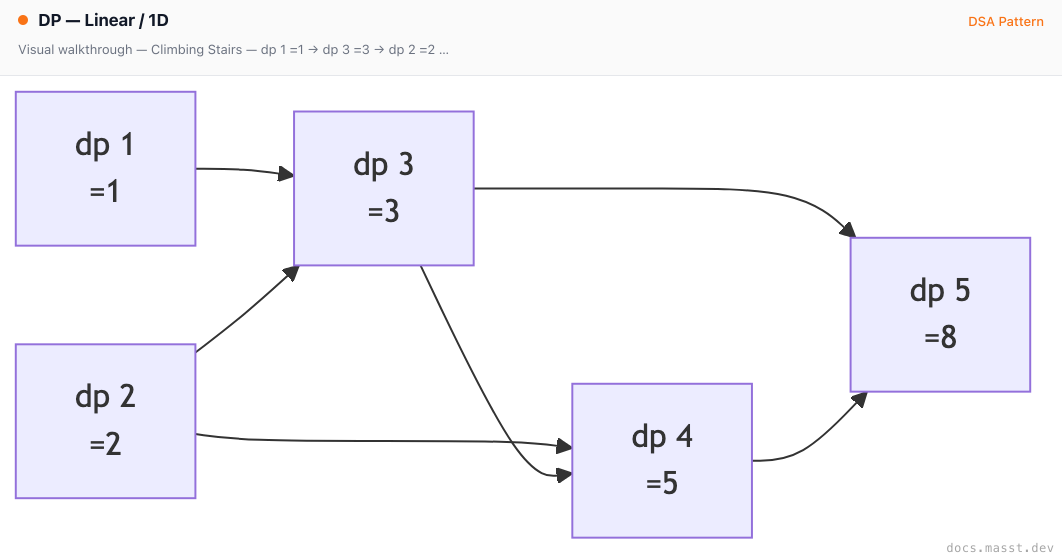
Each cell depends on the previous two. The data flow is the diagram.
Visual walkthrough — Longest Increasing Subsequence
For nums = [10, 9, 2, 5, 3, 7, 101, 18], compute LIS ending at each index.
i=0 (10): dp[0] = 1  (just [10])
i=1 (9):  10 > 9, can't extend. dp[1] = 1  ([9])
i=2 (2):  no prior smaller. dp[2] = 1  ([2])
i=3 (5):  2 < 5, can extend dp[2]+1=2. dp[3] = 2  ([2,5])
i=4 (3):  2 < 3, dp[2]+1=2. dp[4] = 2  ([2,3])
i=5 (7):  Check all prior. 2<7→dp[2]+1=2; 5<7→dp[3]+1=3; 3<7→dp[4]+1=3.
          dp[5] = 3  ([2,5,7] or [2,3,7])
i=6 (101): All smaller. Best extends from dp[5]=3. dp[6] = 4  ([2,5,7,101])
i=7 (18):  All smaller. Best extends from dp[5]=3. dp[7] = 4  ([2,5,7,18])

LIS = max(dp) = 4.
The inner "scan all previous" loop gives O(n²) total. There's a clever O(n log n) version using binary search (see Variant 4), but the O(n²) version is canonical and easier to derive.
The template
Template A — Fibonacci-style (rolling, O(1) space)
def fib_style(n, arr):
    if n <= 1: return base_for(n)
    prev2 = base_0
    prev1 = base_1
    for i in range(2, n + 1):
        curr = f(prev1, prev2, arr[i])
        prev2, prev1 = prev1, curr
    return prev1
Three slots:
- State meaning — what does
prev1andprev2represent? - Transition
f— how to combine them with the current element. - Base cases —
prev2andprev1at the start.
Template B — Full DP table (when you need to look further back)
def full_table(n, arr):
    dp = [0] * n                                     # or initialize per problem
    dp[0] = base_case(arr[0])
    for i in range(1, n):
        dp[i] = best_over_previous(arr, dp, i)
    return max(dp)                                   # or dp[n-1], depends on problem
Template C — Top-down with memoization
When the recurrence is awkward to express bottom-up, write it recursively + memoize.
from functools import cache

def solve(n):
    @cache
    def f(i):
        if i <= 1: return base
        return transition(f(i - 1), f(i - 2), arr[i])
    return f(n)
@cache (Python 3.9+) is the easy button. For non-Python, build a manual memo dict.
Worked example: House Robber (LC 198)
Problem. You're a robber planning to rob houses along a street. Each house has some amount of money. You cannot rob two adjacent houses. Return the maximum amount you can rob.
Example:
nums = [2, 7, 9, 3, 1]→12(rob houses 0, 2, 4: 2+9+1).
Why this is 1D DP. At each house i, you make a binary decision: rob it (and skip i-1) or skip it. The "best so far" at each index depends only on the best at i-1 and i-2.
The state: dp[i] = maximum money robbable from houses 0..i.
The transition:
- If we rob house
i: we getnums[i] + dp[i-2](sincei-1is forbidden). - If we skip house
i: we getdp[i-1]. - Take the max:
dp[i] = max(dp[i-1], dp[i-2] + nums[i]).
Base cases:
dp[0] = nums[0](only one house).dp[1] = max(nums[0], nums[1])(pick the bigger of two).
def rob(nums: list[int]) -> int:
    if not nums: return 0
    if len(nums) == 1: return nums[0]

    prev2 = nums[0]
    prev1 = max(nums[0], nums[1])
    for i in range(2, len(nums)):
        curr = max(prev1, prev2 + nums[i])
        prev2, prev1 = prev1, curr
    return prev1
Dry-run on [2, 7, 9, 3, 1]:
| i | nums[i] | prev2 | prev1 | curr = max(prev1, prev2 + nums[i]) |
|---|---|---|---|---|
| init | — | 2 | 7 | — |
| 2 | 9 | 2 | 7 | max(7, 2+9)=11 |
| 3 | 3 | 7 | 11 | max(11, 7+3)=11 |
| 4 | 1 | 11 | 11 | max(11, 11+1)=12 |
Answer: 12 ✓.
Complexity. O(n) time, O(1) space (rolling).
The key abstraction: at each step, you only need the best-with-rob-i and best-without-rob-i. Two variables suffice.
Variants
Variant 1 — Fibonacci-like (state from i-1 and i-2)
The simplest case. Used when the decision at step i depends only on the immediate predecessors.
Canonical problems: 70 Climbing Stairs (this page's intro), 198 House Robber (this page's worked example), 213 House Robber II (circular — run twice, excluding first or last), 746 Min Cost Climbing Stairs, 91 Decode Ways, 91-like Fibonacci variants.
Variant 2 — Constant lookback (O(k) per state)
Extend Fibonacci to "depends on the last k indices." Still O(n·k) which is O(n) for small constant k.
# Tribonacci (LC 1137): T(n) = T(n-1) + T(n-2) + T(n-3)
def tribonacci(n):
    if n == 0: return 0
    if n <= 2: return 1
    a, b, c = 0, 1, 1
    for _ in range(3, n + 1):
        a, b, c = b, c, a + b + c
    return c
Canonical problems: 1137 N-th Tribonacci Number, 873 Length of Longest Fibonacci-like Subsequence.
Variant 3 — Look-all-previous (LIS-style, O(n²))
Each dp[i] requires scanning every j < i. O(n²) time, O(n) space.
def length_of_lis(nums):
    n = len(nums)
    dp = [1] * n
    for i in range(1, n):
        for j in range(i):
            if nums[j] < nums[i]:
                dp[i] = max(dp[i], dp[j] + 1)
    return max(dp)
Canonical problems: 300 Longest Increasing Subsequence, 673 Number of LIS, 354 Russian Doll Envelopes (sort + LIS), 1048 Longest String Chain.
Variant 4 — LIS in O(n log n) (patience sorting)
Maintain tails[k] = smallest possible tail of an increasing subsequence of length k+1. Binary-search-and-replace.
from bisect import bisect_left
def length_of_lis_fast(nums):
    tails = []
    for x in nums:
        i = bisect_left(tails, x)
        if i == len(tails):
            tails.append(x)
        else:
            tails[i] = x
    return len(tails)
This is the O(n log n) version — combines 1D DP intuition with Binary Search. Not strictly DP anymore but the same problem.
Canonical problems: 300 LIS (revisited), 354 Russian Doll Envelopes (with the binary-search trick).
Variant 5 — Multiple choices per step
When at each index you have more than 2 options.
# Decode Ways (LC 91)
def num_decodings(s):
    if not s or s[0] == '0': return 0
    n = len(s)
    prev2, prev1 = 1, 1
    for i in range(1, n):
        curr = 0
        if s[i] != '0':
            curr += prev1                              # decode single digit
        two = int(s[i-1:i+1])
        if 10 <= two <= 26:
            curr += prev2                              # decode two digits
        prev2, prev1 = prev1, curr
    return prev1
Canonical problems: 91 Decode Ways, 639 Decode Ways II (with * wildcards), 96 Unique Binary Search Trees (Catalan numbers).
Variant 6 — State with extra dimension (still "1D" but augmented)
Sometimes you need to carry extra info per index — e.g., dp[i][0] and dp[i][1] for "is the current element included?"
# Best Time to Buy and Sell Stock with Cooldown (LC 309)
def max_profit(prices):
    n = len(prices)
    # hold[i] = max profit if holding a stock at end of day i
    # sold[i] = max profit if just sold today
    # rest[i] = max profit if resting (no stock, didn't just sell)
    hold = -prices[0]; sold = 0; rest = 0
    for i in range(1, n):
        new_hold = max(hold, rest - prices[i])
        new_sold = hold + prices[i]
        new_rest = max(rest, sold)
        hold, sold, rest = new_hold, new_sold, new_rest
    return max(sold, rest)
Canonical problems: 198 House Robber (rob/skip state), 309 Stock with Cooldown, 714 Stock with Fee, 740 Delete and Earn (transform into House Robber).
Variant 7 — Maximum subarray (Kadane's algorithm)
A famous 1D DP. dp[i] = max sum subarray ending at i. Transition: dp[i] = max(nums[i], dp[i-1] + nums[i]).
def max_subarray(nums):
    best = curr = nums[0]
    for x in nums[1:]:
        curr = max(x, curr + x)
        best = max(best, curr)
    return best
Canonical problems: 53 Maximum Subarray (Kadane's), 152 Maximum Product Subarray (track both min and max — products of negatives flip), 918 Maximum Sum Circular Subarray.
Variant 8 — Word Break (DP + dictionary check)
dp[i] = "is s[:i] segmentable?" Check every cut point.
def word_break(s, words):
    word_set = set(words)
    n = len(s)
    dp = [False] * (n + 1)
    dp[0] = True
    for i in range(1, n + 1):
        for j in range(i):
            if dp[j] and s[j:i] in word_set:
                dp[i] = True
                break
    return dp[n]
Canonical problems: 139 Word Break, 140 Word Break II (collect all sentences — backtracking + DP), 1235 Max Profit in Job Scheduling.
Common pitfalls
| Trap | Fix |
|---|---|
| Defining state ambiguously | "Max so far" vs "Max ending here" — these are different! Be explicit |
| Missing base cases | dp[0] and dp[1] should both be handled. Edge cases like empty / single-element input matter |
| Off-by-one in transition | Whether you index from 0 or 1 affects everything. Pick one and stay consistent |
Returning dp[n] when you should return max(dp) | LIS returns max(dp) (best length over all endings); House Robber returns dp[n-1] (best up to last) |
| Using O(n) space when O(1) suffices | If only dp[i-1] and dp[i-2] matter, use rolling variables |
Forgetting to update both prev2 and prev1 | The two-variable rolling needs simultaneous update via tuple assignment |
| Using bottom-up when recursion is more natural | Memoized recursion is fine — Python's @cache is clean |
Initializing dp = [0] * n when initial value should be 1 or -inf | LIS needs [1] * n (every element is at least a length-1 LIS) |
| Confusing "longest increasing subsequence" with "longest increasing subarray" | Subsequence allows skips; subarray is contiguous |
| Off-by-one when problem is 1-indexed | Read the spec carefully. Some problems count steps starting at 1, others at 0 |
Complexity
Fibonacci-style 1D DP: O(n) time, O(1) space (with rolling).
LIS-style (look-all-previous): O(n²) time, O(n) space. The O(n log n) version uses binary search.
Constant lookback (last k indices): O(n · k) time, O(k) space (with rolling).
Word-break-style: O(n²) time, O(n) space (or O(n · max_word_len) if word lookup is bounded).
The pattern's appeal: 1D DP turns exponential problems into linear or quadratic ones. The transitions are usually a one-liner once you've figured out the state.
When NOT to use 1D DP
- The state isn't a single index. If you need two indices (one per sequence in pair problems, or one per row + column in grid problems), you need 2D DP.
- The state is a subset. When the answer at step
idepends on which subset of items has been "used," you need Bitmask DP. - Each subproblem isn't reused. If
dp[i]is only referenced once, DP is overkill — just compute iteratively without memoization. - The problem has no overlapping subproblems. Then it's not DP. It's recursion / divide-and-conquer / greedy.
- You want to enumerate solutions, not count or optimize. Use Backtracking.
- Greedy works. "Best Time to Buy and Sell Stock" (single transaction) is greedy, not DP. Check greedy first.
Decision rule
| Symptom | Likely pattern |
|---|---|
| "Count ways to reach X" | 1D DP (Fibonacci-style) |
| "Max/min with one decision per step" | 1D DP (House Robber-style) |
| "Longest X subsequence" | 1D DP (LIS-style) |
| "Decode / parse sequence" | 1D DP (Decode Ways-style) |
| "Max sum subarray" | Kadane's (1D DP) |
| "Word break / segment a string" | 1D DP |
| "Pair / two-sequence problem" | 2D DP |
| "Knapsack / take-or-leave with capacity" | Knapsack DP |
| "Enumerate all solutions" | Backtracking |
| "Greedy might work" | Intervals & Greedy — try greedy first |
Real-world applications
- Sequence prediction in ML. Markov chains compute transition probabilities — essentially 1D DP over time.
- Audio / signal processing. Dynamic time warping is a 1D DP variant for sequence alignment.
- Spell correction. Edit distance is a 2D DP, but its 1D rolling version uses constant memory.
- Financial backtesting. "Best time to buy/sell stock" problems map directly to financial strategy evaluation.
- Time-series anomaly detection. Many algorithms compute "best path through prior states" — that's 1D DP.
- Compiler peephole optimization. Each instruction's optimization depends on previous instructions in a window.
- Text justification. Each line break decision uses the optimal previous decisions — 1D DP (LC 1335 Minimum Difficulty of a Job Schedule is a related variant).
Curated practice problems
| # | Problem | Difficulty | Variant | Note |
|---|---|---|---|---|
| 1 | ★ 70 Climbing Stairs | Easy | Fibonacci-style | The canonical |
| 2 | 746 Min Cost Climbing Stairs | Easy | Fibonacci-style, min | Cost variant |
| 3 | ★ 198 House Robber | Medium | Skip-or-take | This page's worked example |
| 4 | 213 House Robber II | Medium | Circular — run twice | Exclude first OR exclude last |
| 5 | 740 Delete and Earn | Medium | Bucket → House Robber | Transform problem |
| 6 | ★ 91 Decode Ways | Medium | Multi-choice transition | Two ways to decode at each step |
| 7 | 639 Decode Ways II | Hard | + wildcards | * matches 1-9 |
| 8 | ★ 300 Longest Increasing Subsequence | Medium | LIS O(n²) or O(n log n) | The canonical LIS |
| 9 | 673 Number of LIS | Medium | LIS + count | Track count alongside length |
| 10 | 354 Russian Doll Envelopes | Hard | 2D LIS | Sort by width, LIS on height |
| 11 | 1048 Longest String Chain | Medium | LIS-flavored | Sort by length, then DP |
| 12 | ★ 53 Maximum Subarray | Easy | Kadane's | The canonical |
| 13 | 152 Maximum Product Subarray | Medium | Kadane's variant | Track min AND max (negatives flip) |
| 14 | 918 Maximum Sum Circular Subarray | Medium | Kadane's two-pass | max(normal, total - min) |
| 15 | ★ 309 Best Time to Buy/Sell with Cooldown | Medium | State machine | hold / sold / rest |
| 16 | 714 Best Time to Buy/Sell with Fee | Medium | State machine | Subtract fee on sell |
| 17 | ★ 139 Word Break | Medium | Sequence partition | DP on cut points |
| 18 | 140 Word Break II | Hard | Enumerate sentences | DP + Backtracking |
| 19 | 1335 Min Difficulty of Job Schedule | Hard | 1D DP with subarray max | k-partition with max-per-segment |
| 20 | 96 Unique Binary Search Trees | Medium | Catalan recurrence | Sum of dp[j] · dp[i-j-1] |
Related patterns
- DP — 2D Grid / Two-Sequence — when the state has two indices
- DP — Knapsack Family — when the state is
(item, capacity) - DP — Tree DP — when the structure is a tree, not a sequence
- DP — Bitmask — when the state is "which subset"
- Backtracking — when you need to enumerate, not just count/optimize
- Binary Search — LIS in O(n log n) uses binary search
Quick-reference card
# Fibonacci-style 1D DP (O(1) space)
prev2, prev1 = base_0, base_1
for i in range(2, n + 1):
    curr = transition(prev1, prev2, arr[i])
    prev2, prev1 = prev1, curr
return prev1

# House Robber pattern
prev2, prev1 = 0, 0
for x in nums:
    prev2, prev1 = prev1, max(prev1, prev2 + x)
return prev1

# Kadane's max subarray
best = curr = nums[0]
for x in nums[1:]:
    curr = max(x, curr + x)
    best = max(best, curr)

# LIS O(n²)
dp = [1] * n
for i in range(1, n):
    for j in range(i):
        if nums[j] < nums[i]:
            dp[i] = max(dp[i], dp[j] + 1)
return max(dp)

# LIS O(n log n)
from bisect import bisect_left
tails = []
for x in nums:
    i = bisect_left(tails, x)
    if i == len(tails): tails.append(x)
    else: tails[i] = x
return len(tails)
Triggers: "climbing stairs", "house robber", "decode ways", "LIS", "max subarray", "word break". Complexity: O(n) or O(n²) depending on lookback.
Finished reading?
Mark it done to track your progress in Interview.