
DP — Knapsack Family
Items with weights/values and a capacity. Pick a subset to optimize. 0/1 knapsack, unbounded knapsack, subset sum, coin change, partition equal subsets.
TL;DR — DP — Knapsack Family
Use when: you have a set of "items" and a numeric "capacity" (or target). Decide whether to take each item (or how many copies) to optimize value, count combinations, or check feasibility.
Trigger phrases: "can we make target sum X", "min coins to make amount", "partition into equal subsets", "knapsack", "number of ways to reach sum", "target sum with +/-".
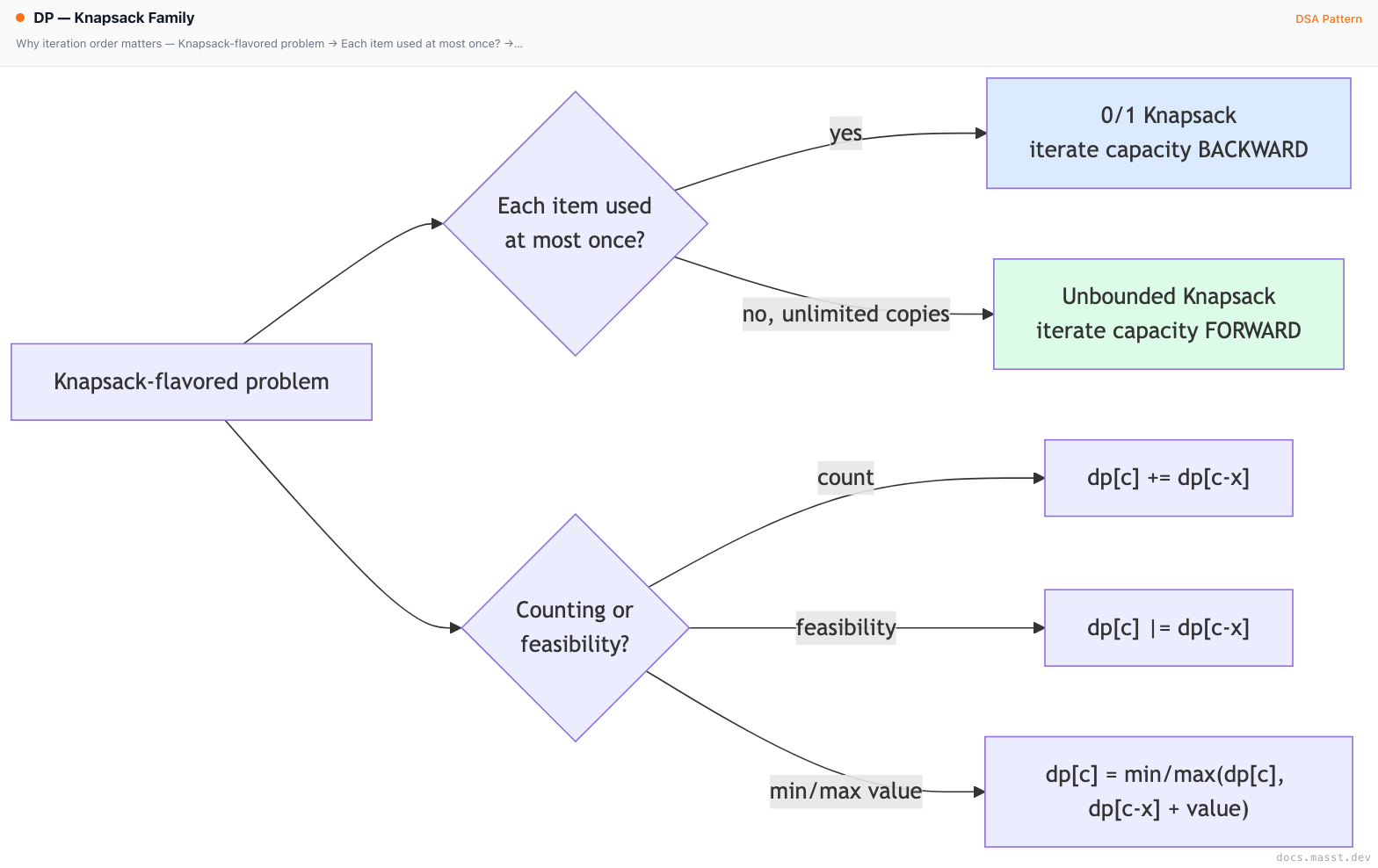
Two flavors:
- 0/1 knapsack — each item can be taken at most once.
- Unbounded knapsack — each item can be taken any number of times.
The key state: dp[i][c] = best value using first i items with remaining capacity c. Often reducible to 1D via careful iteration order.
Complexity: O(n · C) time, O(n · C) or O(C) space (with rolling). C = capacity / target sum.
The problem that motivates this pattern
Partition Equal Subset Sum (LC 416). Given a non-empty array of positive integers, return
Trueif you can partition it into two subsets with equal sum.Example:
nums = [1, 5, 11, 5]→True(subsets[1, 5, 5]and[11]).
If the total sum is odd, impossible. Otherwise, we need a subset summing to total / 2. That's "Subset Sum" — exactly the 0/1 knapsack feasibility problem.
Brute force: try every subset, 2^n options. For n = 20, that's a million; for n = 30, a billion. Doesn't scale.
DP insight: dp[i][c] = "can the first i items form a subset summing to c?"
Recurrence:
- Don't take item
i:dp[i-1][c]. - Take item
i(if it fits):dp[i-1][c - nums[i-1]].
Combine with or. Answer is dp[n][target].
def can_partition(nums):
    total = sum(nums)
    if total % 2 == 1: return False
    target = total // 2

    n = len(nums)
    # 1D rolling: dp[c] = "can we make sum c using items seen so far?"
    dp = [False] * (target + 1)
    dp[0] = True                                      # always make 0 (empty subset)

    for x in nums:
        # Iterate capacity in REVERSE for 0/1 knapsack
        for c in range(target, x - 1, -1):
            dp[c] = dp[c] or dp[c - x]

    return dp[target]
O(n · target) time, O(target) space. For n = 200, target = 10000, that's 2M operations — fast.
The deeper insight: the knapsack family is the canonical "take or don't take" DP. Once you internalize the recurrence and the iteration-order trick, you can solve subset sum, coin change, partition, target sum — all variations on the same template.
The core insight
Knapsack DP is (item, capacity)-state DP. The recurrence is "include this item or skip it." The iteration order distinguishes 0/1 from unbounded.
The invariant we maintain:
By the time we compute
dp[i][c], we've correctly computed every state involving the firsti-1items (for 0/1) or every state with smallerc(for unbounded).
Three things to identify:
- State: usually
dp[c](with the item dimension implicit in the loop order) = answer for capacityc. - Transition: for each item, update
dp[c]fromdp[c - weight]. - Iteration order: this is the magic. 0/1 iterates capacity backward; unbounded iterates forward.
Why iteration order matters
For 0/1 (each item at most once), if we iterate capacity forward, we might use the same item twice in one pass:
Items: [3]
dp = [T, F, F, F, F, F, F]    (capacity 0..6)

Forward iteration with x = 3:
  c=3: dp[3] |= dp[0]  → dp[3] = T   (used item 3 once: good)
  c=6: dp[6] |= dp[3]  → dp[6] = T   (used item 3 twice: BAD for 0/1)

Backward iteration with x = 3:
  c=6: dp[6] |= dp[3]  → dp[3] is still F, dp[6] = F   (correct)
  c=5: dp[5] |= dp[2]  → F
  c=4: dp[4] |= dp[1]  → F
  c=3: dp[3] |= dp[0]  → T
Backward iteration ensures dp[c - x] still reflects the previous item's state, not the current. That's the 0/1 trick.
For unbounded, we want to reuse, so we iterate forward.
Visual walkthrough — 0/1 Subset Sum
nums = [1, 5, 11, 5], target = 11.
Start: dp = [T, F, F, F, F, F, F, F, F, F, F, F] (capacities 0..11).
Process item 1:
- Iterate
cfrom 11 down to 1. dp[1] |= dp[0]→dp[1] = T.dp = [T, T, F, F, F, F, F, F, F, F, F, F].
Process item 5:
dp[11] |= dp[6]→ F.dp[10] |= dp[5]→ F.dp[9] |= dp[4]→ F.dp[8] |= dp[3]→ F.dp[7] |= dp[2]→ F.dp[6] |= dp[1]→ T.dp[5] |= dp[0]→ T.dp = [T, T, F, F, F, T, T, F, F, F, F, F].
Process item 11:
dp[11] |= dp[0]→ T! Already done — early exit possible.dp = [T, T, F, F, F, T, T, F, F, F, F, T].
Result: dp[11] = True → answer is True. ✓
We don't even need to process the last item (5). The pattern often allows early exit when dp[target] becomes True.
The template
Template A — 0/1 Knapsack (each item at most once)
def knapsack_01(items, capacity):
    """items: list of (weight, value). Returns max value within capacity."""
    dp = [0] * (capacity + 1)
    for w, v in items:
        for c in range(capacity, w - 1, -1):          # BACKWARD
            dp[c] = max(dp[c], dp[c - w] + v)
    return dp[capacity]
Three slots:
- State semantic —
dp[c]= best achievable with capacityc. - Transition —
dp[c] = max(dp[c], dp[c - w] + v). Choose between "skip" (olddp[c]) and "take" (dp[c - w] + v). - Iteration order — backward capacity for 0/1. This is non-negotiable.
Template B — Unbounded Knapsack (each item any number of times)
def unbounded_knapsack(items, capacity):
    dp = [0] * (capacity + 1)
    for w, v in items:
        for c in range(w, capacity + 1):              # FORWARD
            dp[c] = max(dp[c], dp[c - w] + v)
    return dp[capacity]
The only difference from 0/1: iterate capacity forward, allowing the same item to be reused.
Template C — Subset Sum (feasibility)
def can_sum_to(nums, target):
    dp = [False] * (target + 1)
    dp[0] = True
    for x in nums:
        for c in range(target, x - 1, -1):
            dp[c] = dp[c] or dp[c - x]
    return dp[target]
Template D — Count Ways
def count_ways(nums, target):
    dp = [0] * (target + 1)
    dp[0] = 1                                          # one way: empty
    for x in nums:
        for c in range(target, x - 1, -1):            # 0/1: backward
            dp[c] += dp[c - x]
    return dp[target]
For unbounded (combinations vs permutations distinction):
# Combinations (order doesn't matter): outer loop coins, inner forward
for coin in coins:
    for c in range(coin, target + 1):
        dp[c] += dp[c - coin]

# Permutations (order matters): outer loop capacity, inner coins
for c in range(1, target + 1):
    for coin in coins:
        if c >= coin: dp[c] += dp[c - coin]
The loop nesting controls whether you count combinations or permutations. Brutal subtlety but central.
Worked example: Coin Change (LC 322)
Problem. Given coin denominations and an amount, return the minimum number of coins to make the amount. You can use each coin any number of times. Return
-1if impossible.Example:
coins = [1, 2, 5],amount = 11→3(use 5 + 5 + 1).
Why this is unbounded knapsack. Coins can be reused (unbounded), and we want the minimum count (optimization).
The state: dp[c] = min coins to make amount c.
The transition: dp[c] = min(dp[c], dp[c - coin] + 1) for each coin.
Base case: dp[0] = 0 (0 coins make 0). All others initialized to infinity.
Iteration order: forward (unbounded — we want to reuse coins).
def coin_change(coins: list[int], amount: int) -> int:
    dp = [float('inf')] * (amount + 1)
    dp[0] = 0

    for coin in coins:
        for c in range(coin, amount + 1):
            dp[c] = min(dp[c], dp[c - coin] + 1)

    return dp[amount] if dp[amount] != float('inf') else -1
Dry-run on coins = [1, 2, 5], amount = 11:
After processing coin = 1:
dp = [0, 1, 2, 3, 4, 5, 6, 7, 8, 9, 10, 11] (use 1 a lot).
After processing coin = 2:
dp[2] = min(2, dp[0]+1) = 1.dp[3] = min(3, dp[1]+1) = 2.dp[4] = min(4, dp[2]+1) = 2.dp[5] = min(5, dp[3]+1) = 3.- ... and so on.
After processing coin = 5:
dp[5] = min(3, dp[0]+1) = 1.dp[6] = min(4, dp[1]+1) = 2.- ...
dp[10] = min(?, dp[5]+1) = 2.dp[11] = min(?, dp[6]+1) = 3.
Answer: 3 ✓.
Why forward iteration is correct here. When updating dp[c] from dp[c - coin], we want dp[c - coin] to potentially already use this coin (since coins are reusable). Forward iteration ensures we see the updated dp[c - coin] from this same coin pass.
Complexity. O(n · amount) time, O(amount) space.
Variants
Variant 1 — 0/1 Knapsack (max value within capacity)
The textbook problem: items with weights and values, capacity W, maximize total value taking each item at most once.
Canonical problems: not directly on LC, but underlies 416 Partition Equal Subset Sum, 494 Target Sum, 474 Ones and Zeroes (2D capacity).
Variant 2 — Subset Sum (feasibility)
"Can we make sum X?" Use dp of booleans.
Canonical problems: 416 Partition Equal Subset Sum (this page's intro), 698 Partition to K Equal Sum Subsets (harder — needs bitmask DP or backtracking), 1981 Minimize the Difference Between Two Sums.
Variant 3 — Count Ways (combinations)
"How many subsets sum to X?"
Canonical problems: 494 Target Sum (transform: P − N = target where P + N = total → P = (total + target) / 2 = a knapsack target), 518 Coin Change II (unbounded count).
Variant 4 — Unbounded Knapsack (Coin Change-style)
Reuse items unlimited times. Min count, max count, or feasibility.
Canonical problems: 322 Coin Change (this page's worked example), 518 Coin Change II (count combinations), 279 Perfect Squares (smallest count of squares summing to N), 377 Combination Sum IV (permutations — different loop nesting!).
Variant 5 — Multi-Dimensional Capacity
When the "capacity" is a tuple. E.g., dp[i][j] = "max items using ≤ i zeros and ≤ j ones."
Canonical problems: 474 Ones and Zeroes (2D capacity: count zeros and ones), 879 Profitable Schemes (2D capacity: profit and people).
Variant 6 — Bounded Knapsack (each item k times)
Generalization: each item has a multiplicity bound. Two approaches:
- Expand each item into k copies → reduce to 0/1.
- Binary decomposition: replace
kcopies with copies of1, 2, 4, ...units summing to k. Reduces from O(n · k · W) to O(n · log(k) · W).
Canonical problems: rare in interviews; common in competitive programming.
Variant 7 — Knapsack with Bitmask State
When you also need to track which items have been taken (not just total weight), use bitmask DP.
Canonical problems: 698 Partition to K Equal Sum Subsets (bitmask version), 1655 Distribute Repeating Integers.
Variant 8 — Target Sum (with +/- signs)
target = P - N where P + N = total. Reframes to finding subset summing to (total + target) / 2.
def find_target_sum_ways(nums, target):
    total = sum(nums)
    if (total + target) % 2 != 0 or abs(target) > total:
        return 0
    s = (total + target) // 2
    dp = [0] * (s + 1)
    dp[0] = 1
    for x in nums:
        for c in range(s, x - 1, -1):
            dp[c] += dp[c - x]
    return dp[s]
Canonical problem: 494 Target Sum.
Common pitfalls
| Trap | Fix |
|---|---|
| Iterating capacity FORWARD for 0/1 knapsack | Allows reuse. Always iterate BACKWARD for 0/1 |
| Iterating capacity BACKWARD for unbounded | Disallows reuse. Iterate FORWARD for unbounded |
Forgetting dp[0] = True / dp[0] = 1 / dp[0] = 0 | Base case for "empty subset / zero amount." Forgetting it breaks everything |
| Confusing combinations vs permutations in coin counting | Outer-loop coins → combinations; outer-loop capacity → permutations. They're different! |
Initializing dp[c] to 0 when you want inf (min problem) | min(0, anything+1) = 0. Use float('inf') and check at the end |
| Reading "subset sum" when problem says "subsequence" or "subarray" | Subarray is contiguous → not knapsack. Subsequence is non-contiguous → could be knapsack |
| Using O(n · C) memory when O(C) rolling works | Both 0/1 and unbounded rolling are well-known. Use them |
| Off-by-one in inner loop range | 0/1 backward: range(capacity, w-1, -1). Unbounded forward: range(w, capacity+1) |
| Treating coin change as 0/1 (which is wrong) | Coin Change is unbounded — coins reusable. Read the spec |
| Forgetting that capacity may not be exactly reachable | If dp[amount] == inf, return -1 |
Complexity
Time: O(n · C) where n = number of items, C = capacity / target sum. This is pseudo-polynomial — it depends on the value of C, not just on log(C). For C up to ~10^4, fine. For C = 10^9, infeasible — knapsack hits its limit.
Space: O(C) with rolling. The full 2D table is O(n · C); rolling collapses it.
Knapsack is famously NP-hard in general (when capacity isn't bounded). The DP gives pseudo-polynomial complexity by exploiting integer constraints.
When NOT to use knapsack DP
- The "capacity" is huge (
C > 10^8or so). The pseudo-polynomial complexity isn't enough. Use meet-in-the-middle, branch-and-bound, or approximation algorithms. - The items have real-valued (float) weights or capacities. DP needs integer states. Switch to a different paradigm.
- You need to enumerate subsets, not optimize/count. Use Backtracking.
- The problem is fractional knapsack (can take part of an item). Sort by value/weight ratio and take greedily. See Intervals & Greedy.
- The problem isn't really "take or don't take." Some problems look knapsack-flavored but are actually about ordering or paths — recheck the structure.
- n is small enough for exhaustive search.
n ≤ 20allows2^n ≈ 10^6brute force.
Decision rule
| Symptom | Likely pattern |
|---|---|
| "Pick subset summing to target" | 0/1 Knapsack (feasibility / count) |
| "Min coins to make amount, unlimited supply" | Unbounded Knapsack |
| "Partition into equal subsets" | 0/1 Knapsack (subset sum = total/2) |
| "Target sum with +/-" | 0/1 Knapsack (transform target) |
| "Permutations of summing combinations" | Unbounded with capacity-outer loop |
| "Fractional take allowed" | Greedy by ratio (not DP) |
| "Multi-dim capacity (0s and 1s)" | 2D Knapsack |
| "Bounded copies per item (k times)" | Bounded Knapsack (binary decompose) |
| "n is huge (10^5+) but values are bounded" | Knapsack OK if capacity is small enough |
| "Real-valued weights / huge capacity" | NOT knapsack — try branch-and-bound or approximation |
Real-world applications
- Budget allocation. "Maximize ROI given a budget" is 0/1 knapsack.
- Cargo loading. Optimizing what to ship in a truck with weight limits — classic knapsack.
- Investment portfolio optimization. Fractional version → greedy; integer version → 0/1 knapsack.
- Resource scheduling in cloud systems. "Fit jobs onto machines with capacity" — bin packing (knapsack's cousin).
- Cutting stock problems. Manufacturing optimization with material constraints.
- Set cover and similar NP-hard problems. Many reduce to or use knapsack as a subroutine.
- Currency conversion / change-making. ATMs and POS systems use coin change DP for change dispensing.
- Memory allocation / placement. Some allocators use knapsack DP for offline optimization.
Curated practice problems
| # | Problem | Difficulty | Variant | Note |
|---|---|---|---|---|
| 1 | ★ 416 Partition Equal Subset Sum | Medium | Subset sum (0/1) | This page's intro |
| 2 | ★ 322 Coin Change | Medium | Unbounded, min | This page's worked example |
| 3 | 518 Coin Change II | Medium | Unbounded, count | Outer-coins gives combinations |
| 4 | ★ 494 Target Sum | Medium | Transform to subset sum | Or memoized recursion |
| 5 | 474 Ones and Zeroes | Medium | 2D capacity (zeros, ones) | Per-string knapsack |
| 6 | 1049 Last Stone Weight II | Medium | Partition close to half | Subset sum variant |
| 7 | 879 Profitable Schemes | Hard | 2D capacity (people, profit) | + count of ways |
| 8 | 377 Combination Sum IV | Medium | Permutations | Outer-capacity loop |
| 9 | ★ 279 Perfect Squares | Medium | Unbounded min | Items = squares ≤ n |
| 10 | 983 Min Cost for Tickets | Medium | DP over days w/ pricing | Knapsack-ish 1D |
| 11 | 1230 Toss Strange Coins | Medium | Probability DP | Knapsack-style but real values |
| 12 | 1981 Minimize Difference Between Two Sums | Hard | Subset sum + binary search | Meet-in-the-middle for huge n |
| 13 | 698 Partition to K Equal Sum Subsets | Medium | Subset sum × K | Backtracking + bitmask DP |
| 14 | 343 Integer Break | Medium | Unbounded product | dp[n] = max product of parts |
| 15 | 1986 Min Number of Work Sessions | Medium | Bitmask DP (related) | Subset assignment |
Related patterns
- DP — Linear — 1D DP; subset sum is 2D but rolled into 1D via the capacity loop
- DP — 2D Grid — different 2D shape (not knapsack)
- DP — Bitmask — when you need to track which items, not just total weight
- DP — Intervals — different DP family
- Backtracking — when you need to enumerate subsets, not count
Quick-reference card
# 0/1 Knapsack — iterate capacity BACKWARD
dp = [0] * (cap + 1)
for w, v in items:
    for c in range(cap, w - 1, -1):
        dp[c] = max(dp[c], dp[c - w] + v)

# Subset Sum / Partition — feasibility
dp = [False] * (target + 1); dp[0] = True
for x in nums:
    for c in range(target, x - 1, -1):
        dp[c] = dp[c] or dp[c - x]

# Unbounded Knapsack — iterate capacity FORWARD
dp = [0] * (cap + 1)
for w, v in items:
    for c in range(w, cap + 1):
        dp[c] = max(dp[c], dp[c - w] + v)

# Coin Change (min count, unbounded)
dp = [float('inf')] * (amount + 1); dp[0] = 0
for coin in coins:
    for c in range(coin, amount + 1):
        dp[c] = min(dp[c], dp[c - coin] + 1)

# Combinations: outer coins, inner forward
# Permutations: outer capacity, inner coins
Triggers: "subset sum", "partition", "coin change", "knapsack", "target sum", "perfect squares". Complexity: O(n · C).
Finished reading?
Mark it done to track your progress in Interview.
DP — 2D Grid / Two-Sequence
dp[i][j] over a matrix or pair of sequences. Unique paths, longest common subsequence, edit distance, minimum path sum.
DP — Intervals / Partition / MCM
dp[i][j] over intervals. Try every split point k between i and j. The pattern behind matrix chain multiplication, burst balloons, palindrome partitioning II, stone games.