
Backtracking
Choose → recurse → unchoose. Systematically enumerate solutions to combinatorial problems with pruning. The universal template for subsets, permutations, combinations, N-Queens, and constraint satisfaction.
TL;DR — Backtracking
Use when: you need to enumerate or count all configurations satisfying some constraint — subsets, permutations, combinations, partitions, paths, board placements.
Trigger phrases: "find all subsets", "all permutations", "all combinations summing to target", "N-Queens", "word search", "valid parentheses", "restore IP addresses", "Sudoku solver", "palindrome partitioning".
The skeleton: choose → recurse → unchoose. Build a partial solution; recurse to extend it; on return, undo the choice so the parent can try the next branch.
Two flavors: exhaustive (collect all solutions) and pruned (cut branches that can't lead to a valid solution — N-Queens, Sudoku).
Complexity: Often O(b^d · path_work) where b = branching factor, d = depth. Exponential by nature, but pruning makes it tractable.
The problem that motivates this pattern
Subsets (LC 78). Given an integer array
numsof unique elements, return all possible subsets (the power set).Example:
nums = [1, 2, 3]→[[], [1], [2], [1,2], [3], [1,3], [2,3], [1,2,3]].
Brute force: iterate from 0 to 2^n - 1, treat each binary number's bits as "include this element or not." Works but feels hacky.
The recursive approach is more flexible and generalizes to permutations, combinations, and N-Queens. At each index, we make a choice: include this element in the current subset, or don't. Recurse on the rest. After the recursion, undo the choice so we can try the other branch.
def subsets(nums):
    result = []
    path = []

    def backtrack(start):
        result.append(path[:])                        # record the current path

        for i in range(start, len(nums)):
            path.append(nums[i])                      # choose
            backtrack(i + 1)                          # recurse
            path.pop()                                # unchoose

    backtrack(0)
    return result
That's it. Three lines of "interesting" code (choose, recurse, unchoose). The pattern generalizes to every enumeration problem you'll encounter.
The deeper insight: backtracking is DFS on the decision tree of partial solutions. Each level of the tree corresponds to a single decision (include/exclude, place/don't-place). When we return from a recursive call, we've explored the entire subtree; the unchoose step lets us try a different decision at this level.
The core insight
Every backtracking problem fits one template: choose → recurse → unchoose. The art is naming the state and the decision.
The invariant:
At every node in the recursion tree,
pathrepresents a valid partial solution. After recursing and returning,pathis restored to its state before the recursion.
This invariant is what lets us share the same path list across the entire recursion — no need to copy on every call. The undo step is mandatory; without it, sibling branches see stale state.
Backtracking has three universal slots:
- State — what we're building (a
pathlist, a board, a set of used elements). - Choices — at each step, what options are available.
- Terminal condition — when to record a complete solution (or prune an invalid one).
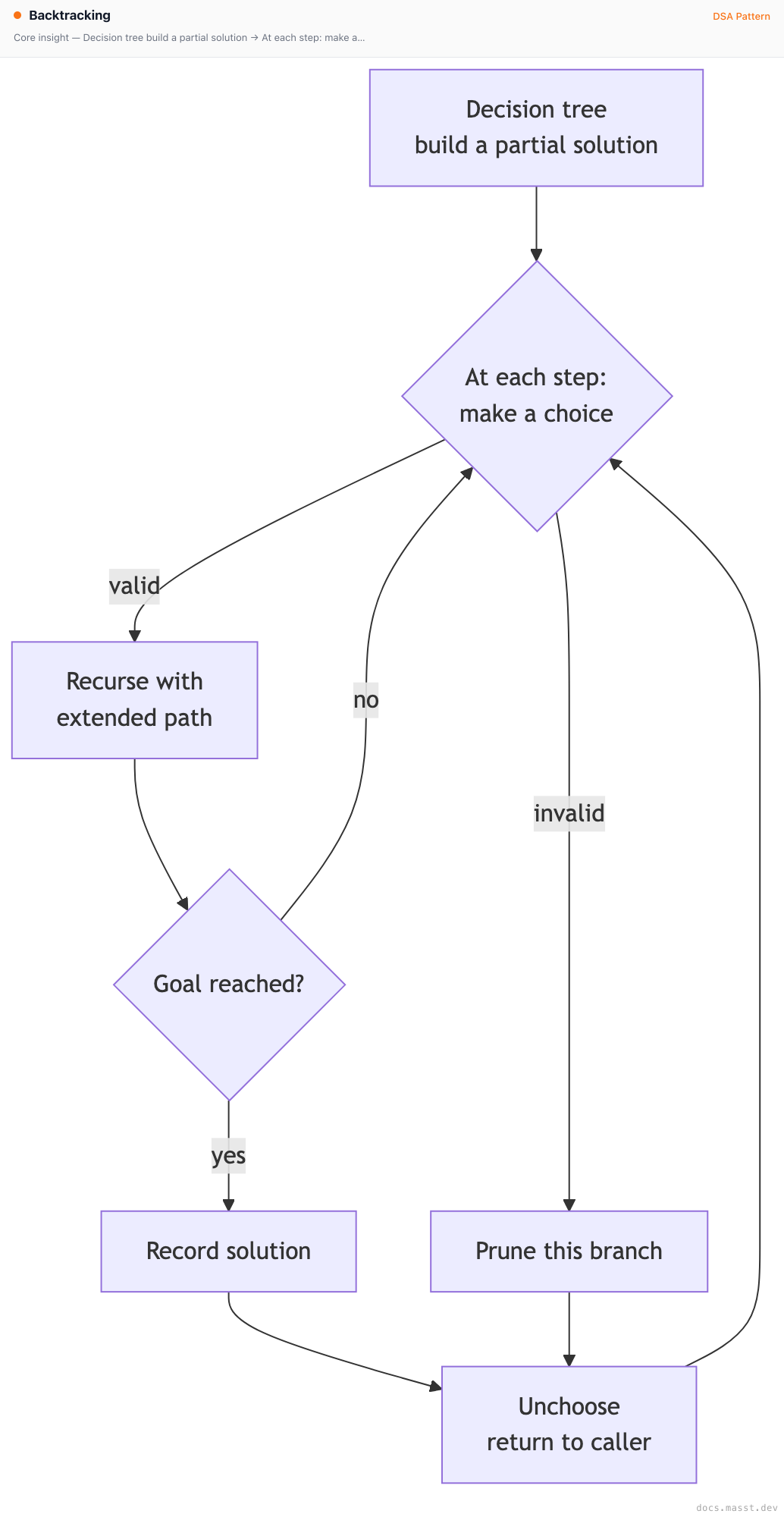
The recursion tree is the diagram of the algorithm. Drawing it on paper for a 3-element input is the fastest way to understand why backtracking works.
Visual walkthrough — Subsets of [1, 2, 3]
                    []
                  / | \
                 1  2  3
                /|  |
               2 3  3
               |
               3

Tree (rendered as nested calls):

backtrack(start=0, path=[])              → record []
  choose 1, path=[1]
    backtrack(start=1, path=[1])         → record [1]
      choose 2, path=[1,2]
        backtrack(start=2, path=[1,2])   → record [1,2]
          choose 3, path=[1,2,3]
            backtrack(start=3, path=[1,2,3]) → record [1,2,3]
          unchoose 3
        unchoose 2
      choose 3, path=[1,3]
        backtrack(start=3, path=[1,3])   → record [1,3]
      unchoose 3
    unchoose 1
  choose 2, path=[2]
    backtrack(start=2, path=[2])         → record [2]
      choose 3, path=[2,3]
        backtrack(...)                    → record [2,3]
      unchoose 3
    unchoose 2
  choose 3, path=[3]
    backtrack(start=3, path=[3])         → record [3]
    unchoose 3
The start parameter prevents revisiting earlier elements — each subset is generated once, not as a permutation. Pop the path after every recursive call. Always.
Why does this enumerate every subset? The recursion tree has 2^n leaves (each element is either in the current path or not — 2 choices × n levels). Each call records exactly one subset — the current path. So we record 2^n subsets total. ✓
The template
Template A — Subsets (decisions don't reorder)
def subsets(nums):
    result = []
    path = []

    def backtrack(start):
        result.append(path[:])                        # record this path

        for i in range(start, len(nums)):
            path.append(nums[i])                      # choose
            backtrack(i + 1)                          # recurse (i+1: no reuse)
            path.pop()                                # unchoose

    backtrack(0)
    return result
Template B — Permutations (use every element, in any order)
def permutations(nums):
    result = []
    path = []
    used = [False] * len(nums)

    def backtrack():
        if len(path) == len(nums):
            result.append(path[:])
            return

        for i in range(len(nums)):
            if used[i]: continue                      # already in path
            path.append(nums[i])
            used[i] = True
            backtrack()
            path.pop()                                # unchoose
            used[i] = False

    backtrack()
    return result
Template C — Combinations (k of n)
def combinations(n, k):
    result = []
    path = []

    def backtrack(start):
        if len(path) == k:
            result.append(path[:])
            return

        for i in range(start, n + 1):                 # 1-indexed
            path.append(i)
            backtrack(i + 1)
            path.pop()

    backtrack(1)
    return result
Template D — Constraint satisfaction (N-Queens style)
def n_queens(n):
    result = []
    cols = set()
    diag1 = set()                                     # row - col
    diag2 = set()                                     # row + col
    board = [-1] * n

    def backtrack(row):
        if row == n:
            result.append(board[:])
            return

        for col in range(n):
            if col in cols or row - col in diag1 or row + col in diag2:
                continue                              # prune
            cols.add(col); diag1.add(row - col); diag2.add(row + col)
            board[row] = col
            backtrack(row + 1)
            cols.remove(col); diag1.remove(row - col); diag2.remove(row + col)

    backtrack(0)
    return result
The pruning (the if col in cols ... check) is what makes N-Queens tractable. Without it: 8^8 = 16M positions. With pruning: ~2000 nodes explored for n=8.
Universal skeleton
def backtrack(state):
    if is_goal(state):
        record(state)
        return

    for choice in available_choices(state):
        if not is_valid(choice, state): continue      # prune
        apply(choice, state)
        backtrack(state)
        undo(choice, state)                           # MANDATORY
Memorize this. Every backtracking problem reduces to filling in is_goal, available_choices, is_valid, apply, undo.
Worked example: Word Search (LC 79)
Problem. Given an
m × ngrid of characters and a stringword, returnTrueifwordcan be constructed from sequentially adjacent cells (horizontally or vertically), with no cell used more than once.Example: board =
[["A","B","C","E"],["S","F","C","S"],["A","D","E","E"]], word ="ABCCED"→True.
Why this is backtracking. We're looking for any path through the board spelling out the word. At each step, we have up to 4 choices (neighbors). If a choice doesn't pan out, we need to undo it and try a different direction. Classic choose/recurse/unchoose.
What changes from the template. Three slots:
- State: current position
(r, c)and how many characters ofwordwe've matched. - Choices: 4 neighbors (up, down, left, right).
- Pruning: skip cells that don't match the next character; skip already-visited cells.
- Undo: when backtracking, restore the cell so other paths can use it.
def exist(board: list[list[str]], word: str) -> bool:
    m, n = len(board), len(board[0])

    def dfs(r, c, i):
        if i == len(word):
            return True                                # all chars matched
        if r < 0 or r >= m or c < 0 or c >= n:
            return False
        if board[r][c] != word[i]:
            return False

        # Choose: mark cell as visited (temporarily)
        original = board[r][c]
        board[r][c] = '#'

        # Recurse: try all 4 directions
        found = (dfs(r+1, c, i+1) or
                 dfs(r-1, c, i+1) or
                 dfs(r, c+1, i+1) or
                 dfs(r, c-1, i+1))

        # Undo: restore the cell
        board[r][c] = original

        return found

    for r in range(m):
        for c in range(n):
            if dfs(r, c, 0):
                return True
    return False
Dry-run on word = "ABCCED", starting at (0, 0) = 'A':
dfs(0, 0, 0): board[0][0]='A' matches word[0]='A'. Mark '#'. Try neighbors.
  dfs(1, 0, 1): 'S' != 'B'. Return False.
  dfs(-1, 0, 1): out of bounds. False.
  dfs(0, 1, 1): 'B' matches word[1]. Mark '#'. Try neighbors.
    dfs(1, 1, 2): 'F' != 'C'. False.
    dfs(0, 2, 2): 'C' matches. Mark. Try neighbors.
      dfs(1, 2, 3): 'C' matches. Mark. Try neighbors.
        dfs(2, 2, 4): 'E' matches. Mark. Try neighbors.
          dfs(2, 1, 5): 'D' matches. word fully consumed → True!
Backtracks all the way up, returning True. ✓
The undo (board[r][c] = original) is what makes this work. Without it, a failed branch would leave '#' markers in the grid and other branches couldn't use those cells.
Complexity. Time: O(m · n · 4^L) where L = word length. Each DFS call explores up to 4 branches; depth bounded by L. The outer m·n is for trying every starting cell. Space: O(L) recursion depth.
Variants
Variant 1 — Subsets (power set)
The canonical template A. Every element is either in or out.
Canonical problems: 78 Subsets, 90 Subsets II (with duplicates — sort + skip), 491 Increasing Subsequences.
Variant 2 — Permutations (use every element, any order)
Template B. Track used[] to avoid reusing elements in the same path.
Canonical problems: 46 Permutations, 47 Permutations II (with duplicates — sort + skip-if-prev-not-used).
Variant 3 — Combinations (k of n)
Template C. Like subsets but only collect paths of length k.
Canonical problems: 77 Combinations, 39 Combination Sum (with reuse), 40 Combination Sum II (no reuse), 216 Combination Sum III.
Variant 4 — Partition into substrings
Each call decides where to "cut" the next substring. Recurse on the remainder.
# Palindrome Partitioning (LC 131)
def partition(s):
    result = []
    path = []
    def backtrack(start):
        if start == len(s):
            result.append(path[:])
            return
        for end in range(start + 1, len(s) + 1):
            sub = s[start:end]
            if sub == sub[::-1]:                      # palindrome
                path.append(sub)
                backtrack(end)
                path.pop()
    backtrack(0)
    return result
Canonical problems: 131 Palindrome Partitioning, 93 Restore IP Addresses, 282 Expression Add Operators, 1593 Split a String Into the Max Number of Unique Substrings.
Variant 5 — Constraint Satisfaction (N-Queens, Sudoku)
Template D. Heavy pruning is what makes them solvable.
Canonical problems: 51 N-Queens, 52 N-Queens II (count only), 37 Sudoku Solver, 36 Valid Sudoku (just validation, no backtracking needed).
Variant 6 — Grid / Maze with backtracking
DFS with explicit undo on the grid. Different from regular DFS because cells get restored.
Canonical problems: 79 Word Search (this page's worked example), 980 Unique Paths III (visit all empty cells), 489 Robot Room Cleaner (online maze exploration).
Variant 7 — Generate strings / sequences
Recurse with a partial string; build character by character.
# Generate Parentheses (LC 22)
def generate_parentheses(n):
    result = []
    def backtrack(s, open_count, close_count):
        if len(s) == 2 * n:
            result.append(s)
            return
        if open_count < n:
            backtrack(s + '(', open_count + 1, close_count)
        if close_count < open_count:
            backtrack(s + ')', open_count, close_count + 1)
    backtrack('', 0, 0)
    return result
Note: strings are immutable in Python, so we don't need explicit undo — the recursion's stack handles it. This is the "implicit unchoose" variant.
Canonical problems: 22 Generate Parentheses, 17 Letter Combinations of a Phone Number, 320 Generalized Abbreviation.
Variant 8 — Backtracking + memoization (turns into DP)
When the recursion tree has overlapping subproblems, memoize. This converts the algorithm from exponential to polynomial — and you've slid from backtracking into DP.
# Word Break (LC 139) — backtracking with memo
def word_break(s, words):
    word_set = set(words)
    @cache
    def can_break(start):
        if start == len(s): return True
        for end in range(start + 1, len(s) + 1):
            if s[start:end] in word_set and can_break(end):
                return True
        return False
    return can_break(0)
This is technically DP — but the structure is backtracking with caching. The bridge between the two patterns.
Common pitfalls
| Trap | Fix |
|---|---|
Forgetting to undo (no path.pop()) | The single most common bug. Always undo before returning to the caller |
Recording path directly instead of path[:] | Python lists are mutable; result.append(path) records a reference that changes |
| Not deduplicating when input has duplicates | For 90 Subsets II / 47 Permutations II: sort first, then skip duplicates at the same level |
| Reusing the same element in combination problems | Use start (template A) or used[] (template B). Don't iterate from 0 for combos |
| Pruning too late | Check feasibility before recursing, not inside the recursion. Saves entire subtrees |
Returning path from backtrack instead of True/False | Backtracking usually mutates shared state and returns booleans/None |
| Forgetting to handle the empty / base case | Both at the start (record/return) and within constraints |
| Stack overflow on deep recursion | Python's default limit is 1000. For tree depth ≥ 1000, use sys.setrecursionlimit or iterative |
| Using lists where sets would speed up "is this used?" check | used in path is O(n). used in used_set is O(1) |
Iterating the full set when start should bound the loop | Reduces branching from b^n to b^k where k is depth |
Complexity
Time depends on the recursion-tree shape:
- Subsets (LC 78): 2^n leaves × O(n) to copy each → O(2^n · n).
- Permutations (LC 46): n! leaves × O(n) to copy → O(n! · n).
- Combinations (LC 77): C(n, k) leaves → O(C(n, k) · k).
- N-Queens (LC 51): in practice ~O(n!), but with pruning much less.
- Word Search (LC 79): O(m · n · 4^L).
Space: O(d) where d is recursion depth. For most problems this is O(n).
The exponential nature is intrinsic. The art is reducing the constant factor through pruning — early-exit when partial solutions can't possibly extend to valid solutions.
When NOT to use backtracking
- Counting is the goal, not enumeration. Use DP — much faster, polynomial time.
- Optimization (minimize / maximize) with overlapping subproblems. DP, again. Backtracking explores all paths; DP shares work.
- The problem has a closed-form combinatorial answer. "Number of ways to choose k of n" is
C(n, k)— don't enumerate. - The branching factor × depth makes the search infeasible. A problem with 50 binary decisions = 2^50 ≈ 10^15. Even with pruning, won't finish.
- The problem is really just "find one valid solution." Sometimes greedy or BFS works without exhaustive enumeration.
- The constraint is too loose to prune effectively. N-Queens prunes ~99% of the tree; if your problem can't prune, backtracking is just brute force.
Decision rule
| Symptom | Likely pattern |
|---|---|
| "Find ALL X (subsets, permutations, combinations, paths)" | Backtracking |
| "Count all X / number of ways" | DP |
| "Find any one X" | DFS / BFS / Backtracking with early return |
| "Optimal X with overlapping subproblems" | DP |
| "Constraint satisfaction (N-Queens, Sudoku)" | Backtracking with pruning |
| "Generate all valid strings of length n" | Backtracking with character-by-character building |
| "Partition string into satisfying parts" | Backtracking with cut points |
| "Word Search / maze with no revisit" | Backtracking with grid undo |
Real-world applications
- SAT / constraint solvers. Z3, MiniSAT, and other SAT solvers use backtracking with sophisticated learning (DPLL with clause learning).
- Type inference / type checking. Programming language type systems often use backtracking to unify type variables.
- Cryptography brute-force (with pruning). Password cracking with rules, attempted key combinations.
- Game tree search. Chess engines, Go AI, poker — minimax with alpha-beta pruning is backtracking + scoring.
- Compiler test case generation. QuickCheck / Hypothesis use backtracking to find minimal failing inputs (shrinkers).
- Scheduling / timetabling. University course schedules, exam timetables — backtracking with constraint propagation.
- Resource allocation puzzles. "Place N tasks on M workers such that ..." — backtracking with pruning.
- DNA assembly. Some assemblers use backtracking to resolve repeats.
Curated practice problems
| # | Problem | Difficulty | Variant | Note |
|---|---|---|---|---|
| 1 | ★ 78 Subsets | Medium | Power set | The canonical |
| 2 | 90 Subsets II | Medium | With duplicates | Sort + skip-same-at-level |
| 3 | ★ 46 Permutations | Medium | All orderings | The canonical |
| 4 | 47 Permutations II | Medium | With duplicates | Sort + used[i-1] skip |
| 5 | 77 Combinations | Medium | k of n | Bound start and len |
| 6 | ★ 39 Combination Sum | Medium | Target sum with reuse | start = i (not i+1) |
| 7 | 40 Combination Sum II | Medium | Target sum, no reuse | start = i + 1, skip dups |
| 8 | 216 Combination Sum III | Medium | k of 1-9 summing to n | Bounded backtrack |
| 9 | ★ 22 Generate Parentheses | Medium | String generation | Implicit unchoose |
| 10 | 17 Letter Combinations of a Phone Number | Medium | Cartesian product | Backtrack per digit |
| 11 | ★ 79 Word Search | Medium | Grid backtracking | This page's worked example |
| 12 | 212 Word Search II | Hard | Trie + backtracking | See Trie |
| 13 | ★ 51 N-Queens | Hard | Constraint satisfaction | Column + diag pruning |
| 14 | 52 N-Queens II | Hard | Count solutions | Same as 51, just count |
| 15 | 37 Sudoku Solver | Hard | Constraint satisfaction | Aggressive pruning |
| 16 | 131 Palindrome Partitioning | Medium | String partition | Try each cut point |
| 17 | 93 Restore IP Addresses | Medium | String partition into 4 parts | Bounded by segment length |
| 18 | 980 Unique Paths III | Hard | Grid, visit all empty | Counter for non-obstacle cells |
| 19 | 282 Expression Add Operators | Hard | Insert operators between digits | Track current/previous expr |
| 20 | 698 Partition to K Equal Sum Subsets | Medium | Backtrack with bitmask | Can also be DP+bitmask |
Related patterns
- DFS / BFS / Islands — backtracking is DFS with explicit choose/unchoose
- Trie — Word Search II uses Trie + backtracking
- DP — Linear — when subproblems overlap, memoize and you're in DP territory
- DP — Bitmask — when state is "subset of used elements," bitmask DP is the structured form
- Binary Tree Traversals — pre-order DFS with path tracking is essentially backtracking on a tree
Quick-reference card
# Universal skeleton
def backtrack(state):
    if is_goal(state):
        record(state)
        return
    for choice in choices(state):
        if not valid(choice, state): continue        # prune
        apply(choice, state)
        backtrack(state)
        undo(choice, state)                          # MANDATORY

# Subsets
def subsets(nums):
    result, path = [], []
    def bt(start):
        result.append(path[:])
        for i in range(start, len(nums)):
            path.append(nums[i])
            bt(i + 1)
            path.pop()
    bt(0)
    return result

# Permutations
def perms(nums):
    result, path = [], []
    used = [False] * len(nums)
    def bt():
        if len(path) == len(nums):
            result.append(path[:]); return
        for i in range(len(nums)):
            if used[i]: continue
            used[i] = True; path.append(nums[i])
            bt()
            path.pop(); used[i] = False
    bt()
    return result
Triggers: "all subsets/permutations/combinations", "N-Queens", "word search", "valid parentheses", "partition string". Complexity: O(b^d).
Finished reading?
Mark it done to track your progress in Interview.