
Hashing
Use a hash map or set for O(1) lookup, frequency counting, seen-state tracking, and group-by. The unlock for problems where "have I seen this before?" is the core question.
TL;DR — Hashing
Use when: you need O(1) lookup, frequency counts, seen-state ("have I seen this before?"), grouping by a derived key, or to trade O(n) space for O(n²) → O(n) time.
Trigger phrases: "two sum" (unsorted), "anagram", "contains duplicate", "longest consecutive sequence", "group by", "first non-repeating", "subarray sum equals K".
Three flavors: hash set (membership), hash map (key → value or key → count), hash map keyed by a derived signature (sorted string, char count tuple, etc.).
Complexity: O(n) average time, O(n) space.
The problem that motivates this pattern
Two Sum (LC 1). Given an integer array
numsand an integertarget, return indicesi, jsuch thatnums[i] + nums[j] = target. The array is not sorted.
Brute force: try every pair. O(n²). For n = 10⁵, that's 10¹⁰ — too slow.
Two Pointers won't work directly — sorting destroys the indices we're asked to return.
Insight: as we walk the array, for each element x at index i, the complement we need is target - x. If we've seen target - x before (at some earlier index j), we have our answer: (j, i). So:
- Keep a hash map of value → index for what we've seen so far.
- At each new
x, check iftarget - xis in the map.
O(n) time, O(n) space. The hash map turned the inner loop into a single lookup.
def two_sum(nums, target):
    seen = {}                              # value → index
    for i, x in enumerate(nums):
        if target - x in seen:
            return [seen[target - x], i]
        seen[x] = i
This is the canonical hashing trade: spend O(n) space to drop time from O(n²) to O(n). The pattern shows up everywhere.
The core insight
A hash map is a tool for converting "have I seen this?" from O(n) to O(1).
That's it. That's the whole pattern. Once you internalize this, you see hash-map problems everywhere:
- "Have I seen this exact number before?" → contains-duplicate.
- "Have I seen this character before in this window?" → longest-substring-without-repeating.
- "Have I seen this sorted-string before?" → group-anagrams.
- "Have I seen this prefix sum before?" → subarray-sum-equals-K.
- "Have I seen this number's neighbor before?" → longest-consecutive-sequence.
The art is choosing the right key. Sometimes the key is the value itself. Sometimes it's a derived signature — a sorted string, a char-count tuple, a prefix sum, a (row, col) of the same value seen earlier.
The invariant we maintain:
At any point in the iteration, the hash map encodes everything relevant from the prefix we've already processed, in a form that makes the current question O(1).
Hashing isn't a single algorithm — it's a primitive that powers dozens of patterns. The skill is recognizing "this problem reduces to repeated O(1) lookup of a derived key."
Visual walkthrough
Let's trace Two Sum on nums = [2, 7, 11, 15], target = 9.
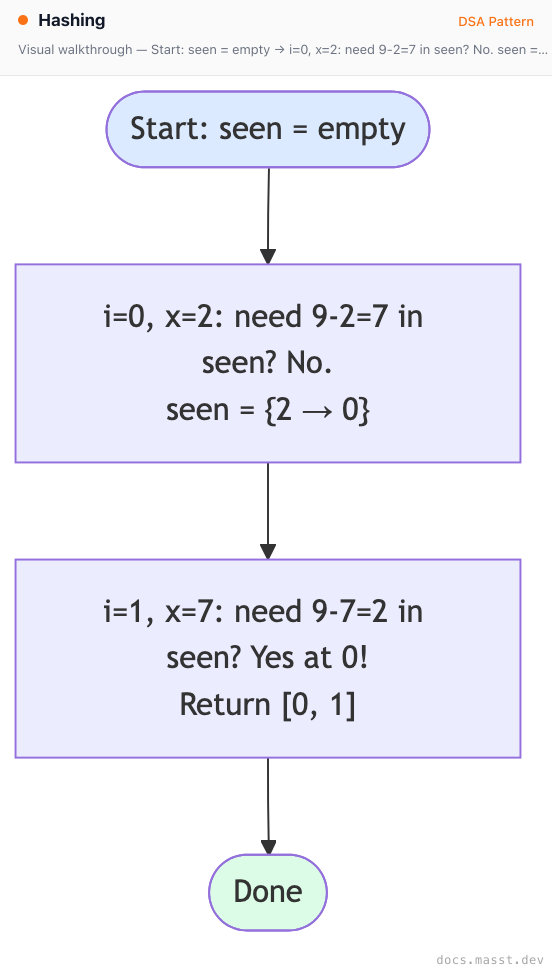
Two iterations. Two hash lookups (each O(1)). Found.
Now let's trace Group Anagrams on ["eat", "tea", "tan", "ate", "nat", "bat"].
The key insight: anagrams have the same sorted string. So "eat" and "tea" and "ate" all hash to "aet". Group by that key.
"eat" → sorted = "aet" → groups["aet"] = ["eat"]
"tea" → sorted = "aet" → groups["aet"] = ["eat", "tea"]
"tan" → sorted = "ant" → groups["ant"] = ["tan"]
"ate" → sorted = "aet" → groups["aet"] = ["eat", "tea", "ate"]
"nat" → sorted = "ant" → groups["ant"] = ["tan", "nat"]
"bat" → sorted = "abt" → groups["abt"] = ["bat"]

Result: [["eat","tea","ate"], ["tan","nat"], ["bat"]]
The derived signature "aet" is the key. Anything that has the same anagram-signature ends up in the same bucket. One pass, O(n · k log k) where k = max string length.
The template
There are three template shapes, depending on what you're storing.
Template A — Hash set (membership only)
def has_duplicate(nums):
    seen = set()
    for x in nums:
        if x in seen:
            return True
        seen.add(x)
    return False
Used for: contains-duplicate, longest-consecutive-sequence (seed by set membership), happy-number (cycle detection via seen-set).
Template B — Hash map (key → value or count)
def two_sum(nums, target):
    seen = {}                              # value → first index
    for i, x in enumerate(nums):
        if target - x in seen:
            return [seen[target - x], i]
        seen[x] = i
For frequency counting:
from collections import Counter
counts = Counter(nums)                     # value → count
most_common = counts.most_common(k)        # top-k by frequency
Used for: two-sum, frequency-based problems, first-non-repeating, top-K frequent.
Template C — Hash map with derived signature key
from collections import defaultdict

def group_anagrams(strs):
    groups = defaultdict(list)
    for s in strs:
        key = ''.join(sorted(s))           # signature
        groups[key].append(s)
    return list(groups.values())
The key isn't the input — it's something you compute from the input that makes equivalent items collide.
Used for: group-anagrams, valid-sudoku (key = "row 3", "col 5", "box 1"), longest-substring-without-repeating (key = char → last-index), prefix-sum-equals-K.
Worked example: Longest Consecutive Sequence (LC 128)
Problem. Given an unsorted array of integers
nums, return the length of the longest consecutive elements sequence. Algorithm must run in O(n). Example:[100, 4, 200, 1, 3, 2]→4(the sequence[1, 2, 3, 4]).
Why this is hashing. The "O(n)" constraint immediately rules out sorting (O(n log n)). What we need: O(1) check for "is this number's neighbor in the set?"
The naive O(n)-attempt that doesn't work: put all numbers in a set, then for each x iterate x+1, x+2, ... until you fall off. This is O(n²) worst case (sequence [1..n] starts a walk from every element).
The fix: only start a walk from the smallest number in each sequence. We can detect "this is the smallest" by checking: is x - 1 NOT in the set? If x - 1 isn't in the set, then x is the start of a streak; walk forward. Otherwise, skip — we'll count this number when we walk from its predecessor.
def longest_consecutive(nums: list[int]) -> int:
    s = set(nums)
    best = 0
    for x in s:
        if x - 1 in s:
            continue                       # not the start of a streak
        # x is a streak start; walk forward
        length = 1
        while x + length in s:
            length += 1
        best = max(best, length)
    return best
Why this is O(n). Each number is touched at most twice: once by the outer for loop, and at most once by some inner while walk (only the streak's start walks; no element is visited by multiple walks).
Dry-run on [100, 4, 200, 1, 3, 2]:
| x | x - 1 in s? | Skip? | Walk | Length |
|---|---|---|---|---|
| 100 | 99? No | start | 100, (101? no) | 1 |
| 4 | 3? Yes | skip | — | — |
| 200 | 199? No | start | 200, (201? no) | 1 |
| 1 | 0? No | start | 1, 2, 3, 4, (5? no) | 4 |
| 3 | 2? Yes | skip | — | — |
| 2 | 1? Yes | skip | — | — |
Answer: 4 ✓.
Complexity. O(n) time, O(n) space. The x - 1 in s check is what makes this work — without it, you'd revisit numbers.
Variants
Variant 1 — Hash set for "have I seen this?"
The simplest case. Used to detect duplicates, cycles, or membership in a set.
Canonical problems: 217 Contains Duplicate, 219 Contains Duplicate II, 202 Happy Number, 268 Missing Number.
Variant 2 — Hash map for frequency counting
Map each element to its count. Often used with most_common(k) or sorting by frequency.
from collections import Counter
def top_k_frequent(nums, k):
    counts = Counter(nums)
    return [val for val, _ in counts.most_common(k)]
Canonical problems: 347 Top K Frequent Elements, 451 Sort Characters by Frequency, 387 First Unique Character, 169 Majority Element (Boyer-Moore is faster, but Counter works).
Variant 3 — Hash map keyed by sorted/canonical signature
The "anagram trick." Group items that map to the same canonical key.
def group_anagrams(strs):
    groups = defaultdict(list)
    for s in strs:
        key = ''.join(sorted(s))           # or tuple of char counts
        groups[key].append(s)
    return list(groups.values())
For very long strings, replace sorted(s) with a 26-tuple of character counts (tuple(Counter(s).get(c, 0) for c in 'abcdefghijklmnopqrstuvwxyz')) for O(n) per key instead of O(n log n).
Canonical problems: 49 Group Anagrams, 242 Valid Anagram, 438 Find All Anagrams in a String.
Variant 4 — Hash map for index lookup ("have I seen this value before?")
The two-sum shape: map value → index, query "is the complement in the map?"
Canonical problems: 1 Two Sum, 167 Two Sum II (use two-pointers instead), 15 3Sum (use two-pointers + hash), 18 4Sum, 454 4Sum II (split into pairs and hash partial sums).
Variant 5 — Hash map for derived running state
The most powerful variant. Combine with Prefix Sums, Sliding Window, or other patterns. The hash map stores "running signature → count or index."
# Subarray sum equals K — prefix_sum is the key
def subarray_sum(nums, k):
    seen = {0: 1}                          # empty prefix
    cum = count = 0
    for x in nums:
        cum += x
        count += seen.get(cum - k, 0)
        seen[cum] = seen.get(cum, 0) + 1
    return count
Canonical problems: 560 Subarray Sum Equals K, 974 Subarray Sums Divisible by K, 525 Contiguous Array (treat 0 as -1; find longest with sum=0), 437 Path Sum III (DFS + prefix hash).
Variant 6 — Hash map for graph / 2D coordinates
Hash maps keyed by tuples (or stringified coordinates) for sparse 2D data or graph adjacency.
visited = set()
visited.add((row, col))                    # tuples are hashable in Python
Canonical problems: 36 Valid Sudoku (hash sets per row/col/box), 149 Max Points on a Line (hash slopes), 36-like Sudoku validators.
Common pitfalls
| Trap | Fix |
|---|---|
| Using a mutable type as a hash key (Python list, JS Object) | Convert to tuple / use string / use object identity carefully |
| Forgetting to handle the "value equals its own complement" case | target - x == x, need to check index ≠ i (Two Sum: harmless since you add x after the check) |
| Mutating during iteration of a Python dict | Iterate over list(d.items()) or use a separate list to collect mutations |
| Comparing floating-point keys | Hash maps don't tolerate floating-point precision errors; round or scale to int first |
| Worst-case O(n) per operation under adversarial input | Rare in practice, but real for malicious inputs. Use a different structure if security matters |
Forgetting to seed the prefix-sum hash with {0: 1} | Causes off-by-one (misses subarrays starting at index 0) |
| Re-computing the signature inside a loop | Compute once per element; store the result |
| Choosing the wrong key | Group-anagrams with len(s) as key groups wrong things. Pick the minimal-information key that makes equivalent items collide |
| Using HashMap when sorting is faster for small N | For n < 100, sorting (O(n log n)) often beats hashing in cache friendliness |
Complexity
Average case: O(1) per insert/lookup, O(n) total.
Worst case: O(n) per operation if hash collisions degenerate to a linked list. In practice this only happens under adversarial input or with a terrible hash function. Most language standard libraries (Python dict, Java HashMap, C++ unordered_map) randomize their hashes to prevent this.
Space: O(n) for the map/set.
The pattern's appeal: hashing trades space for time. If you have memory to spare, the conversion from O(n²) → O(n) is often free.
When NOT to use hashing
- You need ordered iteration. Hash maps don't preserve order (except
OrderedDict/ JavaLinkedHashMap, which preserve insertion order but not sorted order). For "iterate keys in sorted order," use aTreeMap/SortedSet(O(log n) per op). - Memory is tight. Hash maps have significant overhead (often 2-4× the data size). For very large inputs in memory-constrained environments, sorting or bit manipulation may be better.
- The keys are floats or complex types with imprecise equality. Round to integers or use a different data structure (
SortedListwith comparator). - You'd be re-hashing the same key on every query. If the key derivation is expensive, cache the result.
- The problem requires sortedness for the algorithm. Two-Sum-II works with Two Pointers on a sorted array using O(1) space. Hashing would be O(n) space for no benefit.
- Range queries (sum/count over [l, r]). Hash maps support point lookup, not range lookup. Use Prefix Sums or a tree.
Decision rule
| Symptom | Likely pattern |
|---|---|
| "Have I seen this exact thing?" | Hash Set |
| "How many times does X appear?" | Counter / Hash Map |
| "Group by some property" | Hash Map with derived key |
| "Pair / triplet sum (unsorted)" | Hash Map for pair; for triplet, sort + two-pointers |
| "Subarray sum equals K (with negatives)" | Prefix Sum + Hash Map |
| "Longest substring without repeating" | Sliding Window + Hash Map |
| "Top-K most frequent" | Counter + sort, or Heap |
| "Sorted iteration" | TreeMap / sorted list (not hash) |
| "Range queries" | Prefix Sum / Segment Tree (not hash) |
Real-world applications
- Databases. Hash indexes for equality lookups; B-trees for range. Every database has both.
- Caching layers. Redis, Memcached, browser caches, CPU caches — all hash tables under the hood.
- Compilers / interpreters. Symbol tables mapping identifier → declaration are hash maps. Python's local-variable lookup is a dict.
- Bloom filters. A space-efficient probabilistic hash structure for "definitely not seen" queries (cache layer in front of an expensive store).
- Consistent hashing. Used in distributed databases (DynamoDB, Cassandra) to assign keys to shards without massive rebalancing.
- Content-addressable storage. Git stores objects keyed by SHA-1 hash of their content; HashMap of
hash → blob.
Curated practice problems
| # | Problem | Difficulty | Variant | Note |
|---|---|---|---|---|
| 1 | ★ 1 Two Sum | Easy | Map value → index | The canonical hashing problem |
| 2 | 217 Contains Duplicate | Easy | Set membership | The simplest case |
| 3 | 219 Contains Duplicate II | Easy | Map value → most-recent index | "Within K distance" variant |
| 4 | 242 Valid Anagram | Easy | Counter equality | Two ways: sort or count |
| 5 | ★ 49 Group Anagrams | Medium | Derived key (sorted string) | Bucket by signature |
| 6 | 387 First Unique Character | Easy | Counter | Two passes |
| 7 | 169 Majority Element | Easy | Counter (or Boyer-Moore) | Hash is the easy way |
| 8 | 347 Top K Frequent Elements | Medium | Counter + heap | Combines with Heap |
| 9 | ★ 128 Longest Consecutive Sequence | Medium | Set + smart start | This page's worked example |
| 10 | 202 Happy Number | Easy | Cycle via seen-set | Or use Floyd's |
| 11 | 36 Valid Sudoku | Medium | 3 sets per row/col/box | Hash sets for constraint check |
| 12 | ★ 560 Subarray Sum Equals K | Medium | Prefix sum + hash | The killer combo |
| 13 | 525 Contiguous Array | Medium | Prefix sum (0→-1) + hash | Longest with sum=0 |
| 14 | 454 4Sum II | Medium | Hash pair sums | Split into two halves |
| 15 | 149 Max Points on a Line | Hard | Hash slopes | Slopes as tuples (dx, dy) reduced |
Related patterns
- Sliding Window — uses hash map for window state
- Prefix Sums — combines with hash map for subarray-sum problems
- Two Pointers — the alternative when input is sorted
- Heap — when you need top-K and ordering matters
- DFS/BFS — use hash set for
visited
Quick-reference card
# Hash set
seen = set()
for x in items:
    if x in seen: return True
    seen.add(x)

# Hash map: value → index
seen = {}
for i, x in enumerate(items):
    if want - x in seen: return [seen[want - x], i]
    seen[x] = i

# Frequency counter
from collections import Counter
c = Counter(items); c.most_common(k)

# Group by derived signature
from collections import defaultdict
groups = defaultdict(list)
for x in items:
    groups[signature(x)].append(x)
Triggers: "have I seen this", "count of", "group by", "pair-sum unsorted". Complexity: O(n) avg, O(n) space.
Finished reading?
Mark it done to track your progress in Interview.