
DP — Intervals / Partition / MCM
dp[i][j] over intervals. Try every split point k between i and j. The pattern behind matrix chain multiplication, burst balloons, palindrome partitioning II, stone games.
TL;DR — DP — Intervals
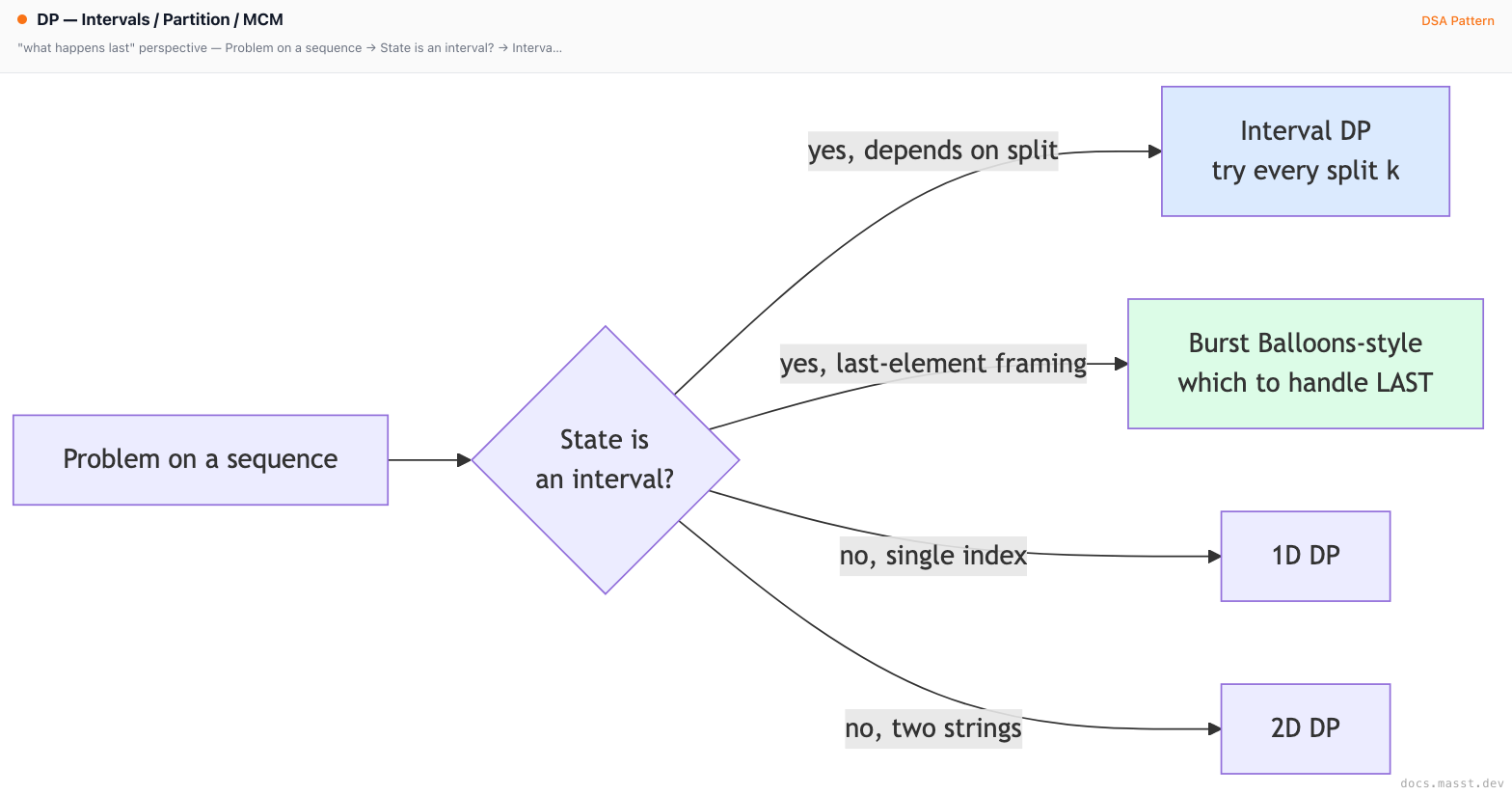
Use when: the state is an interval [i, j] of an array or string, and the answer involves choosing a split point k between i and j to partition the problem.
Trigger phrases: "burst balloons", "matrix chain multiplication", "min/max cost to merge", "palindrome partitioning II", "scramble string", "stone game", "minimum cost tree from leaf values".
The shape: dp[i][j] = min/max over k of (dp[i][k] + dp[k+1][j] + cost(i, k, j)).
The trick: fill the table by interval length, not by (i, j) directly. Smaller intervals computed before larger ones.
Complexity: O(n³) typical — n² states × n splits per state.
The problem that motivates this pattern
Matrix Chain Multiplication. Given dimensions of
nmatrices in sequence, find the minimum number of scalar multiplications to compute their product. MatrixM_ihas dimensionsdims[i] × dims[i+1].Example: matrices
M_1 (10×20),M_2 (20×30),M_3 (30×40),M_4 (40×30)→ dims[10, 20, 30, 40, 30]. The cost depends on the order of multiplication; we want the cheapest.
Multiplying M_1 × M_2 × M_3 × M_4 can be parenthesized in many ways:
((M_1 × M_2) × M_3) × M_4→ costs10·20·30 + 10·30·40 + 10·40·30 = 6000 + 12000 + 12000 = 30000.M_1 × ((M_2 × M_3) × M_4)→ costs20·30·40 + 20·40·30 + 10·20·30 = 24000 + 24000 + 6000 = 54000.
The order matters a lot. The optimal parenthesization for 4 matrices isn't obvious.
The DP insight: to compute the optimal cost over interval [i..j], try every split point k. The cost is dp[i][k] + dp[k+1][j] + cost_of_merging_at_k. The split point k divides the chain into two halves; the optimal way to combine each half is already solved.
def matrix_chain_order(dims):
    n = len(dims) - 1                                # number of matrices
    dp = [[0] * n for _ in range(n)]

    for length in range(2, n + 1):                   # interval length
        for i in range(n - length + 1):
            j = i + length - 1
            dp[i][j] = float('inf')
            for k in range(i, j):                    # try every split
                cost = dp[i][k] + dp[k+1][j] + dims[i] * dims[k+1] * dims[j+1]
                dp[i][j] = min(dp[i][j], cost)

    return dp[0][n-1]
O(n³) total — n² intervals × n splits each.
The deeper insight: interval DP is for problems where the "natural" recursion is "pick a split point and recurse on both halves". The order of operations within the interval is what we're optimizing. This shape appears in surprising places — burst balloons (which to burst LAST in an interval), palindrome partitioning II (where to cut), stone games (which stones to take).
The core insight
Interval DP is when state is (i, j) meaning "the problem restricted to subarray/substring i..j." Transitions try every split point k in i..j.
The invariant we maintain:
By the time we compute
dp[i][j], everydp[a][b]withb - a < j - ihas already been computed.
That's why we iterate by interval length in the outer loop. Smaller intervals first → larger intervals depend on already-solved smaller ones.
Three things to identify:
- State: what does
dp[i][j]mean? "Min cost to merge stones i..j into one pile." "Max coins from bursting balloons in interval i..j." "Min cuts to partition s[i..j] into palindromes." - Split point k: at which index do we partition? Usually
kis chosen from[i, j-1](the boundary between two halves) or it represents which element to handle last in the interval. - Cost of merging at k: what's the cost added when combining the two halves?
The "what happens last" perspective
For some interval DPs (especially Burst Balloons), the right framing isn't "where to split" but "which element is processed LAST". The element processed last is the one that determines the cost between the two halves.
For Burst Balloons:
- Brute-force thinking: which to burst first? Bad — the coins from bursting balloon
idepend on its current neighbors, which change as we burst. - DP thinking: which to burst last? Genius — when balloon
kis last in interval[i, j], its left neighbor isnums[i-1]and right isnums[j+1](the boundaries, which don't change). The coins fromkarenums[i-1] · nums[k] · nums[j+1].
This perspective shift is what makes interval DP unintuitive but powerful.
Visual walkthrough — Matrix Chain Multiplication
dims = [10, 20, 30, 40, 30] (4 matrices: 10×20, 20×30, 30×40, 40×30).
Fill table by interval length.
Length 1: dp[i][i] = 0 (single matrix has zero multiplications).
dp = [0, 0, 0, 0]
       0  0  0
          0  0
             0
Length 2 (pairs):
dp[0][1] = dims[0] · dims[1] · dims[2] = 10·20·30 = 6000.dp[1][2] = dims[1] · dims[2] · dims[3] = 20·30·40 = 24000.dp[2][3] = dims[2] · dims[3] · dims[4] = 30·40·30 = 36000.
Length 3 (try each split):
dp[0][2]:- k=0:
dp[0][0] + dp[1][2] + dims[0]·dims[1]·dims[3] = 0 + 24000 + 8000 = 32000. - k=1:
dp[0][1] + dp[2][2] + dims[0]·dims[2]·dims[3] = 6000 + 0 + 12000 = 18000. ✓ dp[0][2] = 18000.
- k=0:
dp[1][3]:- k=1:
dp[1][1] + dp[2][3] + dims[1]·dims[2]·dims[4] = 0 + 36000 + 18000 = 54000. - k=2:
dp[1][2] + dp[3][3] + dims[1]·dims[3]·dims[4] = 24000 + 0 + 24000 = 48000. ✓ dp[1][3] = 48000.
- k=1:
Length 4 (the full chain):
dp[0][3]:- k=0:
0 + 48000 + dims[0]·dims[1]·dims[4] = 48000 + 6000 = 54000. - k=1:
6000 + 36000 + dims[0]·dims[2]·dims[4] = 6000 + 36000 + 9000 = 51000. - k=2:
18000 + 0 + dims[0]·dims[3]·dims[4] = 18000 + 12000 = 30000. ✓ dp[0][3] = 30000.
- k=0:
Answer: 30000 — multiply (M_1 × M_2 × M_3) first, then × M_4. That matches our earlier hand-calculation.
The template
Template A — Interval DP, length-by-length
def interval_dp(arr):
    n = len(arr)
    dp = [[0] * n for _ in range(n)]

    # Base case: length-1 intervals (or whatever the problem says)
    for i in range(n):
        dp[i][i] = base_case(arr[i])

    # Build by interval length
    for length in range(2, n + 1):
        for i in range(n - length + 1):
            j = i + length - 1
            dp[i][j] = initial_value()                # often inf or -inf
            for k in range(i, j):                     # split at k
                cost = dp[i][k] + dp[k+1][j] + merge_cost(i, k, j)
                dp[i][j] = best(dp[i][j], cost)

    return dp[0][n-1]
Three slots:
- Base case —
dp[i][i]. - Merge cost —
merge_cost(i, k, j)is what the problem charges (or rewards) for combining[i..k]and[k+1..j]. - Best operator —
minormax.
Template B — "Which is LAST" interval DP (Burst Balloons)
def burst_balloons(nums):
    # Pad with 1s at both ends (virtual neighbors)
    nums = [1] + nums + [1]
    n = len(nums)
    dp = [[0] * n for _ in range(n)]

    # length: distance between i and j (i.e., j - i)
    for length in range(2, n):                       # length is at least 2 (one balloon between)
        for i in range(n - length):
            j = i + length
            # try each k in (i, j) as the LAST balloon to burst
            for k in range(i + 1, j):
                # bursting k last means its neighbors are nums[i] and nums[j]
                coins = nums[i] * nums[k] * nums[j]
                dp[i][j] = max(dp[i][j], dp[i][k] + dp[k][j] + coins)

    return dp[0][n-1]
The padding with 1s simulates the "no balloon to the left/right" case mentioned in the spec.
Template C — Memoized recursion (when bottom-up is awkward)
from functools import cache

def solve(arr):
    @cache
    def helper(i, j):
        if i >= j: return 0                          # or whatever base case
        best = float('inf')
        for k in range(i, j):
            best = min(best, helper(i, k) + helper(k+1, j) + cost(i, k, j))
        return best
    return helper(0, len(arr) - 1)
@cache handles memoization automatically. Sometimes the top-down version makes the state and transition clearer.
Worked example: Burst Balloons (LC 312)
Problem.
nballoons indexed0ton-1. Each balloon has a number on it (nums[i]). When you burst ballooni, you earnnums[i-1] * nums[i] * nums[i+1]coins. After bursting,i-1andi+1become adjacent. Return the maximum coins you can earn.Example:
nums = [3, 1, 5, 8]→167. (Best order: burst 1, 5, 3, 8 → coins3·1·5 + 3·5·8 + 1·3·8 + 1·8·1 = 15 + 120 + 24 + 8 = 167.)
Why this is interval DP — and why "which is last" matters. If you tried "which balloon to burst first?", you'd have to track which balloons remain — exponential state. The brilliant reframe: fix k as the LAST balloon to burst in interval [i, j]. Then balloon k's neighbors at burst time are the boundary balloons nums[i-1] and nums[j+1] — they never change during the recursion!
The state: dp[i][j] = max coins from bursting balloons strictly between i and j (exclusive boundaries).
Pad with 1s: nums = [1] + nums + [1]. Now balloon i-1 and j+1 always exist.
Recurrence: dp[i][j] = max over k in (i, j) of dp[i][k] + dp[k][j] + nums[i] * nums[k] * nums[j].
def max_coins(nums: list[int]) -> int:
    nums = [1] + nums + [1]
    n = len(nums)
    dp = [[0] * n for _ in range(n)]

    for length in range(2, n):                       # interval span (must enclose at least 1 balloon)
        for i in range(n - length):
            j = i + length
            for k in range(i + 1, j):
                coins = nums[i] * nums[k] * nums[j]
                dp[i][j] = max(dp[i][j], dp[i][k] + dp[k][j] + coins)

    return dp[0][n-1]
Dry-run on nums = [3, 1, 5, 8] (padded to [1, 3, 1, 5, 8, 1], n=6):
Length 2 (one balloon between):
- dp[0][2]: only k=1. coins = 1·3·1 = 3. dp[0][2] = 3.
- dp[1][3]: only k=2. coins = 3·1·5 = 15. dp[1][3] = 15.
- dp[2][4]: only k=3. coins = 1·5·8 = 40. dp[2][4] = 40.
- dp[3][5]: only k=4. coins = 5·8·1 = 40. dp[3][5] = 40.
Length 3 (two balloons between):
- dp[0][3]: k=1 (coins 1·3·5=15, +dp[1][3]=15) → 30. k=2 (1·1·5=5, +dp[0][2]=3+0) → 8. Max=30.
- dp[1][4]: k=2 (3·1·8=24, +dp[2][4]=40) → 64. k=3 (3·5·8=120, +dp[1][3]=15) → 135. Max=135.
- dp[2][5]: k=3 (1·5·1=5, +dp[3][5]=40) → 45. k=4 (1·8·1=8, +dp[2][4]=40) → 48. Max=48.
Length 4:
- dp[0][4]: k=1 (1·3·8=24, +0+dp[1][4]=135) → 159. k=2 (1·1·8=8, +dp[0][2]=3+dp[2][4]=40) → 51. k=3 (1·5·8=40, +dp[0][3]=30+0) → 70. Max=159.
- dp[1][5]: k=2 (3·1·1=3, +0+dp[2][5]=48) → 51. k=3 (3·5·1=15, +dp[1][3]=15+dp[3][5]=40) → 70. k=4 (3·8·1=24, +dp[1][4]=135+0) → 159. Max=159.
Length 5 (full):
- dp[0][5]: k=1 (1·3·1=3, +0+dp[1][5]=159) → 162. k=2 (1·1·1=1, +dp[0][2]=3+dp[2][5]=48) → 52. k=3 (1·5·1=5, +dp[0][3]=30+dp[3][5]=40) → 75. k=4 (1·8·1=8, +dp[0][4]=159+0) → 167. Max=167 ✓.
Answer: 167 ✓.
Complexity. O(n³) time, O(n²) space.
The "which is last" framing is the single insight that makes this problem solvable. Without it, you'd try bursting orderings — exponential.
Variants
Variant 1 — Matrix Chain Multiplication
The canonical. Try every split.
Canonical problems: not directly on LC, but underlies 1039 Minimum Score Triangulation of Polygon (same shape).
Variant 2 — Burst Balloons-style (which is LAST)
When the "obvious" framing (which first) gives a state-explosion problem. Pad boundaries.
Canonical problems: 312 Burst Balloons (this page's worked example), 546 Remove Boxes (harder — also tracks "how many same-color in a row before this segment").
Variant 3 — Palindrome Partitioning II (Min Cuts)
dp[i] = min cuts for prefix s[:i]. Use a precomputed is_palindrome[i][j] table (also an interval DP).
def min_cut(s):
    n = len(s)
    # is_palin[i][j] = "is s[i..j] a palindrome?"
    is_palin = [[False] * n for _ in range(n)]
    for i in range(n): is_palin[i][i] = True
    for length in range(2, n + 1):
        for i in range(n - length + 1):
            j = i + length - 1
            if s[i] == s[j] and (length == 2 or is_palin[i+1][j-1]):
                is_palin[i][j] = True

    # dp[i] = min cuts for s[0..i]
    dp = [0] * n
    for i in range(n):
        if is_palin[0][i]: dp[i] = 0
        else:
            dp[i] = i                                  # worst case: cut every char
            for j in range(1, i + 1):
                if is_palin[j][i]:
                    dp[i] = min(dp[i], dp[j-1] + 1)
    return dp[n-1]
Canonical problems: 132 Palindrome Partitioning II, 5 Longest Palindromic Substring (interval DP for is_palin), 1278 Palindrome Partitioning III.
Variant 4 — Min Cost to Merge / Stone Game
Each merge combines two adjacent groups. The cost depends on the merge.
# Min Cost to Merge Stones (LC 1000) — k-way merge
# Each turn merges k consecutive piles into 1.
# dp[i][j][p] = min cost to merge piles i..j into p piles.
Canonical problems: 1000 Minimum Cost to Merge Stones, 877 Stone Game, 1690 Stone Game VII.
Variant 5 — Triangulation / MCM-like
Polygon triangulation: pick one edge, then triangulate the two sub-polygons.
Canonical problems: 1039 Minimum Score Triangulation of Polygon — direct MCM.
Variant 6 — Boolean Parenthesization
Count the number of ways to parenthesize a boolean expression to evaluate to true.
def count_ways(symbols, operators):
    n = len(symbols)
    # T[i][j] = number of ways s[i..j] evaluates to True
    # F[i][j] = number of ways s[i..j] evaluates to False
    T = [[0] * n for _ in range(n)]
    F = [[0] * n for _ in range(n)]
    for i in range(n):
        T[i][i] = 1 if symbols[i] == 'T' else 0
        F[i][i] = 1 if symbols[i] == 'F' else 0
    for length in range(2, n + 1):
        for i in range(n - length + 1):
            j = i + length - 1
            for k in range(i, j):
                op = operators[k]
                # Compose T[i][j] and F[i][j] based on T[i][k], F[i][k], T[k+1][j], F[k+1][j]
                # ... (depends on op: &, |, ^)
Canonical problems: GeeksforGeeks "Boolean Parenthesization Problem", 1130 Minimum Cost Tree From Leaf Values (related shape).
Common pitfalls
| Trap | Fix |
|---|---|
Iterating by (i, j) directly instead of by length | The recurrence depends on smaller intervals. Iterate by length first |
| For Burst Balloons, trying "which first" framing | Doesn't decompose. Try "which LAST" instead |
| Forgetting to pad with sentinels (Burst Balloons) | Without [1] + nums + [1], boundary balloons cause off-by-one errors |
Confusing dp[i][k] + dp[k+1][j] (split at k) with dp[i][k] + dp[k][j] (k itself isolated) | Read the problem. MCM splits at k (k+1 starts the next half). Burst Balloons isolates k (so both halves go to k itself) |
| Off-by-one on length range | For "split at k": length goes 2..n. For "isolate k": length goes 2..n-1 (need room on both sides) |
| Using O(n²) space when memoized recursion is cleaner | @cache on a recursive helper is sometimes more readable |
Initializing dp[i][i] to wrong base | dp[i][i] = 0 is common; sometimes it's a specific cost from the problem |
| Forgetting the answer's location | Usually dp[0][n-1]. For Burst Balloons with padding, dp[0][n-1] of the padded array |
| Confusing interval DP with knapsack | Knapsack: (items, capacity). Interval: (left, right). Different state shapes |
| Using O(n³) when better algorithms exist | For specific subproblems (e.g., LCS), 2D DP is enough. Interval DP is overkill |
Complexity
Time: O(n³) — n² intervals × n splits per interval. This is the worst common DP complexity (after O(n²)) but still polynomial.
Space: O(n²) for the DP table. For specific problems (Min Cut, Longest Palindromic Substring), you can sometimes reduce to O(n) but the trick depends on the problem.
Cubic time is the bound to expect. For n = 200, that's 8 million operations — fast. For n = 1000, that's 10⁹ — at the edge. For n = 10000, infeasible.
If your interval DP has additional state (e.g., Remove Boxes has a third dimension), complexity rises to O(n⁴) or O(n³ · k).
When NOT to use interval DP
- The state is a single index. Use 1D DP.
- The state is
(item, capacity). Use Knapsack DP. - Two indices but they're from different sequences. Use 2D Grid / Two-Sequence DP.
- n is too large (
n > 1000). O(n³) won't fit. Look for clever structure (Knuth's optimization, divide-and-conquer DP optimization) or a different algorithm. - The problem is fundamentally greedy. Some "partition" problems are solvable greedily.
- The answer doesn't depend on split points. If the partition is unique (or doesn't matter), DP isn't needed.
Decision rule
| Symptom | Likely pattern |
|---|---|
| "Min/max cost to merge / parenthesize" | Interval DP (MCM-style) |
| "Burst balloons / remove boxes" | Interval DP ("which is last") |
| "Palindrome partitioning II (min cuts)" | Interval DP (precompute is_palin) |
| "Longest palindromic substring" | Interval DP for is_palin, then max |
| "Stone game / merge stones" | Interval DP |
| "Polygon triangulation" | Interval DP (MCM-shape) |
| "Boolean parenthesization" | Interval DP (two tables: T, F) |
| "Partition into k groups" | Knapsack or Bitmask DP (not interval) |
| "Two-sequence problem" | 2D DP (not interval) |
Real-world applications
- Compiler optimization. Optimal expression evaluation order, common subexpression elimination — interval DP shapes.
- Database query optimization. Order of joins (left-deep vs bushy trees) — analogous to matrix chain.
- Parsing / syntax analysis. CYK algorithm for context-free grammars is interval DP.
- Bioinformatics — RNA secondary structure. The classic Nussinov algorithm for predicting RNA folds is interval DP.
- Game theory / minimax over intervals. Some adversarial games have interval-DP solutions.
- Image segmentation. Some pixel-grouping algorithms use interval DP on 1D scanlines.
- Optimal coding (Huffman-like). Some optimal-merge problems are interval DP.
Curated practice problems
| # | Problem | Difficulty | Variant | Note |
|---|---|---|---|---|
| 1 | ★ 312 Burst Balloons | Hard | "Which is last" | This page's worked example |
| 2 | ★ 1039 Min Score Triangulation | Medium | MCM | Try every diagonal triangle |
| 3 | 1547 Minimum Cost to Cut a Stick | Hard | MCM-like | Pad with 0 and n at boundaries |
| 4 | 1000 Min Cost to Merge Stones | Hard | k-way merge | 3D state: dp[i][j][p] |
| 5 | ★ 132 Palindrome Partitioning II | Hard | Min cuts | Precompute is_palindrome |
| 6 | 5 Longest Palindromic Substring | Medium | is_palindrome table | Or expand-around-center |
| 7 | 647 Palindromic Substrings | Medium | Same is_palindrome | Count instead of length |
| 8 | 516 Longest Palindromic Subsequence | Medium | Two-Sequence-like | dp[i][j] = LPS of s[i..j] |
| 9 | 877 Stone Game | Medium | Game theory + interval | dp[i][j] = max diff achievable |
| 10 | 486 Predict the Winner | Medium | Stone Game variant | Same algorithm |
| 11 | 546 Remove Boxes | Hard | Interval + extra state | 3D state: dp[i][j][k] |
| 12 | 1130 Minimum Cost Tree From Leaf Values | Medium | MCM-shape | Or monotonic stack O(n) |
| 13 | 87 Scramble String | Hard | Memoized recursion | (s1, s2) state, split point |
| 14 | 1255 Maximum Score Words | Hard | Backtracking + interval scoring | Subset-flavored |
Related patterns
- DP — 2D Grid / Two-Sequence — different 2D shape; intervals are 2D too but with a different recurrence
- DP — Linear — when state is single index
- DP — Knapsack — different 2D structure
- Monotonic Stack — sometimes solves Min Cost Tree From Leaf Values in O(n)
- Backtracking — when you need to enumerate parenthesizations, not optimize
Quick-reference card
# Interval DP template (iterate by length)
n = len(arr)
dp = [[0] * n for _ in range(n)]
# base case: dp[i][i]
for length in range(2, n + 1):
    for i in range(n - length + 1):
        j = i + length - 1
        dp[i][j] = initial                            # inf or -inf
        for k in range(i, j):
            dp[i][j] = best(dp[i][j], dp[i][k] + dp[k+1][j] + cost(i, k, j))
return dp[0][n-1]

# Burst Balloons (which is LAST)
nums = [1] + nums + [1]; n = len(nums)
dp = [[0] * n for _ in range(n)]
for length in range(2, n):
    for i in range(n - length):
        j = i + length
        for k in range(i + 1, j):
            dp[i][j] = max(dp[i][j], dp[i][k] + dp[k][j] + nums[i]*nums[k]*nums[j])

# Palindrome partitioning min cuts
is_palin = [[True] * n for _ in range(n)]
for length in range(2, n + 1):
    for i in range(n - length + 1):
        j = i + length - 1
        is_palin[i][j] = s[i] == s[j] and (length == 2 or is_palin[i+1][j-1])
Triggers: "burst balloons", "merge stones", "matrix chain", "palindrome partitioning II", "stone game". Complexity: O(n³).
Finished reading?
Mark it done to track your progress in Interview.
DP — Knapsack Family
Items with weights/values and a capacity. Pick a subset to optimize. 0/1 knapsack, unbounded knapsack, subset sum, coin change, partition equal subsets.
DP — Tree DP
Post-order DP on a tree. Child results compose into parent's answer. The pattern behind diameter, house robber on trees, binary tree cameras, and most "compute X over a tree" problems.