
DP — 2D Grid / Two-Sequence
dp[i][j] over a matrix or pair of sequences. Unique paths, longest common subsequence, edit distance, minimum path sum.
TL;DR — DP — 2D Grid / Two-Sequence
Use when: the state requires two indices — either (row, col) of a grid, or (i, j) indexing into two different sequences.
Trigger phrases: "unique paths in a grid", "minimum path sum", "longest common subsequence", "edit distance", "interleaving strings", "regular expression matching", "distinct subsequences".
The shape: dp[i][j] = f(dp[i-1][j], dp[i][j-1], dp[i-1][j-1], arr[i], arr[j]).
Two main flavors:
- Grid DP —
dp[i][j]over a 2D matrix; usually depends on neighbors above and left. - Two-Sequence DP —
dp[i][j]= answer for prefixess1[:i]ands2[:j]; depends on shorter-prefix subproblems.
Complexity: O(m·n) time, O(m·n) or O(min(m,n)) space (with rolling).
The problem that motivates this pattern
Unique Paths (LC 62). A robot is at the top-left of an
m × ngrid. It can only move down or right. How many unique paths reach the bottom-right corner?Example:
m = 3, n = 7→28.
Naive recursion: from (0, 0), branch right or down at each cell. Count paths reaching (m-1, n-1). Exponential — for a 10×10 grid, that's 2^20 = a million paths to check, and it grows fast.
Insight: paths reaching (i, j) are exactly paths reaching (i-1, j) plus paths reaching (i, j-1) — since you arrived from one of those two cells. So dp[i][j] = dp[i-1][j] + dp[i][j-1]. Two-cell lookup, O(m·n) total.
Base case: the entire top row and left column have exactly one path (you can only go straight).
def unique_paths(m, n):
    dp = [[1] * n for _ in range(m)]
    for i in range(1, m):
        for j in range(1, n):
            dp[i][j] = dp[i-1][j] + dp[i][j-1]
    return dp[m-1][n-1]
O(m·n) time, O(m·n) space (and easy to reduce to O(n) with a rolling row).
This is the canonical 2D grid DP. The recurrence is one line; the work is in naming the state correctly.
The deeper insight: 2D DP is what powers most string-matching and grid-traversal algorithms in production — edit distance (used in spell-check, diff, DNA alignment), LCS (used in git diff, bioinformatics), regex matching. Once you internalize the 2D-table-fill pattern, these problems are the same problem with different transitions.
The core insight
2D DP is when the state needs two indices. The table is a grid; each cell's value depends on a constant number of neighbors.
The invariant we maintain:
By the time we compute
dp[i][j], everydp[a][b]fora < ior (a == iandb < j) has already been computed correctly.
Filling order matters. Most 2D DPs fill row-by-row, left-to-right — which makes sure top, left, and top-left neighbors are ready before we compute the current cell.
Three things to identify in any 2D DP:
- State: what does
dp[i][j]mean? "Number of paths to (i,j)." "Min cost to reach (i,j)." "LCS ofs1[:i]ands2[:j]." "Edit distance froms1[:i]tos2[:j]." - Transition: which
dp[a][b]cells doesdp[i][j]depend on? Usuallydp[i-1][j],dp[i][j-1], and/ordp[i-1][j-1]. - Base cases: the first row and first column, or
dp[0][0].
Two flavors
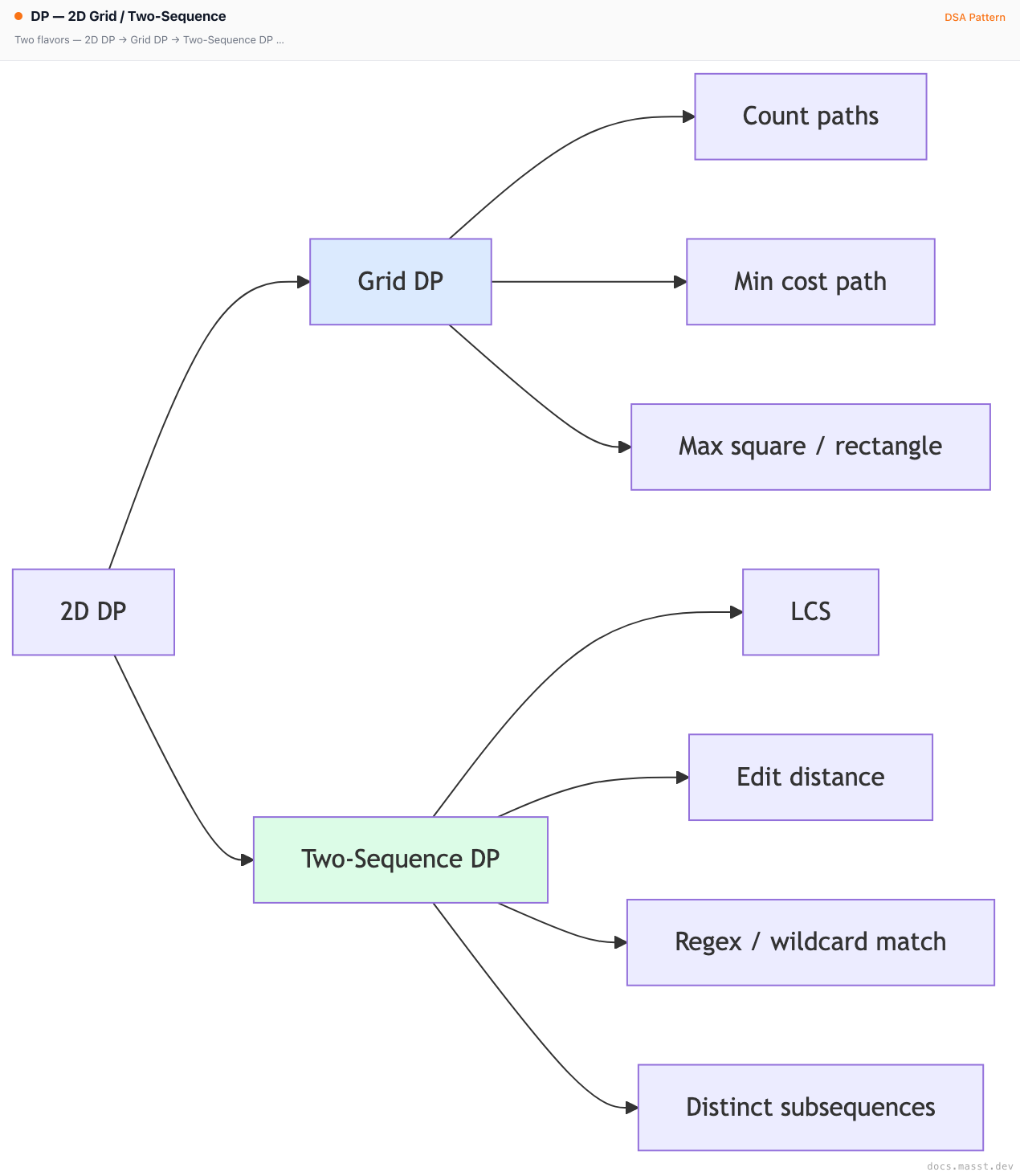
- Grid DP: state =
(row, col)in a 2D matrix. Transition: neighbors in the matrix. - Two-Sequence DP: state =
(i, j)representing prefix lengths into two strings. Transition: based on whethers1[i-1]equalss2[j-1].
Both have the same code shape — a doubly-nested loop and an O(1) transition per cell. The semantic interpretation differs.
Visual walkthrough — Unique Paths on 3×3
Start:
dp =  [1, 1, 1]
      [1, ?, ?]
      [1, ?, ?]
Fill row 1:
dp[1][1] = dp[0][1] + dp[1][0] = 1 + 1 = 2dp[1][2] = dp[0][2] + dp[1][1] = 1 + 2 = 3
Fill row 2:
dp[2][1] = dp[1][1] + dp[2][0] = 2 + 1 = 3dp[2][2] = dp[1][2] + dp[2][1] = 3 + 3 = 6
Final dp:
      [1, 1, 1]
      [1, 2, 3]
      [1, 3, 6]

Answer: dp[2][2] = 6.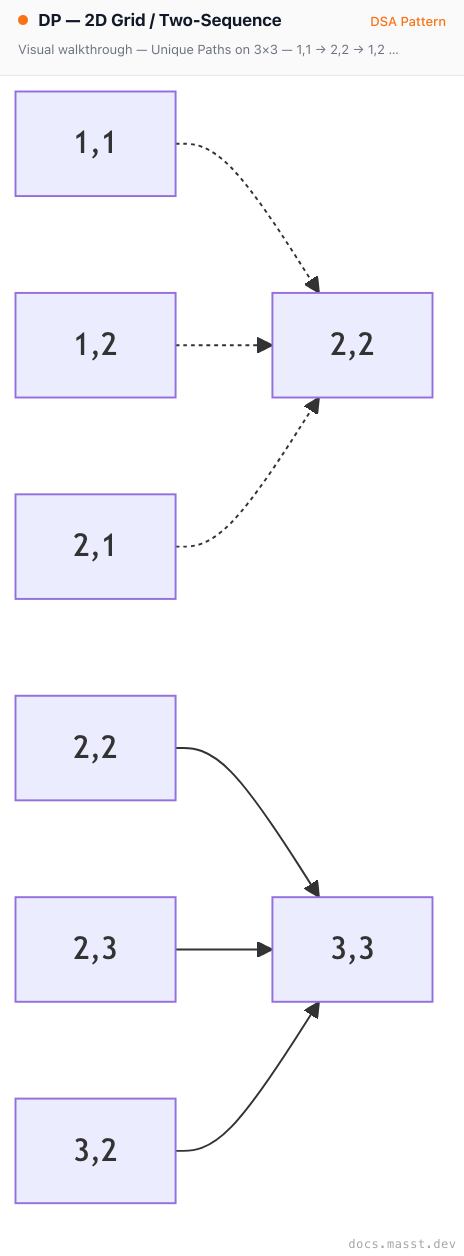
Each cell sums its top and left neighbors. The grid fills itself.
Visual walkthrough — Longest Common Subsequence
s1 = "ABCBDAB", s2 = "BDCAB". LCS = "BCAB" (or "BDAB"), length 4.
We build a (len(s1)+1) × (len(s2)+1) table. dp[i][j] = LCS of s1[:i] and s2[:j].
Recurrence:
- If
s1[i-1] == s2[j-1]:dp[i][j] = dp[i-1][j-1] + 1(extend the LCS). - Else:
dp[i][j] = max(dp[i-1][j], dp[i][j-1])(take the better of skipping a char from either).
       ""  B  D  C  A  B
   ""   0  0  0  0  0  0
    A   0  0  0  0  1  1
    B   0  1  1  1  1  2
    C   0  1  1  2  2  2
    B   0  1  1  2  2  3
    D   0  1  2  2  2  3
    A   0  1  2  2  3  3
    B   0  1  2  2  3  4   ← dp[7][5] = 4
The bottom-right cell is the answer: LCS = 4.
The diagonal vs row/col distinction is what makes this beautiful: when characters match, you "go diagonal" (use both). When they don't, you "go up or left" (skip one char from one string).
The template
Template A — Grid DP
def grid_dp(grid):
    m, n = len(grid), len(grid[0])
    dp = [[0] * n for _ in range(m)]
    dp[0][0] = grid[0][0]                            # base

    # First row and first column
    for j in range(1, n): dp[0][j] = combine(dp[0][j-1], grid[0][j])
    for i in range(1, m): dp[i][0] = combine(dp[i-1][0], grid[i][0])

    # Fill the rest
    for i in range(1, m):
        for j in range(1, n):
            dp[i][j] = best_of(dp[i-1][j], dp[i][j-1]) + cost(grid[i][j])

    return dp[m-1][n-1]
Space optimization: since each row only depends on the previous row, you can rolling-array down to O(n).
Template B — Two-Sequence DP
def two_seq_dp(s1, s2):
    m, n = len(s1), len(s2)
    dp = [[0] * (n + 1) for _ in range(m + 1)]

    # Base cases (typically dp[0][j] and dp[i][0])
    for j in range(n + 1): dp[0][j] = base_func(j)
    for i in range(m + 1): dp[i][0] = base_func(i)

    for i in range(1, m + 1):
        for j in range(1, n + 1):
            if s1[i-1] == s2[j-1]:
                dp[i][j] = match_transition(dp[i-1][j-1])
            else:
                dp[i][j] = mismatch_transition(dp[i-1][j], dp[i][j-1], dp[i-1][j-1])

    return dp[m][n]
Three slots:
- Base case (empty prefix):
dp[0][j]anddp[i][0]— what's the answer when one string is empty? - Match transition: what do we do when
s1[i-1] == s2[j-1]? - Mismatch transition: what do we do when they differ?
Template C — Rolling array (O(min(m, n)) space)
def lcs_rolling(s1, s2):
    if len(s1) < len(s2): s1, s2 = s2, s1            # ensure shorter is s2
    n = len(s2)
    prev = [0] * (n + 1)
    for c1 in s1:
        curr = [0] * (n + 1)
        for j, c2 in enumerate(s2, 1):
            if c1 == c2:
                curr[j] = prev[j-1] + 1
            else:
                curr[j] = max(prev[j], curr[j-1])
        prev = curr
    return prev[n]
Two arrays (prev and curr) instead of the full table. Critical for huge sequences where O(m·n) memory is too much.
Worked example: Edit Distance (LC 72)
Problem. Given two strings
word1andword2, return the minimum number of operations (insert, delete, replace) to convertword1intoword2.Example:
word1 = "horse",word2 = "ros"→3(horse → rorse → rose → ros).
Why this is 2D DP. State (i, j) represents "we've processed word1[:i] and produced word2[:j]." The answer at (i, j) depends on three smaller subproblems:
- Delete from
word1:dp[i-1][j] + 1. - Insert into
word1:dp[i][j-1] + 1. - Replace (or skip if characters match):
dp[i-1][j-1] + (0 if match else 1).
Take the min.
The state: dp[i][j] = min operations to transform word1[:i] into word2[:j].
Base cases:
dp[0][j] = j(needjinsertions to buildword2[:j]from empty).dp[i][0] = i(needideletions to clearword1[:i]).
def min_distance(word1: str, word2: str) -> int:
    m, n = len(word1), len(word2)
    dp = [[0] * (n + 1) for _ in range(m + 1)]

    # Base cases
    for i in range(m + 1): dp[i][0] = i
    for j in range(n + 1): dp[0][j] = j

    for i in range(1, m + 1):
        for j in range(1, n + 1):
            if word1[i-1] == word2[j-1]:
                dp[i][j] = dp[i-1][j-1]              # no op needed
            else:
                dp[i][j] = 1 + min(
                    dp[i-1][j],                       # delete from word1
                    dp[i][j-1],                       # insert into word1
                    dp[i-1][j-1]                      # replace
                )

    return dp[m][n]
Dry-run on word1 = "horse", word2 = "ros":
        ""  r   o   s
    ""   0  1   2   3
    h    1  1   2   3
    o    2  2   1   2
    r    3  2   2   2
    s    4  3   3   2
    e    5  4   4   3   ← dp[5][3] = 3
Reading off the path:
dp[5][3] = 3(final answer).- Came from
dp[4][3] + 1(insert 'e'? actually from delete in this case — moves go down). - Continue: it's 3 operations total.
Answer: 3 ✓.
Complexity. O(m·n) time, O(m·n) space (reducible to O(min(m, n)) with rolling).
Variants
Variant 1 — Count Paths in a Grid
The Unique Paths shape. Sum predecessors.
Canonical problems: 62 Unique Paths (this page's intro), 63 Unique Paths II (with obstacles), 980 Unique Paths III (must visit every empty cell — needs backtracking, not pure DP).
Variant 2 — Min/Max Path Cost in a Grid
Same recurrence shape, with min or max instead of +. Each cell adds its cost.
# Minimum Path Sum (LC 64)
def min_path_sum(grid):
    m, n = len(grid), len(grid[0])
    for i in range(m):
        for j in range(n):
            if i == 0 and j == 0: continue
            top  = grid[i-1][j] if i > 0 else float('inf')
            left = grid[i][j-1] if j > 0 else float('inf')
            grid[i][j] += min(top, left)
    return grid[m-1][n-1]
Canonical problems: 64 Minimum Path Sum, 120 Triangle (1D variant within rows), 174 Dungeon Game (DP from bottom-right backward), 931 Minimum Falling Path Sum.
Variant 3 — Longest Common Subsequence (LCS)
Two-sequence DP. The canonical "match → diagonal+1, else max of up/left."
Canonical problems: 1143 Longest Common Subsequence, 1035 Uncrossed Lines (LCS in disguise), 583 Delete Operation for Two Strings (m + n - 2·LCS), 712 Minimum ASCII Delete Sum.
Variant 4 — Edit Distance
Three operations: insert, delete, replace. The most-studied 2D DP.
Canonical problems: 72 Edit Distance (this page's worked example), 583 Delete Operation, 161 One Edit Distance.
Variant 5 — String Matching (Wildcards, Regex)
dp[i][j] = "does p[:j] match s[:i]?" Special handling for *, ., ?.
# Wildcard Matching (LC 44): ? matches any single char, * matches any sequence
def is_match(s, p):
    m, n = len(s), len(p)
    dp = [[False] * (n + 1) for _ in range(m + 1)]
    dp[0][0] = True
    for j in range(1, n + 1):
        if p[j-1] == '*': dp[0][j] = dp[0][j-1]

    for i in range(1, m + 1):
        for j in range(1, n + 1):
            if p[j-1] == '*':
                dp[i][j] = dp[i-1][j] or dp[i][j-1]
            elif p[j-1] == '?' or p[j-1] == s[i-1]:
                dp[i][j] = dp[i-1][j-1]
    return dp[m][n]
Canonical problems: 44 Wildcard Matching, 10 Regular Expression Matching (harder — * operates on the previous character), 97 Interleaving String, 115 Distinct Subsequences.
Variant 6 — Maximum Square / Rectangle
dp[i][j] = side length of the largest all-1 square ending at (i, j).
# Maximal Square (LC 221)
def maximal_square(matrix):
    m, n = len(matrix), len(matrix[0])
    dp = [[0] * n for _ in range(m)]
    best = 0
    for i in range(m):
        for j in range(n):
            if matrix[i][j] == '1':
                if i == 0 or j == 0:
                    dp[i][j] = 1
                else:
                    dp[i][j] = min(dp[i-1][j], dp[i][j-1], dp[i-1][j-1]) + 1
                best = max(best, dp[i][j])
    return best * best
The "min of three neighbors + 1" trick is elegant.
Canonical problems: 221 Maximal Square, 1277 Count Square Submatrices with All Ones, 85 Maximal Rectangle (per-row Largest Rectangle in Histogram).
Variant 7 — Interleaving / Subsequence Counting
Track dp[i][j] = "can s3 be formed by interleaving s1[:i] and s2[:j]?" or "count distinct ways."
Canonical problems: 97 Interleaving String, 115 Distinct Subsequences, 87 Scramble String.
Variant 8 — Grid with Multiple Robots / Two Paths
dp[i1][j1][i2][j2] — 4D state for two simultaneous walkers. Often reduces to 3D by exploiting i1 + j1 == i2 + j2 (synchronized steps).
# Cherry Pickup (LC 741)
def cherry_pickup(grid):
    n = len(grid)
    # dp[i1][j1][i2] — j2 derived from i1+j1-i2 (sync step count)
    # ... (full implementation is intricate)
Canonical problems: 741 Cherry Pickup, 1463 Cherry Pickup II, 174 Dungeon Game (reverse direction).
Common pitfalls
| Trap | Fix |
|---|---|
Forgetting to allocate (m+1) × (n+1) for two-sequence DP | The extra row/column handles empty-prefix base cases cleanly |
| Indexing off-by-one between string and DP table | dp[i][j] uses s1[i-1] and s2[j-1] (because dp[0] = empty prefix) |
| Wrong base cases | dp[0][0], the first row, and the first column all need explicit values |
Using += 1 when you should += 0 on match | Edit distance: on match, no operation needed; on mismatch, add 1 |
| Confusing LCS with "Longest Common Substring" | Substring is contiguous (dp[i][j] = 0 on mismatch). Subsequence is not |
| Filling in wrong order | Each cell's predecessors must already be filled. Row-by-row, left-to-right works for most cases |
| O(m·n) memory when O(n) would do | If dp[i][j] only depends on dp[i-1][*] and dp[i][j-1], roll down to 1D |
| Returning the wrong cell | LCS returns dp[m][n]. Some grid problems return dp[m-1][n-1]. Read carefully |
Forgetting that dp[i][j-1] might not be set yet when rolling | If you use a 1D rolling array, be careful about overwriting cells you still need |
Mistreating * in regex vs wildcard | LC 44 (wildcard) * = any sequence; LC 10 (regex) * = previous char repeated 0+ times |
Complexity
Time: O(m · n) — every cell of the table is computed in O(1).
Space: O(m · n) for the full table. With rolling, O(min(m, n)).
For grids: m and n are the dimensions of the grid. For two-sequence: m and n are string lengths.
For 4D variants (Cherry Pickup), O(m · n²) or O(m² · n²) — these problems are at the limit of what 2D DP can handle.
When NOT to use 2D DP
- One dimension suffices. If
dp[i]works (state is a single index), don't add a second dimension. See DP — Linear. - State is a subset. If you need to track "which subset of items has been used," that's Bitmask DP, not 2D.
- No overlapping subproblems. If
dp[i][j]is only computed once and never reused, plain recursion or backtracking is fine. - Greedy works. "Min cost to reach (m, n) where you can only move right or down" might have a greedy answer if costs are monotonic.
- The grid is small enough for exhaustive search. A 3×3 grid? Just enumerate.
- You need to enumerate solutions, not count/optimize. Use Backtracking.
Decision rule
| Symptom | Likely pattern |
|---|---|
| "Number of paths in a grid" | Grid DP |
| "Min/max cost path in a grid" | Grid DP |
| "LCS / common subsequence" | Two-Sequence DP |
| "Edit distance" | Two-Sequence DP |
| "Regex / wildcard match" | Two-Sequence DP |
| "Maximal square / rectangle in 0/1 matrix" | Grid DP (or Monotonic Stack for max rectangle) |
| "Interleaving two strings" | Two-Sequence DP |
| "Take or leave with limited capacity" | Knapsack DP |
| "On a tree" | Tree DP |
| "Pick which subset" | Bitmask DP |
Real-world applications
- Spell checkers. Edit distance powers "did you mean?" suggestions in every search engine and text editor.
- DNA / protein sequence alignment. Bioinformatics (Needleman-Wunsch, Smith-Waterman) is exactly edit distance with custom scoring.
- Diff tools.
git diff,diff -u, file comparison — all built on LCS. - Version control merges. Three-way merge algorithms rely on LCS-flavored DP.
- Speech recognition. Dynamic time warping aligns audio sequences — 2D DP with stretching.
- Natural language processing. Word alignment in machine translation.
- Optical character recognition (OCR). Matching scanned characters to dictionaries via edit-distance variants.
- Data quality / fuzzy join. Detecting "John Smith" vs "Jon Smyth" as the same person.
- Plagiarism detection. Text similarity via LCS / edit-distance.
Curated practice problems
| # | Problem | Difficulty | Variant | Note |
|---|---|---|---|---|
| 1 | ★ 62 Unique Paths | Medium | Grid count | This page's intro |
| 2 | 63 Unique Paths II | Medium | + obstacles | Skip obstacle cells |
| 3 | ★ 64 Minimum Path Sum | Medium | Grid min | Add costs as you fill |
| 4 | 120 Triangle | Medium | Grid-like | Top-down or bottom-up |
| 5 | 174 Dungeon Game | Hard | Grid backward | Fill from end |
| 6 | 931 Minimum Falling Path Sum | Medium | Grid with 3 predecessors | Top-left, top, top-right |
| 7 | ★ 1143 Longest Common Subsequence | Medium | LCS | The canonical two-sequence |
| 8 | 583 Delete Operation for Two Strings | Medium | LCS-derived | m + n − 2·LCS |
| 9 | 1035 Uncrossed Lines | Medium | LCS in disguise | Same algorithm |
| 10 | ★ 72 Edit Distance | Hard | Three operations | This page's worked example |
| 11 | 161 One Edit Distance | Medium | Edit distance ≤ 1 | Greedy O(n) check |
| 12 | ★ 221 Maximal Square | Medium | Min of three neighbors + 1 | Track running max |
| 13 | 85 Maximal Rectangle | Hard | Per-row histogram | LRH per row |
| 14 | 1277 Count Square Submatrices | Medium | Sum of all square counts | Same DP, sum it |
| 15 | 44 Wildcard Matching | Hard | DP with ? and * | * matches any sequence |
| 16 | 10 Regular Expression Matching | Hard | DP with . and * | * repeats previous char |
| 17 | 97 Interleaving String | Medium | Two-pointer DP | dp[i][j] = "can interleave s1[:i] and s2[:j]" |
| 18 | 115 Distinct Subsequences | Hard | Count occurrences | dp[i][j] = "ways s[:i] forms t[:j]" |
| 19 | 741 Cherry Pickup | Hard | 4D → 3D state | Two walkers, synchronized |
| 20 | 87 Scramble String | Hard | Recursive 2D | Memoized recursion |
Related patterns
- DP — Linear — 1D version; if state is a single index, use that
- DP — Knapsack — state is
(item, capacity)— also 2D but with a specific structure - DP — Intervals — state is
(i, j)as an interval, processed by length - Monotonic Stack — alternative for Maximal Rectangle
- Backtracking — when you need to enumerate paths
Quick-reference card
# Grid DP (with O(n) rolling)
prev = [grid[0][0]] + [...]                          # first row
for i in range(1, m):
    curr = [grid[i][0] + prev[0]]                    # first column
    for j in range(1, n):
        curr.append(grid[i][j] + best(prev[j], curr[j-1]))
    prev = curr
return prev[n-1]

# Two-Sequence DP (LCS template)
dp = [[0] * (n + 1) for _ in range(m + 1)]
for i in range(1, m + 1):
    for j in range(1, n + 1):
        if s1[i-1] == s2[j-1]:
            dp[i][j] = dp[i-1][j-1] + 1              # match → diagonal+1
        else:
            dp[i][j] = max(dp[i-1][j], dp[i][j-1])   # max of up, left
return dp[m][n]

# Edit Distance
for i in range(1, m + 1):
    for j in range(1, n + 1):
        if word1[i-1] == word2[j-1]:
            dp[i][j] = dp[i-1][j-1]
        else:
            dp[i][j] = 1 + min(dp[i-1][j], dp[i][j-1], dp[i-1][j-1])
Triggers: "grid paths", "LCS", "edit distance", "interleaving", "maximal square". Complexity: O(m · n).
Finished reading?
Mark it done to track your progress in Interview.
DP — Linear / 1D
dp[i] depends on a constant number of previous indices. The foundation of dynamic programming — climbing stairs, house robber, longest increasing subsequence, decode ways.
DP — Knapsack Family
Items with weights/values and a capacity. Pick a subset to optimize. 0/1 knapsack, unbounded knapsack, subset sum, coin change, partition equal subsets.