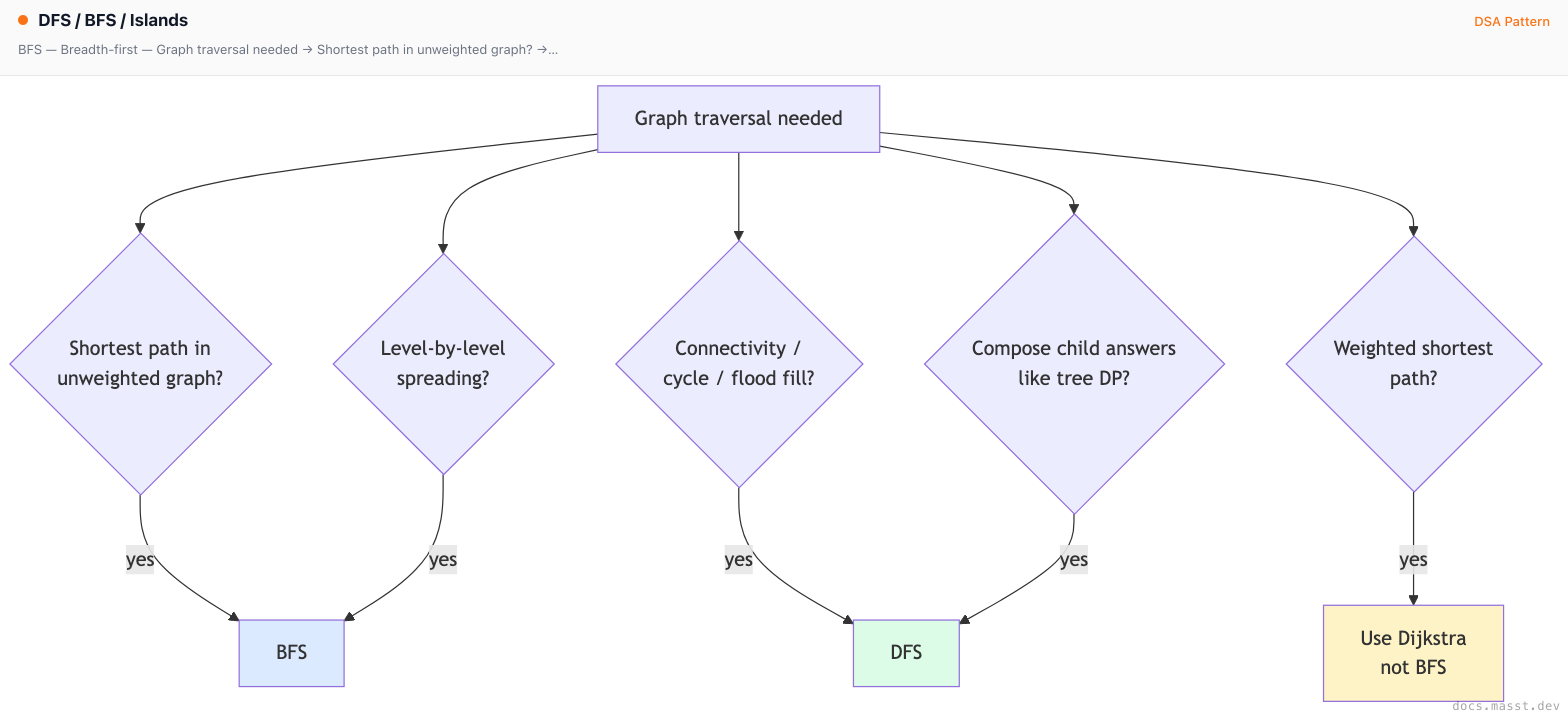
Generic graph traversal — depth-first for connectivity and recursion-friendly problems; breadth-first for shortest path in unweighted graphs; flood fill for 2D grid problems.
10 min readInterview · DSA Patterns
TL;DR — DFS / BFS / Islands
Use when: you need to explore a graph (or 2D grid as implicit graph) — count connected components, find reachable nodes, shortest path in unweighted graphs, flood fill a region.
DFS — recursion or explicit stack. Goes as deep as possible before backtracking. Use for: connectivity, cycle detection, post-order composition, tree-like exploration.
BFS — queue. Explores by distance from the source. Use for: shortest path in unweighted graph, level-by-level processing, multi-source spreading.
Complexity: O(V + E) for sparse graphs, O(V²) for dense adjacency-matrix representations.
Number of Islands (LC 200). Given an m × n binary grid where '1' is land and '0' is water, count the number of islands. An island is a maximal group of '1's connected horizontally or vertically.
Example:
11000110000010000011
→ 3 islands.
Naive brute force: not obvious. You'd have to compare every cell to every other to figure out which connected components exist. That's O((mn)²).
Insight: walk the grid cell by cell. When you find an unvisited '1', start a search from it (DFS or BFS) and mark every connected land cell as visited. That whole search counts as one island. Repeat until every cell is checked.
def num_islands(grid):
    if not grid: return 0
    m, n = len(grid), len(grid[0])
    count = 0

    def dfs(r, c):
        if r < 0 or r >= m or c < 0 or c >= n or grid[r][c] != '1':
            return
        grid[r][c] = '#'                              # mark as visited
        dfs(r+1, c); dfs(r-1, c); dfs(r, c+1); dfs(r, c-1)

    for r in range(m):
        for c in range(n):
            if grid[r][c] == '1':
                count += 1
                dfs(r, c)
    return count
O(mn). Each cell is visited at most once. The double-loop is misleading — it doesn't make it O((mn)²). The outer loop scans for unvisited cells; the inner DFS marks them visited so the outer loop skips them next time.
This is the canonical 2D-grid-as-graph traversal. Once you see "grid of connected stuff," DFS or BFS is almost always the tool.
Graphs (and 2D grids) are explored either by going deep (DFS) or by going wide (BFS). The structural choice depends on what you need from the traversal.
Outer scan starts at (0,0). grid[0][0]='1' → count = 1, dfs(0,0). Mark (0,0)='#'. Visit (1,0)='1' → mark '#'. Visit (1,1)='1' → mark '#'. From (1,1), try (2,1)=0, (1,2)=0, etc. No further land. From (1,0), try (2,0)=0, (1,1)='#' visited. No further. From (0,0), try (0,1)='1' → mark '#'. (0,2)=0, etc. Visit (1,1)='#' visited. No more. DFS returns. Island 1 fully marked.Outer scan continues. (0,1) is '#'. (0,2)..(0,3)=0. (1,0)..(1,1)='#'. (1,2)..(1,3)=0.(2,0)..(2,1)=0. (2,2)='1' → count = 2, dfs(2,2). Marks (2,2). No neighbors.(2,3)=0. (3,0)..(3,2)=0. (3,3)='1' → count = 3, dfs(3,3). Marks (3,3).Result: 3.
Notice: each cell is visited exactly twice — once by the outer loop's scan, once by the DFS that touches it. Total: O(mn).
2 = rotten, 1 = fresh, 0 = empty. Each minute, every fresh orange adjacent to a rotten one becomes rotten. Return the minimum minutes for all oranges to rot, or -1 if impossible.
Multi-source BFS: start with ALL rotten oranges in the queue at minute 0.
Minute 0: Queue = [(0,0)] (the only rotten) Fresh count = 6Minute 1: Process (0,0). Its neighbors (0,1)=1 and (1,0)=1 become rotten. Queue for next minute = [(0,1), (1,0)] Fresh count = 4 Grid: 2 2 1 2 1 0 0 1 1Minute 2: Process (0,1) → (0,2)=1 rots. Process (1,0) → (1,1)=1 rots. Queue next = [(0,2), (1,1)] Fresh count = 2Minute 3: Process (0,2) → no fresh neighbors. Process (1,1) → (2,1)=1 rots. Queue next = [(2,1)] Fresh count = 1Minute 4: Process (2,1) → (2,2)=1 rots. Queue next = [(2,2)] Fresh count = 0Done. All rotten. Answer: 4.
The freeze-size trick (process all nodes at the current minute before incrementing) is what makes "minutes elapsed" come out correctly.
from collections import dequedef oranges_rotting(grid): m, n = len(grid), len(grid[0]) queue = deque() fresh = 0 for r in range(m): for c in range(n): if grid[r][c] == 2: queue.append((r, c)) elif grid[r][c] == 1: fresh += 1 minutes = 0 while queue and fresh > 0: size = len(queue) for _ in range(size): r, c = queue.popleft() for dr, dc in [(-1,0), (1,0), (0,-1), (0,1)]: nr, nc = r+dr, c+dc if 0 <= nr < m and 0 <= nc < n and grid[nr][nc] == 1: grid[nr][nc] = 2 fresh -= 1 queue.append((nr, nc)) minutes += 1 return minutes if fresh == 0 else -1
def dfs(graph, start):
    visited = set()
    def visit(node):
        if node in visited: return
        visited.add(node)
        # process node here (pre-order)
        for neighbor in graph[node]:
            visit(neighbor)
        # process node here (post-order)
    visit(start)
Iterative version (when recursion depth is a concern):
def dfs_iterative(graph, start):
    visited = {start}
    stack = [start]
    while stack:
        node = stack.pop()
        # process node
        for neighbor in graph[node]:
            if neighbor not in visited:
                visited.add(neighbor)
                stack.append(neighbor)
from collections import dequedef bfs(graph, start, target): visited = {start} queue = deque([(start, 0)]) # (node, distance) while queue: node, dist = queue.popleft() if node == target: return dist for neighbor in graph[node]: if neighbor not in visited: visited.add(neighbor) # mark when enqueued, not when popped queue.append((neighbor, dist + 1)) return -1 # unreachable
Critical detail: mark visited when enqueueing, not when popping. Otherwise the same node gets queued multiple times before any of them get processed, blowing up runtime.
DIRS = [(-1, 0), (1, 0), (0, -1), (0, 1)] # 4-connectivitydef dfs_grid(grid, r, c): m, n = len(grid), len(grid[0]) if r < 0 or r >= m or c < 0 or c >= n: return if grid[r][c] != '1': return grid[r][c] = '#' # mark visited in place for dr, dc in DIRS: dfs_grid(grid, r + dr, c + dc)
For 8-connectivity (including diagonals), use 8 directions.
def multi_source_bfs(grid, sources):
    m, n = len(grid), len(grid[0])
    queue = deque(sources)
    visited = set(sources)
    dist = 0
    while queue:
        for _ in range(len(queue)):
            r, c = queue.popleft()
            for dr, dc in DIRS:
                nr, nc = r+dr, c+dc
                if 0 <= nr < m and 0 <= nc < n and (nr, nc) not in visited:
                    visited.add((nr, nc))
                    queue.append((nr, nc))
        dist += 1
    return dist
The freeze-size trick gives you "distance from nearest source" naturally.
Problem. Given two words begin and end and a dictionary wordList, return the length of the shortest transformation sequence from begin to end such that:
Each adjacent pair differs by exactly one letter.
Each intermediate word must be in wordList.
Example: begin = "hit", end = "cog", wordList = ["hot","dot","dog","lot","log","cog"] → 5 (hit → hot → dot → dog → cog).
Why this is BFS. "Shortest" + "unweighted edges" = BFS. Each word is a node; an edge connects two words that differ by one letter. We want the minimum number of edges from begin to end.
The naive O(N²·L) approach: build the full graph by comparing every pair of words. For 5000 words of length 10, that's 25M comparisons × 10 = 250M ops. Too slow.
The trick — implicit graph via wildcards: for each word in the dictionary, generate all "patterns" by replacing each letter with *. e.g., "hot" generates "*ot", "h*t", "ho*". Index words by these patterns. To find neighbors of "hot", look up its three patterns and grab everything else there. O(N·L²) total.
from collections import defaultdict, dequedef ladder_length(begin: str, end: str, word_list: list[str]) -> int: if end not in word_list: return 0 word_set = set(word_list) L = len(begin) # Build pattern index: "*ot" -> ["hot", "dot", "lot"] patterns = defaultdict(list) for word in word_set: for i in range(L): patterns[word[:i] + '*' + word[i+1:]].append(word) # BFS visited = {begin} queue = deque([(begin, 1)]) # (word, steps_so_far) while queue: word, steps = queue.popleft() if word == end: return steps for i in range(L): pattern = word[:i] + '*' + word[i+1:] for neighbor in patterns[pattern]: if neighbor not in visited: visited.add(neighbor) queue.append((neighbor, steps + 1)) patterns[pattern] = [] # clear to avoid re-checking return 0
Dry-run on the example:
Patterns built:
*ot: hot, dot, lot
h*t: hot
ho*: hot
d*t: dot
do*: dot, dog
l*t: lot
lo*: lot, log
*og: dog, log, cog
d*g: dog
l*g: log
c*g: cog
co*: cog
BFS from hit:
Step
Pop
Patterns of word
Neighbors found
1
(hit, 1)
*it, h*t, hi*
hot (via h*t)
2
(hot, 2)
*ot, h*t, ho*
dot, lot (via *ot)
3
(dot, 3)
*ot, d*t, do*
dog (via do*)
4
(lot, 3)
*ot, l*t, lo*
log (via lo*)
5
(dog, 4)
*og, d*g, do*
cog, log (log already visited)
6
(log, 4)
*og, l*g, lo*
already visited
7
(cog, 5)
matches end → return 5 ✓
Complexity. O(N·L²) — N words, L = length, L² patterns per word (each takes O(L) to build). Plus BFS itself is O(N·L) edges × O(L) for the work per visit.
The canonical 2D flood-fill. Outer scan; on unvisited land, run DFS/BFS to consume the whole island; count.
Canonical problems: 200 Number of Islands, 695 Max Area of Island, 463 Island Perimeter, 1254 Number of Closed Islands, 547 Number of Provinces (adjacency-matrix version).
Run DFS/BFS from the boundary to mark cells that can "escape." Anything not marked is fully surrounded.
def solve(board):
    if not board: return
    m, n = len(board), len(board[0])
    def dfs(r, c):
        if r < 0 or r >= m or c < 0 or c >= n or board[r][c] != 'O':
            return
        board[r][c] = 'S'                              # safe (anchored to border)
        for dr, dc in DIRS: dfs(r+dr, c+dc)
    for r in range(m):
        dfs(r, 0); dfs(r, n-1)
    for c in range(n):
        dfs(0, c); dfs(m-1, c)
    for r in range(m):
        for c in range(n):
            board[r][c] = 'X' if board[r][c] == 'O' else ('O' if board[r][c] == 'S' else 'X')
Canonical problems: 130 Surrounded Regions, 1020 Number of Enclaves, 417 Pacific Atlantic Water Flow.
Canonical problems: 127 Word Ladder (this page's worked example), 433 Minimum Genetic Mutation, 752 Open the Lock, 1129 Shortest Path with Alternating Colors.
DFS with three colors: WHITE (unvisited), GRAY (on current path), BLACK (done). Revisiting a GRAY means a cycle.
def has_cycle(graph, n):
    WHITE, GRAY, BLACK = 0, 1, 2
    color = [WHITE] * n
    def dfs(node):
        if color[node] == GRAY: return True            # back edge → cycle
        if color[node] == BLACK: return False
        color[node] = GRAY
        for nb in graph[node]:
            if dfs(nb): return True
        color[node] = BLACK
        return False
    return any(dfs(i) for i in range(n) if color[i] == WHITE)
Canonical problems: 207 Course Schedule (also see Topological Sort), 261 Graph Valid Tree, 684 Redundant Connection (also see Union-Find).
For shortest-path problems with a known target, BFS from both ends and meet in the middle. Cuts complexity from O(b^d) to O(b^(d/2)).
def bidirectional_bfs(start, end, get_neighbors):
    if start == end: return 0
    front, back = {start}, {end}
    visited = {start, end}
    steps = 0
    while front and back:
        if len(front) > len(back): front, back = back, front
        steps += 1
        next_front = set()
        for node in front:
            for nb in get_neighbors(node):
                if nb in back: return steps
                if nb not in visited:
                    visited.add(nb)
                    next_front.add(nb)
        front = next_front
    return -1
Used in Word Ladder for big dictionaries, LinkedIn's degree-of-connection — see LinkedIn Connections.
Pre-order DFS with a hash map original_node → cloned_node. Each node creates its clone first, then recurses to clone its neighbors.
def clone_graph(node):
    if not node: return None
    clones = {}
    def dfs(n):
        if n in clones: return clones[n]
        clone = Node(n.val)
        clones[n] = clone
        clone.neighbors = [dfs(nb) for nb in n.neighbors]
        return clone
    return dfs(node)
Canonical problems: 133 Clone Graph, 138 Copy List with Random Pointer (linked-list variant).
Time: O(V + E) for adjacency-list-based graphs. Each vertex is visited once; each edge is traversed at most twice (once in each direction for undirected).
Space: O(V) for the visited set / queue / recursion stack.
For 2D grids of size m × n treated as graphs: O(mn) time (each cell is V; each edge to a neighbor is E, but there are only 4 edges per cell so E = O(V)).
For dense graphs represented as an adjacency matrix: O(V²) per traversal (you scan the full row for each node).
Bidirectional BFS cuts complexity to O(b^(d/2)) where b is branching factor and d is solution depth — huge for deep search trees.
DIRS = [(-1,0), (1,0), (0,-1), (0,1)]# DFS on grid (recursive)def dfs(r, c): if r<0 or r>=m or c<0 or c>=n or grid[r][c] != '1': return grid[r][c] = '#' for dr, dc in DIRS: dfs(r+dr, c+dc)# BFS on grid (single source, level-aware)from collections import dequeq = deque([(sr, sc)]); visited = {(sr, sc)}; steps = 0while q: for _ in range(len(q)): r, c = q.popleft() for dr, dc in DIRS: nr, nc = r+dr, c+dc if (0<=nr<m and 0<=nc<n and (nr,nc) not in visited): visited.add((nr,nc)); q.append((nr,nc)) steps += 1# Multi-source BFSq = deque(initial_sources); visited = set(initial_sources)# ... same loop ...# DFS on graph (cycle detection, 3-color)WHITE, GRAY, BLACK = 0, 1, 2color = [WHITE] * ndef dfs(u): if color[u] == GRAY: return True # cycle if color[u] == BLACK: return False color[u] = GRAY for v in graph[u]: if dfs(v): return True color[u] = BLACK return False