
DSA Patterns
25 patterns that cover ~85% of FAANG-style interview problems. Each is teachable in one diagram and one template.
You don't memorize 3,000 LeetCode problems. You learn ~25 patterns and a checklist for recognizing which pattern matches a given problem.
This is a curated reference, not a solution archive. Every page teaches:
- What to look for in the problem statement to know this pattern applies
- The invariant the pattern preserves (the "why it works")
- A canonical template you can adapt to any problem in the family
- A worked example showing the template applied end-to-end
- Variants, pitfalls, and curated practice problems linked to LeetCode
The 25 patterns
Arrays & Strings
Two Pointers, Sliding Window, Prefix Sums, Binary Search, Hashing, Intervals & Greedy
Stacks & Queues
Monotonic Stack and Deque
Linked List
Reverse, merge, fast/slow, cycle detection
Trees
Traversals, BST, Trie
Graphs
DFS/BFS, Topological Sort, Union-Find, Shortest Paths
Heaps
Top-K, K-way Merge, Two Heaps
Recursion & Search
Backtracking and Cyclic Sort
Dynamic Programming
Linear, 2D Grid, Knapsack, Intervals, Tree DP, Bitmask
Bit Tricks
XOR, masks-as-sets, n & (n-1)
How to learn DSA in 10 weeks
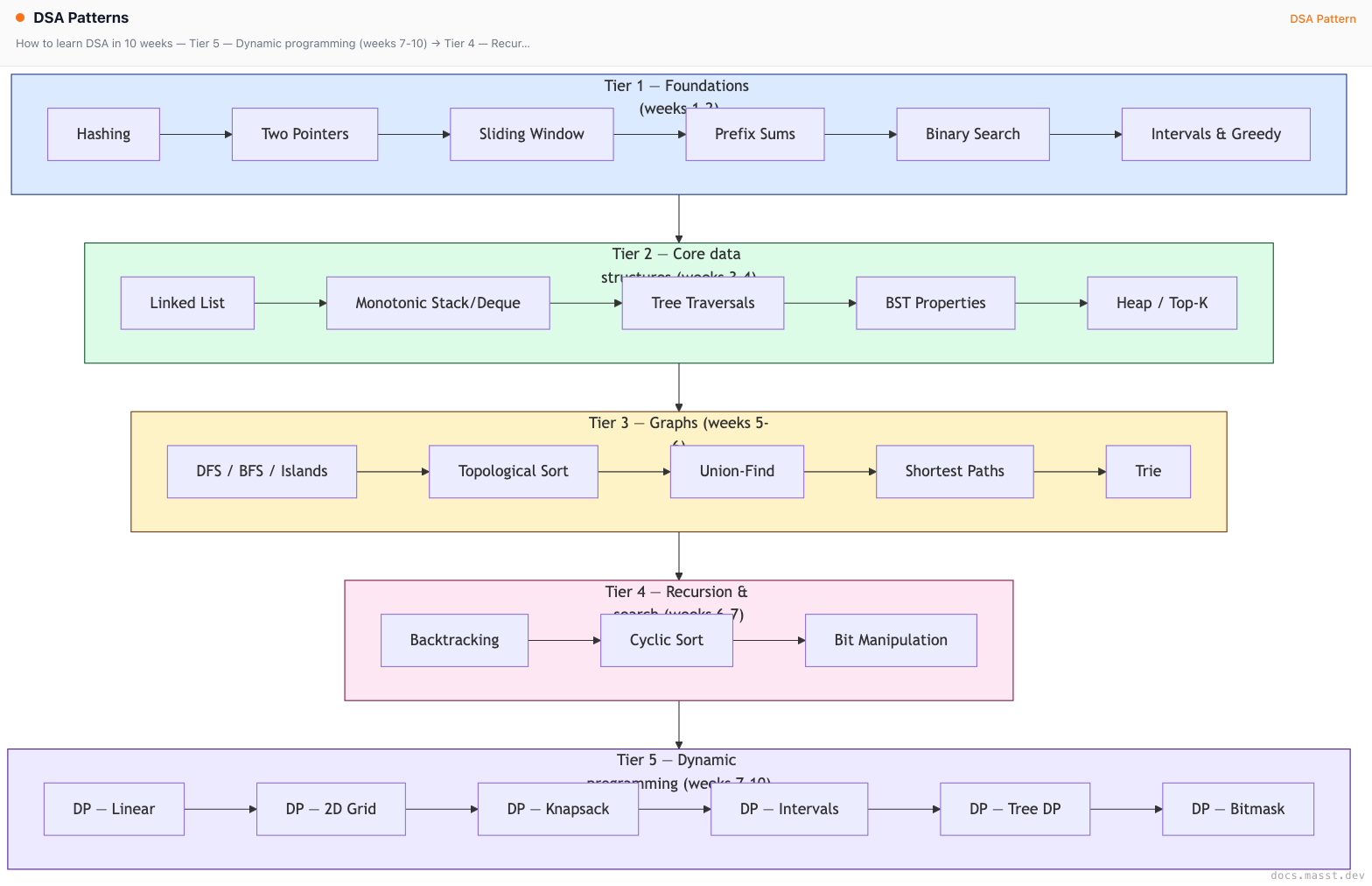
The order matters. The Tier 1 patterns unlock ~40% of interview problems. Tier 3 (graphs) and Tier 5 (DP) are the gates that block most candidates — earn them last, after you're fluent in the basics.
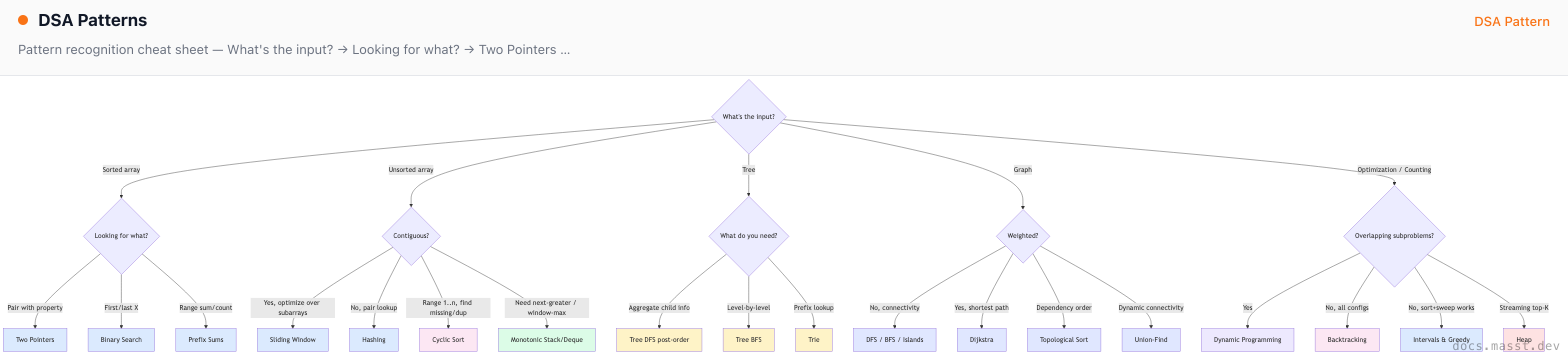
Pattern recognition cheat sheet
The single most useful skill in DSA interviews is mapping problem phrasing → pattern in the first 30 seconds. Here's the decision tree:
What's covered (and what's not)
Covered (the 25 patterns above)
These cover roughly 85% of problems asked in FAANG-style interviews. They're the patterns NeetCode, takeUforward, Grokking, and AlgoMonster all agree are essential.
Deliberately skipped
- String matching algorithms (KMP, Z, Manacher, Aho-Corasick, Suffix Arrays) — virtually never asked at FAANG SWE level
- Segment Tree, Fenwick/BIT, Sparse Table — competitive programming territory
- Bridges, Articulation Points, Tarjan / Kosaraju (SCC) — rare in interviews
- DP optimizations (convex hull trick, divide-and-conquer optimization, Knuth) — competitive programming
- Digit DP, Game Theory / Minimax, Geometry — < 1% of FAANG questions
If you're prepping for ICPC or Codeforces Div 1, you'll want a separate reference for these. For SWE interviews, the 25 patterns here are enough.
How to use this section
Mode A — learning from scratch. Follow the Tier 1 → Tier 5 order. Each page is self-contained, takes ~20 minutes to read, and links to 8–15 curated LeetCode problems. Do at least 3 problems per pattern before moving on.
Mode B — refreshing before a problem. Each page has a TL;DR card at the top with the template and trigger conditions. 30 seconds gets you back into the pattern.
Mode C — pattern recognition during interview prep. Use the decision tree above + the "Trigger Conditions" section on each page. Practice mapping a problem statement to a pattern in 30 seconds before you write any code.
Related sections
- System Design (HLD) — the architecture layer
- HLD Case Studies — real systems like Netflix, Uber, WhatsApp
- LLD & Patterns — OOP, GoF patterns, machine coding
DSA shows up inside many LLD case studies — LRU Cache uses a linked list, LinkedIn Connections uses BFS, Movie Booking uses interval reasoning. The cross-links go both ways.