
Prefix Sums & Difference Arrays
Precompute cumulative sums for O(1) range queries (prefix sum) and O(1) range updates (difference array). They are inverses of each other.
TL;DR — Prefix Sums & Difference Arrays
Use when: many range queries (prefix sum) or many range updates (difference array), or "count subarrays with sum X" (prefix sum + hashmap).
Trigger phrases: "sum of range [i, j]", "subarray sum equals K", "range updates then a final read", "increment range [l, r] by v many times".
Two duals:
- Prefix sum turns O(n) range queries into O(1), at the cost of O(n) one-time preprocessing.
- Difference array turns O(n) range updates into O(1), at the cost of O(n) one-time finalization.
Complexity: O(n) preprocessing + O(1) per operation.
The problem that motivates this pattern
Range Sum Query — Immutable. Given an integer array
nums, design a class that supportssumRange(left, right)returning the sum of elements from indexlefttorightinclusive. The array doesn't change.
Naive: each sumRange call loops from left to right. O(n) per query. With Q queries, O(Q · n). For Q = n = 10⁵, that's 10¹⁰ — too slow.
Insight: if we precompute prefix[i] = nums[0] + nums[1] + ... + nums[i-1] (sum of the first i elements), then the sum of [left, right] is just prefix[right + 1] - prefix[left]. One subtraction. O(1) per query, after O(n) preprocessing.
nums   = [3, 1, 4, 1, 5, 9, 2, 6]
prefix = [0, 3, 4, 8, 9, 14, 23, 25, 31]
         ↑                            ↑
       prefix[0]=0               prefix[8]=sum of all 8
sumRange(2, 5) = prefix[6] - prefix[2] = 23 - 4 = 19. Verify: 4 + 1 + 5 + 9 = 19 ✓.
This is the pain prefix sums relieve: turning O(n) range work into O(1) by paying O(n) upfront.
The dual problem motivates the difference array:
Corporate Flight Bookings. Given
nflights numbered 1..n and a list of bookings[first, last, seats]meaning "addseatsto every flight in[first, last]", return the seat count for each flight.
Naive: each booking loops from first to last adding seats. O(B · n) for B bookings. For B = n = 10⁵, again 10¹⁰.
Insight: instead of writing to every cell in the range, write only the endpoints: +seats at first, -seats at last+1. Take a prefix sum at the end. Each booking is O(1); finalization is O(n).
n=5, bookings = [[1,2,10], [2,3,20], [2,5,25]]
diff = [0, 0, 0, 0, 0, 0]

booking [1,2,10]:  diff[1]+=10, diff[3]-=10  →  [0, 10, 0, -10, 0, 0]
booking [2,3,20]:  diff[2]+=20, diff[4]-=20  →  [0, 10, 20, -10, -20, 0]
booking [2,5,25]:  diff[2]+=25, diff[6]-=25  →  [0, 10, 45, -10, -20, 0]   (idx 6 out of range, ignored)

prefix sum   →  [0, 10, 55, 45, 25, 25]
answer (1..5) → [10, 55, 45, 25, 25]
The same prefix[i+1] - prefix[i] = original[i] relationship that powers prefix sums runs the other way in a difference array. They're duals.
The core insight
Prefix sums and difference arrays are the same idea, run in opposite directions.
Let P be the prefix-sum array of A. Then:
P[i] = A[0] + A[1] + ... + A[i-1](forward)A[i] = P[i+1] - P[i](inverse)
So prefix-sum is integration and difference is differentiation. The invariant powering both:
At every index
i, the cumulative effect of all operations on celliis encoded in O(1) bookkeeping.
For prefix sums: that bookkeeping is P[i+1] - P[L], the cumulative-sum delta over a range. For difference arrays: that bookkeeping is the sum of +v and -v markers at the range endpoints, finalized by one sweep.
The deeper insight: range queries and range updates are dual problems, and the choice of which to make O(1) depends on which is more frequent.
| Read-heavy | Update-heavy | Both heavy |
|---|---|---|
| Prefix sum | Difference array | Segment Tree / Fenwick (out of scope here) |
Visual walkthrough — prefix sums
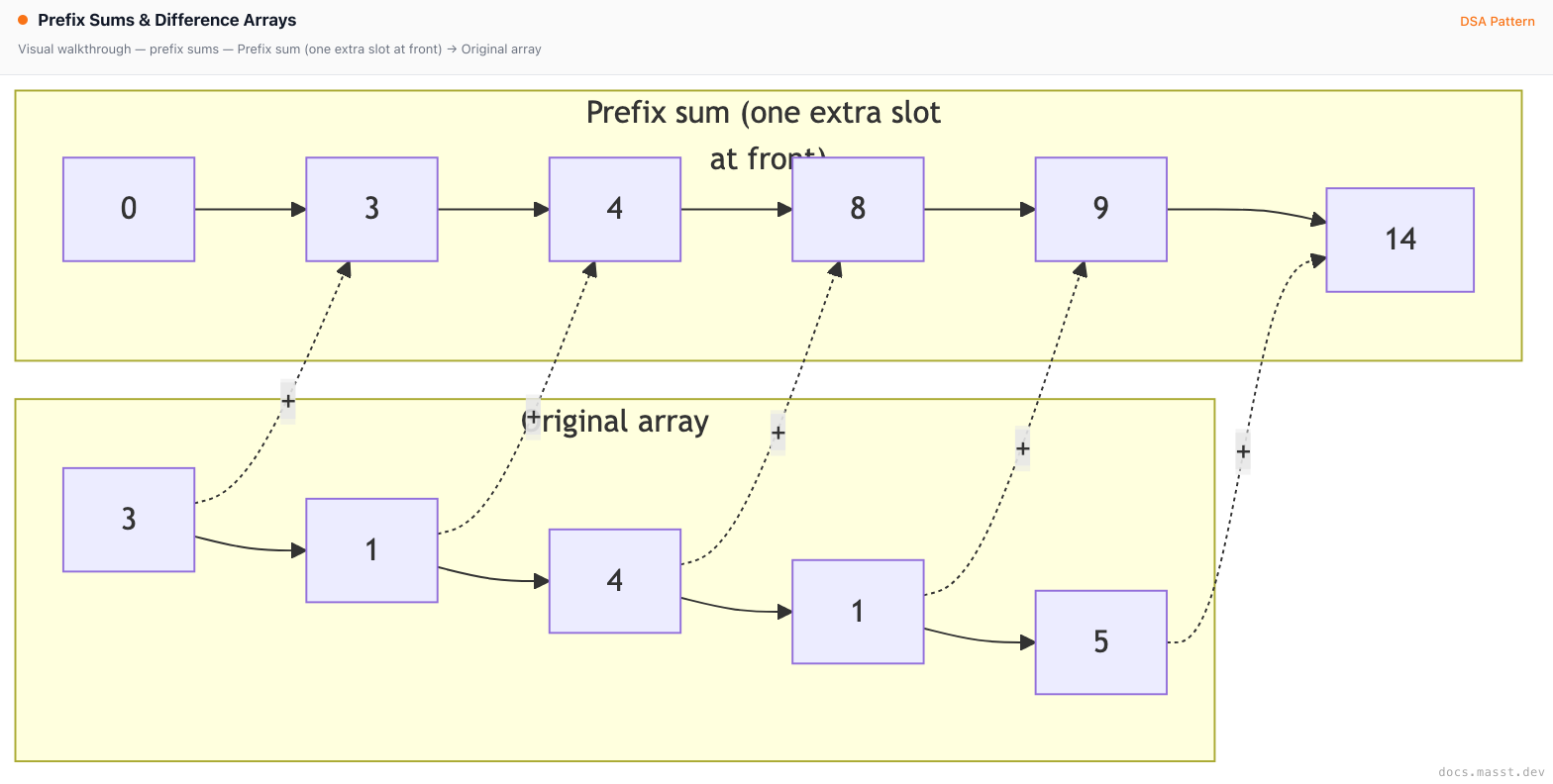
Query: sum of [1, 3] (elements 1, 4, 1).
P[4] - P[1] = 9 - 3 = 6. Verify: 1 + 4 + 1 = 6 ✓.
The off-by-one: P[i] is the sum of the first i elements. So P[right+1] - P[left] gives [left, right] inclusive. The "+1" matters; people get this wrong constantly.
Visual walkthrough — difference array

Each range update [L, R] += v touches two cells: +v at L and -v at R+1. After all updates, run a single prefix-sum pass to materialize the actual values.
The template
Template A — Prefix sum (for range queries)
class PrefixSum:
    def __init__(self, nums):
        n = len(nums)
        self.prefix = [0] * (n + 1)
        for i in range(n):
            self.prefix[i + 1] = self.prefix[i] + nums[i]

    def sum_range(self, left, right):
        return self.prefix[right + 1] - self.prefix[left]
Template B — Difference array (for range updates)
def apply_range_updates(n, updates):
    diff = [0] * (n + 1)            # +1 for the right boundary
    for left, right, val in updates:
        diff[left] += val
        diff[right + 1] -= val

    # Take prefix sum to recover the final array
    result = [0] * n
    result[0] = diff[0]
    for i in range(1, n):
        result[i] = result[i - 1] + diff[i]
    return result
Template C — Prefix sum + hash map (for "subarrays with sum K")
The combo. Use prefix sum to express "sum of [i+1, j] equals K" as P[j+1] - P[i+1] = K, then ask "how many P[i+1] equal P[j+1] - K?" — a hash-map lookup.
def subarray_sum_equals_k(nums, k):
    count = 0
    cumsum = 0
    seen = {0: 1}                    # prefix=0 occurs once (empty prefix)
    for x in nums:
        cumsum += x
        count += seen.get(cumsum - k, 0)
        seen[cumsum] = seen.get(cumsum, 0) + 1
    return count
This is the most-tested variant in interviews.
Worked example: Subarray Sum Equals K (LC 560)
Problem. Given an array
numsand integerk, return the total number of subarrays whose sum equalsk. Example:nums = [1, 1, 1],k = 2→2.
Why this is prefix sum. "Subarray sum equals K" is the canonical trigger. Brute force is O(n²) (try every (i, j)). Prefix sum + hash map drops it to O(n).
The reformulation. Let P[i] be the prefix sum after the first i elements. The sum of subarray nums[i..j] is P[j+1] - P[i]. We want P[j+1] - P[i] = k, i.e., for each j, count the number of earlier prefix sums equal to P[j+1] - k.
def subarray_sum(nums: list[int], k: int) -> int:
    count = 0
    cumsum = 0
    seen = {0: 1}                          # empty prefix has sum 0
    for x in nums:
        cumsum += x
        count += seen.get(cumsum - k, 0)
        seen[cumsum] = seen.get(cumsum, 0) + 1
    return count
Dry-run on nums = [1, 1, 1], k = 2:
| i | nums[i] | cumsum | want = cumsum - k | seen.get(want)? | count | seen after |
|---|---|---|---|---|---|---|
| 0 | 1 | 1 | -1 | 0 | 0 | {0:1, 1:1} |
| 1 | 1 | 2 | 0 | 1 | 1 | {0:1, 1:1, 2:1} |
| 2 | 1 | 3 | 1 | 1 | 2 | {0:1, 1:1, 2:1, 3:1} |
Final: 2 (the subarrays [1,1] at indices 0..1 and 1..2).
Why seen = {0: 1} initially? Because of the empty prefix. A subarray starting at index 0 has its "earlier prefix sum" equal to 0. Without this seed, we'd miss subarrays whose own prefix equals exactly k.
Complexity. O(n) time, O(n) space.
Variants
Variant 1 — 1D prefix sum (the basic case)
Range-sum queries on an immutable array. Build once, query many times.
Canonical problems: 303 Range Sum Query — Immutable, 1480 Running Sum of 1D Array.
Variant 2 — 2D prefix sum
Same idea, two dimensions. P[i][j] = sum of the rectangle from (0,0) to (i-1, j-1). Range sum of rectangle (r1, c1) to (r2, c2):
sum = P[r2+1][c2+1] - P[r1][c2+1] - P[r2+1][c1] + P[r1][c1](Inclusion-exclusion: subtract the two strips, add back the corner counted twice.)
Canonical problem: 304 Range Sum Query 2D — Immutable, 1314 Matrix Block Sum.
Variant 3 — Prefix XOR
Same template, replace + with ^. The identity A ^ A = 0 makes XOR perfect for "subarray XOR equals K" problems.
prefix_xor = 0
seen = {0: 1}
count = 0
for x in nums:
    prefix_xor ^= x
    count += seen.get(prefix_xor ^ k, 0)
    seen[prefix_xor] = seen.get(prefix_xor, 0) + 1
Canonical problem: 1310 XOR Queries of a Subarray.
Variant 4 — Difference array (1D)
The dual: O(1) range updates, O(n) finalization. Used when updates dominate queries.
Canonical problems: 1109 Corporate Flight Bookings, 1854 Maximum Population Year, 252/253 Meeting Rooms II (sweep-line variant), 370 Range Addition.
Variant 5 — Difference array (2D / imos method)
For range updates on a 2D grid. Mark four corners per update:
diff[r1][c1]   += v
diff[r1][c2+1] -= v
diff[r2+1][c1] -= v
diff[r2+1][c2+1] += v
Then run 2D prefix sum to finalize. O(updates) + O(rows × cols).
Canonical problem: 2536 Increment Submatrices by One.
Variant 6 — Prefix sum + modular arithmetic
For "subarrays with sum divisible by K," use prefix mod K as the hash key instead of prefix - k.
Canonical problem: 974 Subarray Sums Divisible by K, 523 Continuous Subarray Sum.
Common pitfalls
| Trap | Fix |
|---|---|
Off-by-one: writing P[right] - P[left] instead of P[right+1] - P[left] | Always allocate prefix with n+1 slots; cleaner indexing |
Forgetting to seed seen = {0: 1} in the hash-map variant | Without it, you miss subarrays starting at index 0 |
In difference array, writing diff[right] instead of diff[right+1] | Subtract at right+1 so the cumulative effect ends after right |
Allocating diff with size n instead of n+1 for difference array | Need the extra slot for the right+1 sentinel |
| Building prefix sum every query instead of once | Build O(n) once; query O(1) many times |
Using subtraction on int types that overflow | In languages without arbitrary precision (Java, C++), use long |
| 2D off-by-one: forgetting the inclusion-exclusion correction | The 4-term formula is P[r2+1][c2+1] - P[r1][c2+1] - P[r2+1][c1] + P[r1][c1] |
| Confusing prefix-sum-of-difference-array with original | They're inverses: prefix-sum the diff array to recover; differentiate the prefix array to revert |
Complexity
Prefix sum. O(n) build, O(1) query. O(n) space.
Difference array. O(1) per update, O(n) finalization. O(n) space.
Prefix sum + hash map (subarray-sum-equals-K variants). O(n) time, O(n) space.
2D variants. O(rows × cols) build/finalize, O(1) per query/update.
The pattern shines when the number of queries (or updates) is at least Θ(n). If you only have a constant number of range operations, just do them naively.
When NOT to use prefix sums / difference arrays
- The array is mutable and you have both range updates AND range queries interleaved. Prefix sum invalidates on every update (O(n) to rebuild). Use a Segment Tree or Fenwick Tree (BIT) — out of scope here but the next step up.
- The operation isn't associative / invertible. Prefix sum works because
+has an inverse (-). For "min of range" or "GCD of range," you can't use prefix-sum — you need a Sparse Table or Segment Tree. - You need to compute a range product but the values can be zero. Prefix product fails: dividing by zero is undefined. Use a different approach.
- The constraint is non-monotonic in the prefix array. "Longest subarray with sum at most K" on an array with negatives — the prefix sums aren't monotonic, so Sliding Window breaks too. Use a monotonic deque or different framing.
- Single query only. Just sum directly — no need for the precomputation overhead.
Decision rule
| Symptom | Likely pattern |
|---|---|
| "Range sum, many queries, immutable" | Prefix Sum |
| "Range sum, many updates AND queries" | Segment Tree / Fenwick (advanced) |
| "Range update, single final read" | Difference Array |
| "Count subarrays with sum = K" (signed integers) | Prefix Sum + Hash Map |
| "Count subarrays with sum = K" (only positives) | Sliding Window |
| "Range XOR" | Prefix XOR + Hash Map |
| "Range max/min" | Sparse Table (out of scope) |
Real-world applications
- Image processing — integral images. 2D prefix sums (called "summed-area tables") let you compute the sum of any rectangle in O(1). Used in face detection (Viola-Jones), image filtering, and OpenCV's
integral()function. - Database analytics. Cumulative-sum aggregates (
SUM(...) OVER (ORDER BY ...)in SQL) are exactly prefix sums precomputed for fast range queries. - Time series. Computing "average over the last K seconds" in a streaming system uses a sliding prefix sum.
- CDN cache analytics. "Number of requests in [t1, t2]" → 1D prefix sum over request counts per second.
- Sweep-line algorithms in computational geometry. Difference-array-like markers at event boundaries.
Curated practice problems
| # | Problem | Difficulty | Variant | Note |
|---|---|---|---|---|
| 1 | ★ 303 Range Sum Query — Immutable | Easy | 1D prefix | The canonical problem |
| 2 | 1480 Running Sum of 1D Array | Easy | 1D prefix | Just build the prefix |
| 3 | ★ 560 Subarray Sum Equals K | Medium | Prefix + Hash | This page's worked example |
| 4 | 974 Subarray Sums Divisible by K | Medium | Prefix mod K + Hash | Use remainders as keys |
| 5 | 523 Continuous Subarray Sum | Medium | Prefix mod K + Hash | Same trick, different output |
| 6 | 525 Contiguous Array | Medium | Prefix + Hash | Treat 0s as -1s, find subarray sum = 0 |
| 7 | ★ 304 Range Sum Query 2D — Immutable | Medium | 2D prefix | Inclusion-exclusion |
| 8 | 1314 Matrix Block Sum | Medium | 2D prefix | Sum of K×K neighborhood |
| 9 | ★ 1109 Corporate Flight Bookings | Medium | 1D difference | The canonical diff-array problem |
| 10 | 1854 Maximum Population Year | Easy | 1D difference | Diff-array on a small range |
| 11 | 370 Range Addition | Medium | 1D difference | The textbook diff-array problem |
| 12 | 2536 Increment Submatrices by One | Medium | 2D difference (imos) | 4-corner trick |
| 13 | 1310 XOR Queries of a Subarray | Medium | Prefix XOR | XOR instead of sum |
| 14 | 1248 Count Number of Nice Subarrays | Medium | Prefix + Hash | "Exactly K odds" → count of odd-prefix-counts |
| 15 | 437 Path Sum III | Medium | Prefix on tree | DFS with a running prefix-sum hashmap |
Related patterns
- Sliding Window — when the constraint is monotonic in window size; faster for "longest contiguous"
- Hashing — the hash map is the engine in "subarray-sum-equals-K" variants
- Binary Search — combined with prefix sums for "smallest subarray with sum ≥ K"
- Monotonic Deque — for max/min over windows when prefix sum doesn't apply
Quick-reference card
# Range sum (immutable)
prefix = [0] * (n + 1)
for i in range(n): prefix[i+1] = prefix[i] + nums[i]
sum_range = lambda l, r: prefix[r+1] - prefix[l]

# Subarray sum == K
cum, count, seen = 0, 0, {0: 1}
for x in nums:
    cum += x
    count += seen.get(cum - k, 0)
    seen[cum] = seen.get(cum, 0) + 1

# Range updates (difference array)
diff = [0] * (n + 1)
for l, r, v in updates: diff[l] += v; diff[r+1] -= v
for i in range(1, n): diff[i] += diff[i-1]
Triggers: range sum, subarray sum = K, many range updates. Complexity: O(n) preprocess, O(1) per op.
Finished reading?
Mark it done to track your progress in Interview.