
Two Pointers
Move two indices through an array (opposite or same direction) to find pairs, partition in place, or detect cycles in O(n) instead of O(n²).
TL;DR — Two Pointers
Use when: you'd otherwise need two nested loops over an array, and the input has structure you can exploit — sortedness, palindromic symmetry, in-place partitioning, or a linked-list cycle.
Trigger phrases: "sorted array", "pair sum equals", "remove duplicates in place", "palindrome", "cycle in linked list", "container with most water".
Two flavors: opposing (left/right close in toward each other) and same-direction (slow/fast move forward, often at different speeds).
Complexity: O(n) time, O(1) space.
The problem that motivates this pattern
Two Sum II — Input Array is Sorted. Given a 1-indexed sorted array of integers and a target sum, return the indices of the two numbers that add to the target.
Brute force is the same as plain Two Sum: every pair, O(n²). With hashing you can do it in O(n) time and O(n) space. But because the array is sorted, you can do it in O(n) time and O(1) space — no hash map needed.
That's the trade. Sortedness is information. The two-pointers pattern is how you spend it.
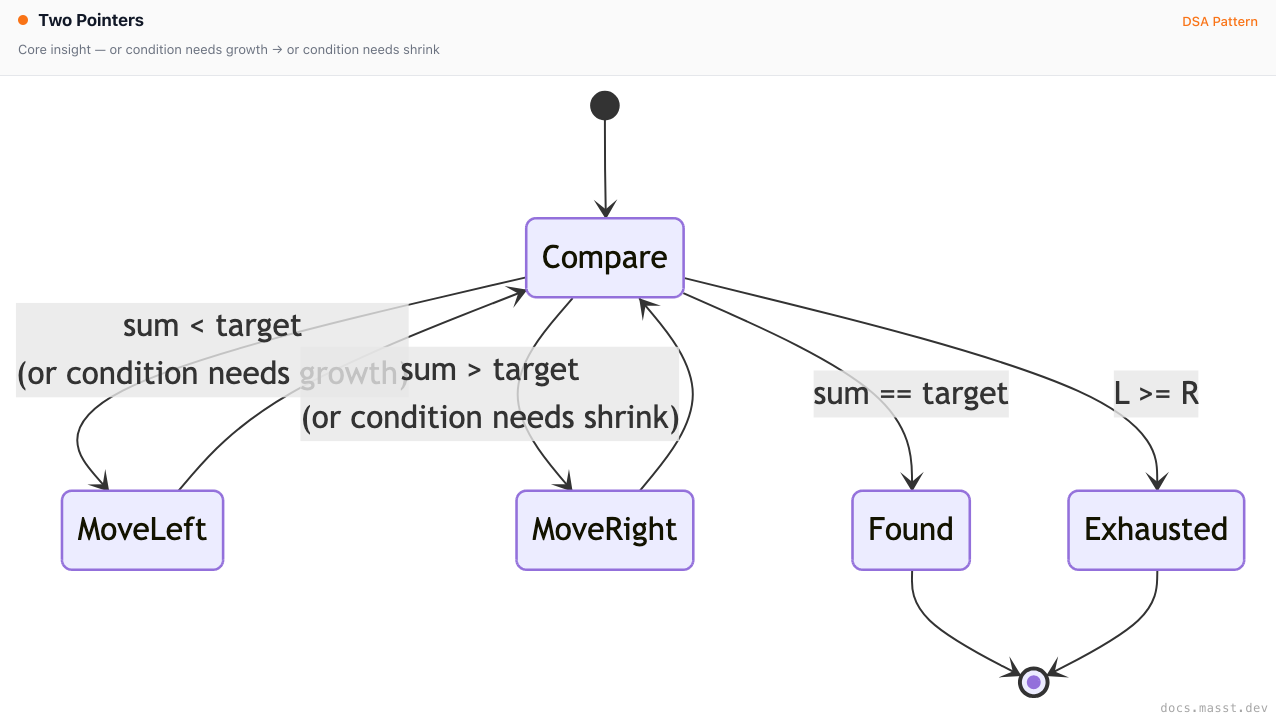
The idea: put one pointer at the start, one at the end. Read off the sum. If too small, increase it by moving the left pointer right (next-larger element). If too large, decrease it by moving the right pointer left. The pointers converge in O(n) total moves.
array = [2, 7, 11, 15], target = 9
        L           R       sum = 2 + 15 = 17 > 9   → R--
        L      R            sum = 2 + 11 = 13 > 9   → R--
        L  R                sum = 2 + 7 = 9          ✓ found
The brute force checked all 6 pairs. Two-pointers checked 3. On a million-element array, it's a million vs a trillion.
The core insight
Two pointers works when monotonicity lets us discard half the search space at every step.
In Two Sum II, when sum > target we know every pair (i, R') for any R' < R (with i = L) is also too small only if we'd already moved L — but more importantly, every pair (L, R) with the current L and larger R would only be larger. So the only pair worth checking with L is one where R is smaller. By moving R left, we discard R itself and all bigger-R combinations from consideration. Symmetrically when sum < target.
The invariant we maintain — and you should be able to say this out loud — is:
At every step, the answer (if one exists) is in the unexplored slice
[L, R]. Pointers never skip over a possible answer.
That invariant is what lets us terminate in O(n). Each iteration moves exactly one pointer by one step. The pointers meet in at most n iterations. We never revisit indices.
The same invariant powers the same-direction variant (Floyd's tortoise and hare, or in-place partitioning) — even though both pointers move in the same direction, the relative monotonicity ("slow lags fast by a known amount" or "everything before slow is partitioned") plays the role of the search-space shrink.
Visual walkthrough
Let's trace 3Sum on nums = [-1, 0, 1, 2, -1, -4], target 0.
Step 1. Sort: [-4, -1, -1, 0, 1, 2].
Step 2. Fix the first element at each index i. For each i, run two-pointers on the suffix to find pairs summing to -nums[i].
Iteration: i = 0, target = 4. Pointers L = 1, R = 5.
[-4, -1, -1, 0, 1, 2]
     L              R     sum = -1 + 2 = 1 < 4   → L++
[-4, -1, -1, 0, 1, 2]
         L          R     sum = -1 + 2 = 1 < 4   → L++
[-4, -1, -1, 0, 1, 2]
            L       R     sum = 0 + 2 = 2 < 4    → L++
[-4, -1, -1, 0, 1, 2]
               L    R     sum = 1 + 2 = 3 < 4    → L++
[-4, -1, -1, 0, 1, 2]
                  LR      L >= R, exit
No triplet with -4.
Iteration: i = 1, target = 1. Pointers L = 2, R = 5.
[-4, -1, -1, 0, 1, 2]
         L          R     sum = -1 + 2 = 1 ✓ found [-1, -1, 2]
Move both: L = 3, R = 4. sum = 0 + 1 = 1 ✓ found [-1, 0, 1]. Move both: L = R, exit.
Result: [[-1, -1, 2], [-1, 0, 1]].
The point: at iteration i = 1, we found both triplets in 2 moves — not in O(n²) checks. That's two-pointers paying off.
The template
There are two distinct two-pointer templates. Use opposing when the array is sorted; same-direction when you're scanning forward maintaining an invariant.
Template A — Opposing pointers (most common)
def opposing(arr):
    left, right = 0, len(arr) - 1
    while left < right:
        if condition(arr[left], arr[right]):
            return found(arr[left], arr[right])
        elif should_grow(arr[left], arr[right]):
            left += 1
        else:
            right -= 1
    return not_found
The three slots:
condition— when the pair satisfies the target (e.g.,arr[left] + arr[right] == target).should_grow— when to moveleftrightward to increase the candidate value.else— implicitly, moverightleftward.
Template B — Same-direction pointers (slow + fast)
def same_direction(arr):
    slow = 0
    for fast in range(len(arr)):
        if should_advance_slow(arr[fast]):
            arr[slow] = arr[fast]      # or some other update
            slow += 1
    return slow                         # often returns the new length
This is the in-place partitioning shape: slow marks the next slot to write into, fast reads through the array. Used for "Remove Duplicates from Sorted Array", "Move Zeroes", "Sort Colors" (Dutch flag), etc.
Template C — Floyd's Tortoise and Hare (same direction, different speeds)
def has_cycle(head):
    slow = fast = head
    while fast and fast.next:
        slow = slow.next            # 1 step
        fast = fast.next.next       # 2 steps
        if slow == fast:
            return True             # cycle detected
    return False
This is the cycle-detection specialization. Fast moves twice as fast as slow; if there's a cycle, they meet inside it within O(n) steps. Used in Linked List Cycle (141), Find Duplicate Number (287), Happy Number (202).
Worked example: 3Sum
Problem. Given an integer array
nums, return all unique triplets[a, b, c]wherea + b + c = 0. The solution set must not contain duplicate triplets. Example:nums = [-1, 0, 1, 2, -1, -4]→[[-1, -1, 2], [-1, 0, 1]].
Why this is two-pointers. Brute force is O(n³) — three nested loops. Hashing gets you to O(n²) with O(n) space. Two-pointers gets you O(n²) time with O(1) extra space (ignoring sort), and the "no duplicate triplets" requirement is much easier to handle on sorted input.
What changes from the template. Three slots:
- Outer loop: fix
nums[i]and run two-pointers on the suffix[i+1, n-1]to find pairs summing to-nums[i]. - Dedup: after finding a triplet, skip duplicates of
nums[left]andnums[right]. Also skip duplicates ofnums[i]in the outer loop. - Early exit: if
nums[i] > 0, no triplet can sum to 0 (since the suffix is sorted ≥nums[i]). Break.
def three_sum(nums: list[int]) -> list[list[int]]:
    nums.sort()
    ans = []
    n = len(nums)

    for i in range(n - 2):
        if nums[i] > 0:                              # early exit
            break
        if i > 0 and nums[i] == nums[i - 1]:         # skip outer dups
            continue

        left, right = i + 1, n - 1
        target = -nums[i]

        while left < right:
            s = nums[left] + nums[right]
            if s == target:
                ans.append([nums[i], nums[left], nums[right]])
                left += 1
                right -= 1
                while left < right and nums[left] == nums[left - 1]:
                    left += 1                         # skip inner dups
                while left < right and nums[right] == nums[right + 1]:
                    right -= 1
            elif s < target:
                left += 1
            else:
                right -= 1

    return ans
Dry-run on [-4, -1, -1, 0, 1, 2]:
| i | nums[i] | target | L→R trace | Found |
|---|---|---|---|---|
| 0 | -4 | 4 | Sum range = -1+2..1+2 = 1..3, never reaches 4 | none |
| 1 | -1 | 1 | (-1,2)=1✓, (0,1)=1✓ | [-1,-1,2], [-1,0,1] |
| 2 | -1 | — | skipped (dup of i=1) | — |
| 3 | 0 | 0 | (1,2)=3 too big, exit | none |
Complexity. O(n²) time — outer loop is O(n), inner two-pointer scan is O(n). O(log n) extra space (for the sort), O(1) ignoring sort.
Variants
Variant 1 — Opposing pointers on sorted array
The canonical shape. Used for pair-sum and triplet-sum problems on sorted input. Container With Most Water (11) is a clever variant where the "value" being computed is min(h[L], h[R]) * (R - L) — same shrink-the-smaller-side logic.
Canonical problems: 167 Two Sum II, 15 3Sum, 16 3Sum Closest, 11 Container With Most Water, 977 Squares of Sorted Array (merge from outside in).
Variant 2 — Same-direction (slow + fast) for in-place partitioning
Slow points to the next "write" slot; fast scans the array. Used to compact, deduplicate, or partition in place with O(1) extra space.
# Remove duplicates from sorted array
def remove_dups(nums):
    slow = 0
    for fast in range(len(nums)):
        if fast == 0 or nums[fast] != nums[fast - 1]:
            nums[slow] = nums[fast]
            slow += 1
    return slow
Canonical problems: 26 Remove Duplicates, 27 Remove Element, 283 Move Zeroes, 75 Sort Colors (Dutch national flag — three pointers, but same idea).
Variant 3 — Floyd's Tortoise and Hare (cycle detection)
Same-direction with different speeds. The classic application of two-pointers to linked lists or implicit-graph cycle detection.
Canonical problems: 141 Linked List Cycle, 142 Linked List Cycle II, 287 Find the Duplicate Number, 202 Happy Number.
Floyd's also detects the cycle start: after fast and slow meet, reset slow to the head; both move one step at a time; they meet at the cycle start. This is non-obvious — see Linked List for the proof.
Variant 4 — Meeting in the middle (palindrome check)
Opposing pointers, no sort needed — just symmetric comparison.
def is_palindrome(s):
    left, right = 0, len(s) - 1
    while left < right:
        if s[left] != s[right]:
            return False
        left += 1
        right -= 1
    return True
Canonical problems: 125 Valid Palindrome, 680 Valid Palindrome II (allow one deletion).
Common pitfalls
| Trap | Fix |
|---|---|
| Using two-pointers on an unsorted array for pair-sum | Sort first (O(n log n)) or switch to hashing |
| Forgetting to skip duplicates after finding a triplet | Always advance both pointers and skip equal neighbors |
Off-by-one with left <= right vs left < right | left < right for "two distinct indices"; left <= right for "include same index" (rare) |
| Moving both pointers when the condition fails | Move only one — the one that brings the sum closer to target |
| Same-direction template overwriting before reading | If fast and slow could alias, read first, then write |
In Floyd's, checking fast.next != null but not fast itself | Always check both fast and fast.next before fast = fast.next.next |
| Mistakenly thinking two-pointers needs sortedness | It doesn't — palindrome check, partitioning, and Floyd's don't sort |
Complexity
Time: O(n) for a single two-pointer pass. With an outer loop (3Sum), it becomes O(n²). With sort, add O(n log n) — but that's still dominated by the n² when present.
Space: O(1) auxiliary. This is the pattern's superpower over hashing: hash-based two-sum is O(n) time but O(n) space; sorted two-pointers is O(n log n) total but O(1) extra.
The amortized argument: each pointer moves at most n times total across the algorithm. They never revisit indices. So all work is bounded by 2n = O(n).
When NOT to use two pointers
- The array is unsorted and you can't sort. If sorting destroys the indexing the problem requires (e.g., "return indices into the original array"), and you need O(n), use hashing instead.
- You need to find triplets/k-tuples with constraints across all three. Two-pointers handles pair-sum after fixing one element. For "find four numbers that multiply to X," you may need a different approach.
- The condition isn't monotonic in pointer movement. If moving
leftright orrightleft doesn't predictably grow/shrink your target value, the pattern's invariant collapses. Use a different approach. - You need access to arbitrary indices inside the window. Two pointers exposes only the endpoints. For "median of window" or other interior queries, use heaps or another structure.
Decision rule
| Symptom | Likely pattern |
|---|---|
| "Pair summing to target, sorted array" | Two Pointers — opposing |
| "Pair summing to target, unsorted, return indices" | Hashing |
| "Triplet / quadruplet sum" | Two Pointers (fix one, two-point the rest) |
| "Container with most water" | Two Pointers — opposing |
| "Remove duplicates / partition in place" | Two Pointers — slow/fast |
| "Cycle in linked list" | Floyd's tortoise & hare |
| "Longest contiguous subarray with property" | Sliding Window |
| "Palindrome check" | Two Pointers — opposing |
Real-world applications
- Database join algorithms. Sort-merge join uses two pointers walking through two sorted indexes — exactly the same shape.
- Mergesort merge step. The classic merge of two sorted arrays is two pointers.
- DNA sequence comparison. Pairwise alignment scans use two-pointer walks across sequences.
- Garbage collectors. Mark-and-sweep compactors use a "scan" pointer (read) and a "free" pointer (write) — that's slow/fast.
Curated practice problems
| # | Problem | Difficulty | Variant | Note |
|---|---|---|---|---|
| 1 | ★ 167 Two Sum II — Sorted | Easy | Opposing | The canonical pair-sum |
| 2 | 125 Valid Palindrome | Easy | Opposing | Skip non-alphanumerics |
| 3 | 26 Remove Duplicates from Sorted Array | Easy | Slow/Fast | In-place |
| 4 | 283 Move Zeroes | Easy | Slow/Fast | Variant of partition |
| 5 | ★ 11 Container With Most Water | Medium | Opposing | "Shrink the smaller side" trick |
| 6 | ★ 15 3Sum | Medium | Opposing + outer loop | Dedup is the gotcha |
| 7 | 16 3Sum Closest | Medium | Opposing + outer loop | Track best, don't require equality |
| 8 | 18 4Sum | Medium | Opposing + 2 outer loops | Same template, one more nest |
| 9 | 75 Sort Colors | Medium | Three-pointer (Dutch flag) | Generalizes slow/fast |
| 10 | 680 Valid Palindrome II | Easy | Opposing | One-deletion allowance |
| 11 | ★ 141 Linked List Cycle | Easy | Floyd's | The classic |
| 12 | 142 Linked List Cycle II | Medium | Floyd's | Find cycle start |
| 13 | 287 Find the Duplicate Number | Medium | Floyd's on implicit graph | Treat array as linked list |
| 14 | 202 Happy Number | Easy | Floyd's on number sequence | |
| 15 | 977 Squares of Sorted Array | Easy | Opposing, build outward in | Merge from extremes |
Related patterns
- Sliding Window — when both pointers move in the same direction maintaining a contract
- Binary Search — when the search space is monotonic and you halve it (not walk it)
- Linked List Manipulation — Floyd's lives here for cycle problems
- Hashing — the alternative when you can't sort
Quick-reference card
# Opposing
left, right = 0, len(arr) - 1
while left < right:
    if cond(arr[left], arr[right]): return found
    elif should_grow: left += 1
    else: right -= 1

# Same-direction (slow/fast)
slow = 0
for fast in range(len(arr)):
    if keep(arr[fast]):
        arr[slow] = arr[fast]; slow += 1

# Floyd's
slow = fast = head
while fast and fast.next:
    slow, fast = slow.next, fast.next.next
    if slow == fast: return True
Triggers: sorted array + pair, in-place partition, palindrome, linked list cycle. Complexity: O(n) time, O(1) extra space.
Finished reading?
Mark it done to track your progress in Interview.