
DP — Bitmask
Use bits as a "set of used elements." dp[mask] iterates over 2^n states. The pattern for TSP, assignment problems, shortest-path-visiting-all-nodes, and "which subset have I taken" problems.
TL;DR — DP — Bitmask
Use when: the state of your problem is "which subset of n items has been used / visited / picked," and n ≤ 20. Beyond n ≈ 20, 2^n becomes infeasible.
Trigger phrases: "traveling salesman", "shortest path visiting all nodes", "partition to k equal sum subsets", "min cost to assign n tasks to n workers", "minimum incompatibility", "find shortest superstring".
The shape: dp[mask] or dp[mask][extra_state]. A bit set in mask means "this item is used/visited/picked."
Two operations:
- Iterate all masks:
for mask in range(1 << n). - Iterate sub-masks:
sub = mask; while sub > 0: ...; sub = (sub - 1) & mask.
Complexity: O(2^n · n) typical; O(3^n) for sub-mask enumeration over all masks.
The problem that motivates this pattern
Shortest Path Visiting All Nodes (LC 847). An undirected, connected graph of
nnodes. Return the length of the shortest path that visits every node. You may start and stop at any node, may revisit, and may reuse edges.
Brute force: try every permutation of node visits as a starting order. O(n!) — for n=12, that's ~500 million.
Insight: the state we care about is (current node, set of nodes visited so far). The "set of visited" can have up to 2^n values; the current node has n. State space = n · 2^n — for n=12, ~50K states. Feasible.
Transition: from state (u, mask), move to any neighbor v. New state: (v, mask | (1 << v)). Each edge contributes 1 step.
from collections import deque

def shortest_path_length(graph):
    n = len(graph)
    target = (1 << n) - 1                            # all bits set
    visited = set()
    queue = deque()

    for i in range(n):
        queue.append((i, 1 << i, 0))                 # (node, mask, distance)
        visited.add((i, 1 << i))

    while queue:
        node, mask, dist = queue.popleft()
        if mask == target: return dist
        for nb in graph[node]:
            new_mask = mask | (1 << nb)
            if (nb, new_mask) not in visited:
                visited.add((nb, new_mask))
                queue.append((nb, new_mask, dist + 1))
BFS-on-bitmask-state. n · 2^n states, each visited once. O(n · 2^n · degree).
The deeper insight: bitmask DP turns combinatorial "which subset" problems into polynomial-in-2^n algorithms. The trade: only works for n ≤ 20. But for small n with combinatorial structure (TSP, assignment, set cover), it's the only way to get an exact answer in reasonable time.
The core insight
A bitmask is an integer where each bit represents "is this element in the set?" Set operations become bit operations.
The invariant we maintain:
dp[mask](ordp[mask][extra]) is the optimal answer for any way of arriving at the state wheremask's bits represent which elements are used.
Three things to identify:
- What does the bitmask represent? Almost always "which elements have been processed/used/visited." Bit
iset ⇒ elementiis in the subset. - What's the extra state, if any? Sometimes you need "(current_position, mask)" — like TSP, where you also track the current city. Sometimes just
dp[mask]. - Transition: how do you extend the subset by one element?
The fundamental operations
# Test if bit i is set in mask
mask & (1 << i)

# Add element i to mask
mask | (1 << i)

# Remove element i from mask
mask & ~(1 << i)

# Toggle element i
mask ^ (1 << i)

# Iterate all elements in mask
i = 0
while (1 << i) <= mask:
    if mask & (1 << i):
        process(i)
    i += 1

# Iterate all subsets of mask (smaller-first by numeric value, decreasing)
sub = mask
while sub > 0:
    process(sub)
    sub = (sub - 1) & mask
process(0)                                           # empty subset
See Bit Manipulation for more on these.
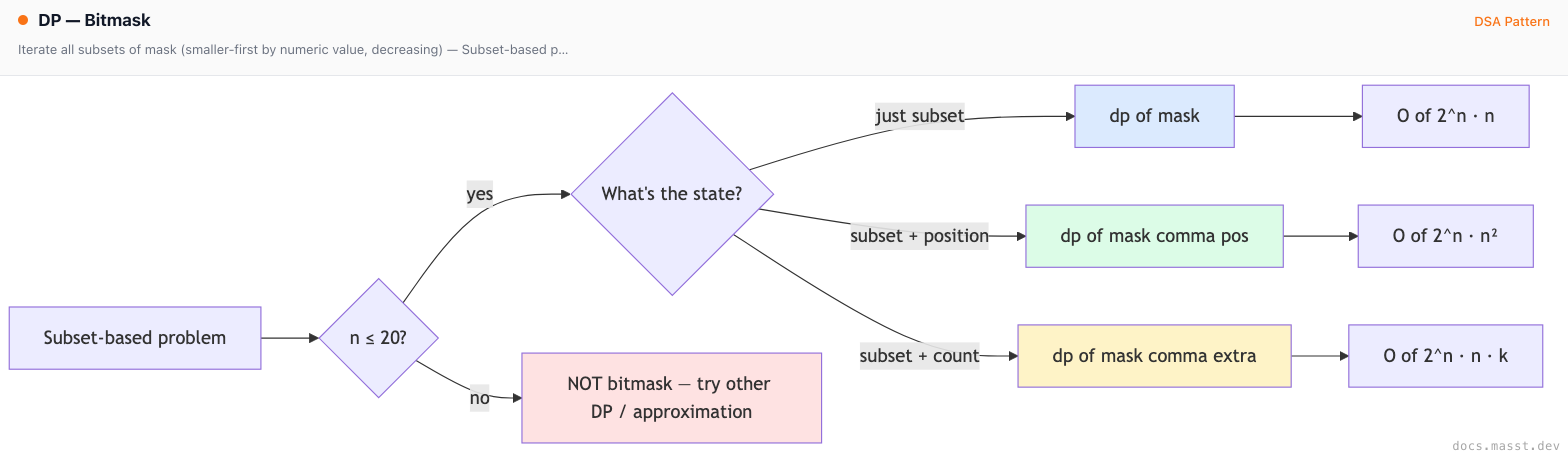
For n = 20: 2^n ≈ 10⁶. With another factor of n = 20: 20 million ops. Fast. For n = 25: 2^n ≈ 33M. With n = 25: nearly a billion. Slow but doable. For n = 30: 2^n ≈ 10⁹. Infeasible without massive optimization.
Visual walkthrough — Shortest Path Visiting All Nodes
3-node graph: 0—1—2.
States: (current_node, visited_mask). We start with (i, 1 << i, 0) for each i.
Initial queue: [(0, 001, 0), (1, 010, 0), (2, 100, 0)]

Step 1: pop (0, 001, 0). target = 111. Not target.
  Neighbors of 0: [1]. new state (1, 011, 1). Add.

Step 2: pop (1, 010, 0). Neighbors: [0, 2].
  (0, 011, 1) — already visited via different path, skip.
  (2, 110, 1). Add.

Step 3: pop (2, 100, 0). Neighbors: [1].
  (1, 110, 1). Add.

Step 4: pop (1, 011, 1). Neighbors: [0, 2].
  (0, 011) already visited (but we don't track (0, 011) explicitly — well we'd want to, but new visit changes mask). Actually (0, 011, 2) would be slower than going to 2.
  (2, 111, 2). 111 = target! Return 2.
Answer: 2 ✓.
The key: we visit each (node, mask) pair at most once. So we don't re-explore unproductive paths. The state space is n · 2^n, BFS visits each at most once → O(n · 2^n · degree).
The template
Template A — TSP (Traveling Salesman, Held-Karp)
def tsp(dist, n):
    """dist[i][j] = distance from city i to j. Returns shortest tour
    starting and ending at city 0."""
    INF = float('inf')
    # dp[mask][i] = min cost to start at 0, visit cities in mask, end at i
    dp = [[INF] * n for _ in range(1 << n)]
    dp[1][0] = 0                                      # start at 0, only 0 visited

    for mask in range(1 << n):
        if not (mask & 1): continue                   # must include city 0
        for u in range(n):
            if not (mask & (1 << u)): continue
            if dp[mask][u] == INF: continue
            for v in range(n):
                if mask & (1 << v): continue          # v already visited
                new_mask = mask | (1 << v)
                dp[new_mask][v] = min(dp[new_mask][v], dp[mask][u] + dist[u][v])

    full = (1 << n) - 1
    return min(dp[full][i] + dist[i][0] for i in range(1, n))
O(2^n · n²). For n = 15, ~7M ops. For n = 20, ~400M — slow but doable.
Three slots:
- State:
dp[mask][last_city]. - Transition: from
(mask, u)to(mask | (1 << v), v)for unvisitedv. - Final answer: minimize over all ending cities, adding the cost to return to start.
Template B — Partition / Assignment
# Min sum of max-per-group when partitioning into K groups (LC 1986-flavored)
def can_partition_k(nums, k):
    n = len(nums)
    if sum(nums) % k != 0: return False
    target = sum(nums) // k

    # dp[mask] = "after using items in mask, the current group's sum modulo target"
    # If we can make all bins, then dp[full] == 0 (we just completed a group).
    dp = [-1] * (1 << n)
    dp[0] = 0

    for mask in range(1 << n):
        if dp[mask] == -1: continue
        for i in range(n):
            if mask & (1 << i): continue
            if dp[mask] + nums[i] > target: continue
            new_mask = mask | (1 << i)
            dp[new_mask] = (dp[mask] + nums[i]) % target

    return dp[(1 << n) - 1] == 0
The trick: track current group's sum modulo target. When a group is "full" (sum == target), it wraps to 0; we implicitly start a new group.
Template C — Sub-mask enumeration (DP over subsets of subsets)
When the transition involves "split mask into two non-empty submasks," iterate sub-masks.
for mask in range(1, 1 << n):
    sub = mask
    while sub > 0:
        complement = mask ^ sub
        # process the partition (sub, complement)
        sub = (sub - 1) & mask
Total complexity: O(3^n) (the sum over all masks of 2^popcount(mask) is 3^n by the binomial theorem).
For n ≤ 16, 3^n ≈ 43M — feasible.
Worked example: Find the Shortest Superstring (LC 943)
Problem. Given an array of strings, find the shortest string that contains each
words[i]as a substring. If multiple answers, return any.Example:
words = ["catg", "ctaagt", "gcta", "ttca", "atgcatc"]→"gctaagttcatgcatc".
Why this is bitmask DP. We want to chain the words so each can overlap with the next, minimizing total length. The natural state: (last_word_used, set_of_words_in_chain).
For n words, state space is n · 2^n. For n=12, that's ~50K states. Workable.
Setup:
- Precompute
overlap[i][j]= length of longest suffix ofwords[i]that matches a prefix ofwords[j]. (This is the "savings" from joining them.) dp[mask][i]= (cost, parent) of the best way to reach the state "words in mask used, last word = i."- Cost = total length of resulting superstring.
def shortest_superstring(words: list[str]) -> str:
    n = len(words)

    # Precompute overlap[i][j]
    overlap = [[0] * n for _ in range(n)]
    for i in range(n):
        for j in range(n):
            if i == j: continue
            max_ov = min(len(words[i]), len(words[j]))
            for k in range(max_ov, 0, -1):
                if words[i].endswith(words[j][:k]):
                    overlap[i][j] = k
                    break

    # dp[mask][i] = (cost, parent_word_index)
    INF = float('inf')
    dp = [[INF] * n for _ in range(1 << n)]
    parent = [[-1] * n for _ in range(1 << n)]

    # Base case: only word i used
    for i in range(n):
        dp[1 << i][i] = len(words[i])

    # Build up
    for mask in range(1, 1 << n):
        for i in range(n):
            if not (mask & (1 << i)): continue
            if dp[mask][i] == INF: continue
            for j in range(n):
                if mask & (1 << j): continue          # word j not yet used
                new_mask = mask | (1 << j)
                new_cost = dp[mask][i] + len(words[j]) - overlap[i][j]
                if new_cost < dp[new_mask][j]:
                    dp[new_mask][j] = new_cost
                    parent[new_mask][j] = i

    # Find best ending state
    full = (1 << n) - 1
    last = min(range(n), key=lambda i: dp[full][i])

    # Reconstruct the path of word indices
    path = []
    mask = full
    while last != -1:
        path.append(last)
        prev_last = parent[mask][last]
        mask ^= (1 << last)
        last = prev_last
    path.reverse()

    # Build the superstring by concatenating with overlap
    result = words[path[0]]
    for i in range(1, len(path)):
        result += words[path[i]][overlap[path[i-1]][path[i]]:]
    return result
Complexity. O(2^n · n²) DP + O(n² · L²) overlap precomputation. For n=12, totals to ~50M ops — fast.
The trick that makes this work: encoding the "which words used" as a bitmask. Without it, we'd be tracking permutations (n!) — for n=12, 500M, and without subproblem sharing.
Variants
Variant 1 — Iterate Sets, Pick One Element to Add
The base case. dp[mask] builds from dp[mask without i] for each i in mask.
Canonical problems: 1986 Min Sessions to Finish Tasks, 698 Partition to K Equal Sum Subsets (with the modulo trick).
Variant 2 — TSP-style (Held-Karp)
State: dp[mask][last_position]. Transition: add a new city.
Canonical problems: 943 Find Shortest Superstring (this page's worked example — TSP in disguise), 1659 Max Grid Happiness (state is mask of row positions), 847 Shortest Path Visiting All Nodes (BFS over (node, mask)).
Variant 3 — Assignment Problem
Each of n people can be assigned to one of n tasks, with some cost. Find the min total cost.
# Assignment via bitmask DP
# dp[mask] = min cost to assign people 0..popcount(mask)-1 to the tasks in mask
def assignment(cost):
    n = len(cost)
    INF = float('inf')
    dp = [INF] * (1 << n)
    dp[0] = 0
    for mask in range(1 << n):
        if dp[mask] == INF: continue
        i = bin(mask).count('1')                     # which person is next?
        if i == n: continue
        for j in range(n):
            if mask & (1 << j): continue              # task j taken
            new_mask = mask | (1 << j)
            dp[new_mask] = min(dp[new_mask], dp[mask] + cost[i][j])
    return dp[(1 << n) - 1]
Canonical problems: 1879 Min XOR Sum of Two Arrays, 1947 Maximum Compatibility Score Sum.
Variant 4 — Sub-mask DP (3^n)
When the transition splits mask into two parts. Iterate sub-masks of each mask.
for mask in range(1, 1 << n):
    sub = mask
    while sub > 0:
        # process (sub, mask ^ sub)
        sub = (sub - 1) & mask
Canonical problems: 1494 Parallel Courses II, 1879 Min XOR Sum (sub-mask iteration optional), 2403 Minimum Time to Kill All Monsters (variant).
Variant 5 — Bitmask + Multiple Dimensions
Sometimes bitmask alone isn't enough — combine with another dimension.
# dp[i][mask] = min cost considering first i rows, with state mask for the current rowCanonical problems: 1659 Maximum Grid Happiness (state = mask of last row), 1601 Maximum Number of Achievable Transfer Requests (mask of selected requests).
Variant 6 — Profile DP (bitmask on grid rows)
For grid problems where the "state" of a row affects the next row. Bitmask the row.
# dp[i][mask] = ways to tile first i rows with the i-th row's filled cells = maskCanonical problems: 1349 Maximum Students Taking Exam (mask of seated students per row), 1494 Parallel Courses II.
Variant 7 — Bitmask for "Visited So Far" in Graph
When the graph has ≤ 20 nodes and you need to track visited.
Canonical problems: 847 Shortest Path Visiting All Nodes, 1066 Campus Bikes II (mask of used bikes).
Common pitfalls
| Trap | Fix |
|---|---|
| Using bitmask DP with n > 20 | 2^20 = 1M is the practical limit. n=25 already pushes memory limits |
Forgetting that mask & (1 << i) returns the bit value, not a boolean | Use if mask & (1 << i) (Python implicit truthy) or != 0 (explicit) |
Off-by-one in 1 << n vs (1 << n) - 1 | 1 << n is the count of masks; (1 << n) - 1 is the all-bits-set mask |
| Iterating outer loop in wrong order | If dp[mask] depends on dp[smaller mask], iterate masks ascending. Iterating descending breaks DP |
| Reverse-iterating mask but reading the wrong transition | Read carefully; bottom-up bitmask DP usually goes ascending |
Trying to enumerate sub-masks via range(mask) | That's O(2^n) per mask, total O(4^n). Use (sub - 1) & mask for O(3^n) total |
| Forgetting the empty subset in sub-mask iteration | while sub > 0 stops before sub=0. If you need empty, handle it explicitly |
| Bitmask over the wrong dimension | If items are 30 and dependencies are 10, bitmask the 10 (dependencies), not 30 |
| Mistaking "popcount of mask" for "value of mask" | Different! popcount(0b101) = 2 but value = 5 |
Using bin(mask).count('1') in a tight loop | Slow. Cache popcounts, or use math: bin(mask).count('1') is O(n) per call |
Complexity
Time: depends on the shape.
- Plain dp[mask]: O(2^n · n) — visit each mask, try each transition. For n=20, ~20M ops.
- dp[mask][k] (extra state): O(2^n · n · k).
- TSP-style (dp[mask][last]): O(2^n · n²). For n=15, ~7M.
- Sub-mask iteration: O(3^n). For n=15, ~14M.
Space: O(2^n) typical. For n=20, ~8 MB of integers — at the memory limit but workable.
Beyond n=22: memory and time both become problems.
When NOT to use bitmask DP
- n is too large. Above 20-22, 2^n is infeasible. Look for problem structure that allows polynomial DP, or use approximation algorithms.
- The state isn't really a subset. If your "state" is too high-dimensional (e.g., a partition of items into K groups with K ≥ 4), bitmask might not capture it.
- A polynomial DP exists. Sometimes a TSP-like problem has tree or DAG structure that allows O(n^k) solutions. Check first.
- Greedy or specialized algorithms work. Min-cost assignment has a polynomial Hungarian algorithm O(n³). Use it if you can.
- Memory is tight. 2^n integers = 4n MB for 32-bit. For n=22, that's 16 MB. May not fit in stack.
- You need exact solution but want average-case fast. Sometimes branch-and-bound with good pruning is much faster than bitmask DP.
Decision rule
| Symptom | Likely pattern |
|---|---|
| "Traveling Salesman / shortest tour" | Bitmask DP (Held-Karp) |
| "Visit all nodes / cover all" | Bitmask DP |
| "Assign n tasks to n workers" | Bitmask DP (or Hungarian O(n³)) |
| "Partition into K subsets, n ≤ 20" | Bitmask DP |
| "Find shortest superstring" | Bitmask DP (TSP-like) |
| "Maximum students per row" | Bitmask DP (profile DP) |
| "n > 25" | NOT bitmask — use polynomial DP or approximation |
| "Subset sum (just by total)" | Knapsack DP, not bitmask |
| "Subset query (max XOR)" | Trie (binary trie), not bitmask |
Real-world applications
- Traveling salesman variants. Vehicle routing, last-mile delivery, drone path planning — Held-Karp is the gold-standard exact algorithm for small instances.
- Compiler instruction scheduling. Selecting an optimal order of instructions with dependencies.
- Resource assignment. Assigning jobs to machines, professors to courses, tasks to time slots.
- Bioinformatics — set cover. Selecting probes to cover all genes; minimum spanning hypergraph.
- Optimal coding / compression. Some specialized compression algorithms use bitmask DP for offline optimization.
- VLSI design. Layout optimization sometimes uses bitmask DP for small cell groups.
- AI planning. STRIPS-style classical planning with small state spaces.
Curated practice problems
| # | Problem | Difficulty | Variant | Note |
|---|---|---|---|---|
| 1 | ★ 847 Shortest Path Visiting All Nodes | Hard | BFS over (node, mask) | This page's intro |
| 2 | ★ 943 Find the Shortest Superstring | Hard | TSP-like with overlap | This page's worked example |
| 3 | 1659 Maximum Grid Happiness | Hard | Profile DP (bitmask per row) | n_rows × n_cols ≤ 25 |
| 4 | 1494 Parallel Courses II | Hard | Sub-mask iteration | Pick K courses per semester |
| 5 | 698 Partition to K Equal Sum Subsets | Medium | Bitmask + modulo trick | Or backtracking |
| 6 | 1986 Minimum Number of Work Sessions | Medium | Bitmask DP | Pack tasks into sessions |
| 7 | ★ 1879 Min XOR Sum of Two Arrays | Hard | Assignment-style | dp[mask] = min XOR sum |
| 8 | 1947 Maximum Compatibility Score Sum | Medium | Assignment | dp[mask] over students |
| 9 | 1066 Campus Bikes II | Medium | Bitmask of used bikes | Hungarian also works |
| 10 | 1239 Max Length of Concat Strings | Medium | Bitmask of letters | Per-string letter set |
| 11 | 1255 Maximum Score Words | Hard | Backtracking + bitmask | Subset sum-flavored |
| 12 | 1349 Maximum Students Taking Exam | Hard | Profile DP | Each row's mask of seated |
| 13 | 691 Stickers to Spell Word | Hard | Bitmask + BFS/DP | mask = letters remaining to spell |
| 14 | 996 Number of Squareful Arrays | Hard | TSP-flavored | DP[mask][last_index] = count |
| 15 | 1681 Minimum Incompatibility | Hard | Bitmask partition into K bins | k × (2^n) state |
Related patterns
- Bit Manipulation — bitmask DP uses bit operations heavily
- DP — Knapsack — alternative when you only care about total weight, not which items
- Backtracking — when state space is too large for bitmask
- DP — Linear — when state is index, not subset
- Shortest Paths — Dijkstra on (node, mask) state
Quick-reference card
# Iterate all masks
for mask in range(1 << n):
    ...

# Iterate all bits in mask
for i in range(n):
    if mask & (1 << i):
        process(i)

# Iterate all subsets of mask (O(3^n) total over all masks)
sub = mask
while sub > 0:
    process(sub)
    sub = (sub - 1) & mask
process(0)                                          # don't forget empty

# TSP template
dp = [[INF] * n for _ in range(1 << n)]
dp[1 << start][start] = 0
for mask in range(1 << n):
    for u in range(n):
        if not (mask & (1 << u)): continue
        if dp[mask][u] == INF: continue
        for v in range(n):
            if mask & (1 << v): continue
            new_mask = mask | (1 << v)
            dp[new_mask][v] = min(dp[new_mask][v], dp[mask][u] + cost[u][v])

# Useful tricks
mask | (1 << i)           # add i
mask & ~(1 << i)          # remove i
mask ^ (1 << i)           # toggle i
mask & -mask              # isolate lowest bit
bin(mask).count('1')      # popcount (slow in tight loop)
Triggers: "TSP", "visit all nodes", "assign n tasks", "partition into K subsets", "find shortest superstring". Complexity: O(2^n · n) typical.
Finished reading?
Mark it done to track your progress in Interview.