
Intervals & Greedy
Sort by a custom key, then sweep. The pattern that collapses most "interval" and many "greedy" problems into a single linear pass.
TL;DR — Intervals & Greedy
Use when: you can sort the input by some key and the optimal choice at each step depends only on what you've seen so far (no need to look ahead).
Trigger phrases: "merge intervals", "non-overlapping", "minimum number of meeting rooms", "schedule jobs", "earliest deadline", "minimum platforms", "jump game", "gas station", "candy".
Two flavors: interval problems (sort by start/end, sweep) and exchange-argument greedy (sort by a key that proves correctness via local swaps).
Complexity: O(n log n) — dominated by the sort.
The problem that motivates this pattern
Merge Intervals (LC 56). Given an array of intervals
[start_i, end_i], merge all overlapping intervals and return non-overlapping intervals covering the same range. Example:[[1,3],[2,6],[8,10],[15,18]]→[[1,6],[8,10],[15,18]].
Brute force: for each pair of intervals, check if they overlap; if yes, merge; repeat until no changes. That's O(n²) at minimum, often O(n³) with naive implementations.
Insight: if we sort intervals by start time, an overlap can only occur between consecutive intervals. Once you walk past (1,6) to (8,10), you know nothing earlier can overlap (8,10) because their starts were all < 8.
So: sort by start. Walk linearly. Merge consecutive overlaps. O(n log n).
def merge(intervals):
    intervals.sort(key=lambda x: x[0])
    merged = [intervals[0]]
    for start, end in intervals[1:]:
        if start <= merged[-1][1]:
            merged[-1][1] = max(merged[-1][1], end)
        else:
            merged.append([start, end])
    return merged
The sort is the pattern. Once sorted, the problem becomes O(n). Everything else — non-overlapping, meeting rooms, balloon arrows — is variations on this theme.
For pure greedy (no intervals), the trick is the same: find a sort order that makes the locally-optimal choice provably globally optimal. When you can do that, you replace dynamic programming or backtracking with a single O(n log n) pass.
The core insight
There are two flavors that share one principle.
Flavor 1 — Sort + Sweep (interval problems)
Sort intervals by some key (usually start, sometimes end). Walk through them; maintain a small piece of state (last-merged interval, count of active intervals, etc.); make a local decision at each step.
The invariant:
After processing the first
kintervals (in sorted order), our running state is the optimal solution for thosek.
Sortedness guarantees that future intervals can only affect future decisions, never past ones.
Flavor 2 — Exchange-argument greedy
Sort by a key such that the locally-optimal choice is provably globally optimal. Example: in interval scheduling (max non-overlapping intervals), sort by end time — the interval ending earliest leaves the most room for others. You can prove this by exchange argument: any optimal solution can be swapped to start with the earliest-ending interval without losing optimality.
The invariant:
At each step, the greedy choice is at least as good as any other choice for the remaining problem.
Both flavors collapse to: sort, then sweep with a one-pass state machine.
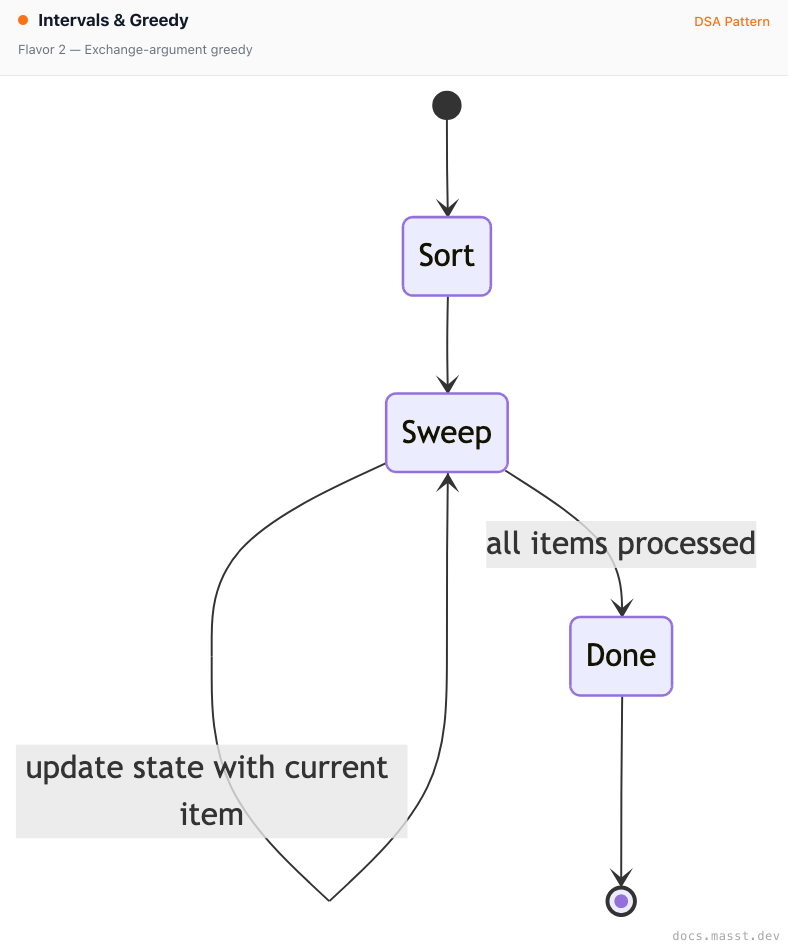
The art is picking the right sort key. Sort by start for merging. Sort by end for maximum non-overlapping. Sort by deadline for earliest-deadline-first. Sort by ratio for fractional knapsack. The sort key encodes the greedy strategy.
Visual walkthrough — Merge Intervals
Input: [[1,3], [2,6], [8,10], [15,18]] (already sorted by start).
Initial:  intervals sorted by start
          [1,3]  [2,6]  [8,10]  [15,18]
          ─────  ─────  ──────  ───────

Step 1:   start with [1,3]
          merged = [[1,3]]

Step 2:   next = [2,6]. start(2) <= end(3)? Yes — overlap.
          Merge: [1, max(3, 6)] = [1, 6]
          merged = [[1,6]]

Step 3:   next = [8,10]. start(8) <= end(6)? No — disjoint.
          Append.
          merged = [[1,6], [8,10]]

Step 4:   next = [15,18]. start(15) <= end(10)? No — disjoint.
          Append.
          merged = [[1,6], [8,10], [15,18]]

Done.
One pass after the sort. O(n log n) total.
Visual walkthrough — Interval Scheduling (Maximum Non-Overlapping)
Input: 5 jobs with [start, end]: [1,3], [2,5], [4,7], [6,8], [3,4].
Naive (sort by start): Greedy would pick [1,3], then [4,7], then nothing more — 2 jobs. But optimal is 3.
Correct (sort by end):
Sort by end time: [1,3], [3,4], [2,5], [4,7], [6,8].
Step 1:  pick [1,3] (ends earliest).  Last end = 3.
Step 2:  [3,4]: start 3 >= 3. Pick it. Last end = 4.
Step 3:  [2,5]: start 2 < 4. Skip.
Step 4:  [4,7]: start 4 >= 4. Pick it. Last end = 7.
Step 5:  [6,8]: start 6 < 7. Skip.

Selected: [1,3], [3,4], [4,7] — 3 jobs. ✓
Why does sorting by end work? Exchange argument: suppose the optimal solution doesn't start with the earliest-ending interval e. Swap its first interval for e; the rest of the solution is still valid (since e ends earlier, it can only help future picks). So the greedy choice is no worse than any alternative.
The template
Template A — Sort + Sweep (interval problems)
def interval_sweep(intervals):
    intervals.sort(key=lambda x: x[0])     # or x[1] depending on problem
    result = init()
    for interval in intervals:
        result = update(result, interval)
    return result
The slots:
- Sort key — start, end, or a derived value.
- Initial state — usually empty list or accumulator.
- Update — how each new interval modifies state. For merging, peek at the last and either extend or append.
Template B — Greedy choice (no intervals, just an order)
def greedy(items):
    items.sort(key=greedy_key)
    state = init()
    for item in items:
        state = take_locally_best(state, item)
    return state
The slot is greedy_key. The insight is finding what to sort by. That's the hard part; the code is trivial.
Template C — Sweep line (events at coordinates)
For "max active intervals at any point" (meeting rooms), use a sweep line: convert each interval into two events (+1 at start, -1 at end), sort all events by time, sweep counting active.
def min_meeting_rooms(intervals):
    events = []
    for s, e in intervals:
        events.append((s, +1))             # start
        events.append((e, -1))             # end (process before starts at same time)
    events.sort(key=lambda x: (x[0], x[1]))  # ties: end first
    active = max_active = 0
    for _, delta in events:
        active += delta
        max_active = max(max_active, active)
    return max_active
This is conceptually the same as a Difference Array on the time axis.
Worked example: Non-Overlapping Intervals (LC 435)
Problem. Given an array of intervals, return the minimum number of intervals you need to remove to make the rest non-overlapping. Example:
[[1,2],[2,3],[3,4],[1,3]]→1(remove[1,3]).
Why this is greedy. The dual problem is "maximum number of non-overlapping intervals" — remove the fewest = keep the most. The classic interval-scheduling greedy says: sort by end, greedily pick the earliest-ending interval that doesn't conflict with the last picked.
What changes from the template. Three slots:
- Sort key:
end(the magic ingredient). - State:
last_end— the end time of the most recently kept interval. - Update: if
start >= last_end, keep it; else discard (count one removal).
def erase_overlap_intervals(intervals: list[list[int]]) -> int:
    intervals.sort(key=lambda x: x[1])     # sort by end
    last_end = float('-inf')
    removed = 0
    for start, end in intervals:
        if start >= last_end:
            last_end = end                  # keep this interval
        else:
            removed += 1                    # overlap — discard
    return removed
Dry-run on [[1,2],[2,3],[3,4],[1,3]]:
After sort by end: [[1,2],[2,3],[1,3],[3,4]].
| start | end | last_end before | start ≥ last_end? | Action | last_end after | removed |
|---|---|---|---|---|---|---|
| 1 | 2 | -∞ | yes | keep | 2 | 0 |
| 2 | 3 | 2 | yes | keep | 3 | 0 |
| 1 | 3 | 3 | no | remove | 3 | 1 |
| 3 | 4 | 3 | yes | keep | 4 | 1 |
Answer: 1 ✓.
Complexity. O(n log n) for the sort, O(n) for the sweep. O(1) extra space.
Why sort by end (not start)? Try sorting by start: [[1,2],[1,3],[2,3],[3,4]]. We'd keep [1,2], then conflict with [1,3] and [2,3] (both removed), then [3,4] kept — 2 removed. Worse. The exchange argument: among any two overlapping intervals, the one ending later is strictly worse to keep (it blocks more future intervals). So always pick the earlier-ending one.
Variants
Variant 1 — Merge intervals
The canonical sort-by-start sweep. Update: extend if overlapping, else append.
Canonical problems: 56 Merge Intervals, 57 Insert Interval, 252 Meeting Rooms (just check for any overlap).
Variant 2 — Maximum non-overlapping (interval scheduling)
Sort by end. Greedily pick if it doesn't conflict. The classic.
Canonical problems: 435 Non-Overlapping Intervals (this page's worked example), 452 Minimum Arrows to Burst Balloons (same shape — burst at earliest end).
Variant 3 — Sweep line / event counting
Convert intervals to +1 start / -1 end events. Sweep to count active.
Canonical problems: 253 Meeting Rooms II, 1851 Min Interval to Include Each Query (advanced), 218 The Skyline Problem (sweep + heap).
Variant 4 — Pure greedy (no intervals)
Sort by a clever key, sweep, make local choice. The trick: proving the sort key gives global optimality.
# Jump Game II — minimum jumps to reach end
def jump(nums):
    jumps = current_end = farthest = 0
    for i in range(len(nums) - 1):
        farthest = max(farthest, i + nums[i])
        if i == current_end:                # exhausted current jump's reach
            jumps += 1
            current_end = farthest
    return jumps
Canonical problems: 55 Jump Game (can you reach?), 45 Jump Game II (min jumps), 134 Gas Station (greedy reset), 121 Best Time to Buy & Sell Stock (greedy track minimum), 122 Stock II (sum all positive deltas).
Variant 5 — Two-axis greedy (sort by one key, optimize the other)
Sort by one dimension, then run greedy/another structure on the second.
# Russian Doll Envelopes — LC 354
def max_envelopes(envelopes):
    envelopes.sort(key=lambda x: (x[0], -x[1]))     # ascending width, descending height
    # Now problem becomes LIS on heights
    return length_of_lis([h for _, h in envelopes])
Canonical problems: 354 Russian Doll Envelopes, 406 Queue Reconstruction by Height, 1235 Maximum Profit in Job Scheduling (sort + DP with binary search).
Variant 6 — Fractional knapsack / ratio greedy
Sort items by value-per-unit-weight (ratio). Take as much of the highest-ratio item as fits, then the next, etc.
def fractional_knapsack(items, capacity):
    items.sort(key=lambda x: -x.value / x.weight)
    total = 0
    for item in items:
        if capacity >= item.weight:
            total += item.value
            capacity -= item.weight
        else:
            total += item.value * capacity / item.weight
            break
    return total
This is not 0/1 knapsack — that one requires DP because you can't take fractions.
Common pitfalls
| Trap | Fix |
|---|---|
| Sorting by the wrong key | Most "this greedy doesn't work" bugs are wrong sort key. Try sort-by-end vs sort-by-start vs sort-by-difference |
| Greedy + DP confusion | Greedy works when the local choice is provably globally optimal. If you need to compare alternatives, it's DP, not greedy |
| Forgetting strict vs non-strict overlap | Does [1,3] and [3,5] overlap? Depends on the problem — read the spec |
| In sweep line, ties between start and end events | At the same time, end events should fire first ((time, +1) after (time, -1)). Sort ties carefully |
| Not proving the greedy choice is correct | Always sketch an exchange argument. If you can't, it might not be greedy |
| Sorting mutates the input when the caller doesn't expect it | Use sorted(...) instead of .sort() if the caller needs the original |
| Using greedy on a problem that needs DP | "Min cost" with branching choices → usually DP. Pure greedy is rare; most "greedy" problems hide in interval form |
| Off-by-one on inclusive vs exclusive end | "Intervals [1,3] and [3,5] overlap" — half-open vs closed makes a difference; spec it |
Complexity
Time: O(n log n) dominated by the sort. The sweep itself is O(n).
Space: O(1) for in-place sweep (excluding the sort's stack space, which is O(log n) for most algorithms).
For sweep line: O(n) extra space for the events list.
The pattern's appeal: n log n is the speed limit. You can't beat it without exploiting more structure. So if the problem accepts n log n, sort-then-sweep is usually optimal.
When NOT to use intervals & greedy
- The greedy choice isn't provably correct. Many problems look greedy but aren't. "Coin change with arbitrary denominations" is famous: greedy works for US coins but fails for
[1, 7, 10](greedy says 4 coins for 14, but7+7is 2 coins). Use DP when the greedy claim isn't airtight. - You need to compare multiple paths. If at each step you have to look ahead more than one step, it's not greedy — it's DP or BFS.
- The intervals are dynamic (added/removed online). Sort + sweep is offline. For online interval problems, use a balanced BST or segment tree.
- The problem requires the actual list of removed/kept items, not a count. Sometimes a count is easy but recovery is hard; you may need to keep auxiliary indices.
- The "intervals" are on a circular axis (e.g., days of the week wrapping). Standard sweep needs adjustment.
- The optimal solution involves backtracking choices. Greedy commits at each step. If the optimal solution sometimes requires un-doing a decision, DP wins.
Decision rule
| Symptom | Likely pattern |
|---|---|
| "Merge overlapping intervals" | Sort by start, sweep |
| "Maximum non-overlapping" | Sort by end, greedy |
| "Minimum X to remove for no overlaps" | Sort by end, greedy (complement) |
| "How many concurrent / meeting rooms" | Sweep line (+1/-1 events) |
| "Burst balloons / arrows" | Sort by end, greedy |
| "Schedule jobs to maximize profit" | DP + binary search (often) |
| "Knapsack-like with branching choices" | DP (not greedy) |
| "Jump game" | Greedy with reach tracking |
| "Coin change (min coins)" | DP (greedy fails for arbitrary denoms) |
Real-world applications
- Calendar systems. Detecting meeting conflicts, finding free slots, computing busy/free time — all interval-merge problems.
- OS process scheduling. Earliest-deadline-first (EDF) scheduling is a greedy: schedule the job with the closest deadline.
- Network routing. Many routing algorithms (OSPF, BGP path selection) are greedy on locally-known link costs.
- Compiler register allocation. Linear-scan register allocation is interval-sweep: sort live ranges by start, allocate registers greedily.
- Memory allocator. Free-list-based allocators often greedily pick the smallest fitting block (best-fit) or the first fitting block (first-fit).
- Geographic/satellite coverage planning. Choosing minimum tower locations to cover an area is interval scheduling in disguise.
- CDN cache eviction. LRU is greedy on time-of-last-access; LFU is greedy on frequency.
Curated practice problems
| # | Problem | Difficulty | Variant | Note |
|---|---|---|---|---|
| 1 | ★ 56 Merge Intervals | Medium | Sort by start, sweep | The canonical merge |
| 2 | 57 Insert Interval | Medium | Variant of 56 | Sorted input + one insertion |
| 3 | 252 Meeting Rooms | Easy | Sweep for any overlap | Just check sorted neighbors |
| 4 | ★ 253 Meeting Rooms II | Medium | Sweep line | +1/-1 events, max active |
| 5 | ★ 435 Non-Overlapping Intervals | Medium | Sort by end, greedy | This page's worked example |
| 6 | 452 Min Arrows to Burst Balloons | Medium | Sort by end, greedy | Same shape as 435 |
| 7 | 1288 Remove Covered Intervals | Medium | Sort + sweep | Sort by start ascending, end descending |
| 8 | 986 Interval List Intersections | Medium | Two-pointer on two sorted | Different shape — pointer over each list |
| 9 | ★ 55 Jump Game | Medium | Greedy reach | Track farthest reachable |
| 10 | 45 Jump Game II | Medium | Greedy reach + counter | Each "jump" extends reach |
| 11 | 134 Gas Station | Medium | Greedy reset | If total ≥ 0, answer exists; reset on deficit |
| 12 | 121 Best Time to Buy/Sell Stock | Easy | Greedy min-tracker | One pass tracking min seen |
| 13 | 122 Best Time to Buy/Sell Stock II | Easy | Greedy sum-positives | Take every uphill |
| 14 | 406 Queue Reconstruction by Height | Medium | Two-axis greedy | Sort by height desc, insert by k |
| 15 | 1851 Minimum Interval to Include Each Query | Hard | Sort + heap | Offline: sort intervals and queries |
Related patterns
- Prefix Sums / Difference Arrays — sweep-line for "count at any point" is structurally identical
- Sliding Window — when the "interval" is dynamic over a single array
- Heap — sweep line often pairs with a heap (skyline, K closest)
- DP — Linear — when greedy isn't enough; many DP problems are "greedy with memoization to handle alternatives"
Quick-reference card
# Merge intervals
intervals.sort(key=lambda x: x[0])
merged = []
for s, e in intervals:
    if merged and s <= merged[-1][1]:
        merged[-1][1] = max(merged[-1][1], e)
    else:
        merged.append([s, e])

# Max non-overlapping (interval scheduling)
intervals.sort(key=lambda x: x[1])    # SORT BY END
last_end, count = -inf, 0
for s, e in intervals:
    if s >= last_end:
        count += 1; last_end = e

# Sweep line for max active
events = [(s, +1) for s, _ in intervals] + [(e, -1) for _, e in intervals]
events.sort(key=lambda x: (x[0], x[1]))    # ends before starts at same time
active = best = 0
for _, d in events:
    active += d; best = max(best, active)
Triggers: "merge", "overlapping", "meeting rooms", "minimum arrows", "schedule". Complexity: O(n log n).
Finished reading?
Mark it done to track your progress in Interview.
Hashing
Use a hash map or set for O(1) lookup, frequency counting, seen-state tracking, and group-by. The unlock for problems where "have I seen this before?" is the core question.
Stacks & Queues
Monotonic stack and deque — the two specialized container patterns that unlock 'next greater' and 'window max' problems.