
Sliding Window
Maintain a contiguous window with expand-right and shrink-left to optimize over subarrays in O(n). Fixed-size and variable-size variants.
TL;DR — Sliding Window
Use when: you need to optimize over all contiguous subarrays of an input — find the longest, shortest, max-sum, or count satisfying a constraint.
Trigger phrases: "longest substring", "shortest subarray", "at most K distinct", "exactly K", "max sum of K elements", "smallest window containing".
Template: expand right, shrink left while invariant violated, update answer.
Complexity: O(n) time, O(1) or O(window-state) space.
The problem that motivates this pattern
Longest Substring with At Most K Distinct Characters. Given a string
sand an integerk, return the length of the longest substring ofsthat contains at most k distinct characters.
You think: "easy, I'll check every substring." Two nested loops generate every (left, right) pair; for each one you check how many distinct characters it has and keep the max. That's O(n²) substrings × O(n) to count distinct = O(n³).
You can do better: precompute distinct-count incrementally. As you extend right by 1, you only need to update a counter. That brings it to O(n²).
But there's still a problem. Most of those n² windows are useless. If you found a valid window from index 2 to index 7, you don't need to also check windows from 3 to 6, 3 to 7, 4 to 7, etc. — they're all subsets you already know are valid. The brute force is wasting work checking subsets of windows you've already validated.
This is the pain that the sliding window pattern relieves. Once you internalize that every valid window contains valid sub-windows, you realize: we only need to track the maximal valid window ending at each position. And we can maintain it incrementally as right moves forward.
The core insight
The window is a contract, not a region.
Naively, we picture the window as "the chunk we're currently looking at." That framing is useless. The useful framing is: the window from left to right is the longest valid suffix ending at right. Every iteration of the outer loop has one job: extend that suffix by one. If extending it violates the constraint, contract from the left until it's valid again.
The invariant we maintain — and you should be able to recite this in an interview — is:
After every iteration,
[left, right]is a valid window, andleftis the smallest index for which[left, right]is valid.
Because of this invariant:
- We never need to look "inside" the window. The answer at step
rightis simplyright - left + 1. - We never need to backtrack
right— it only moves forward. leftalso only moves forward. It never goes back.- So the total work is O(n): each index is visited at most twice (once when
rightpasses it, once whenleftpasses it).
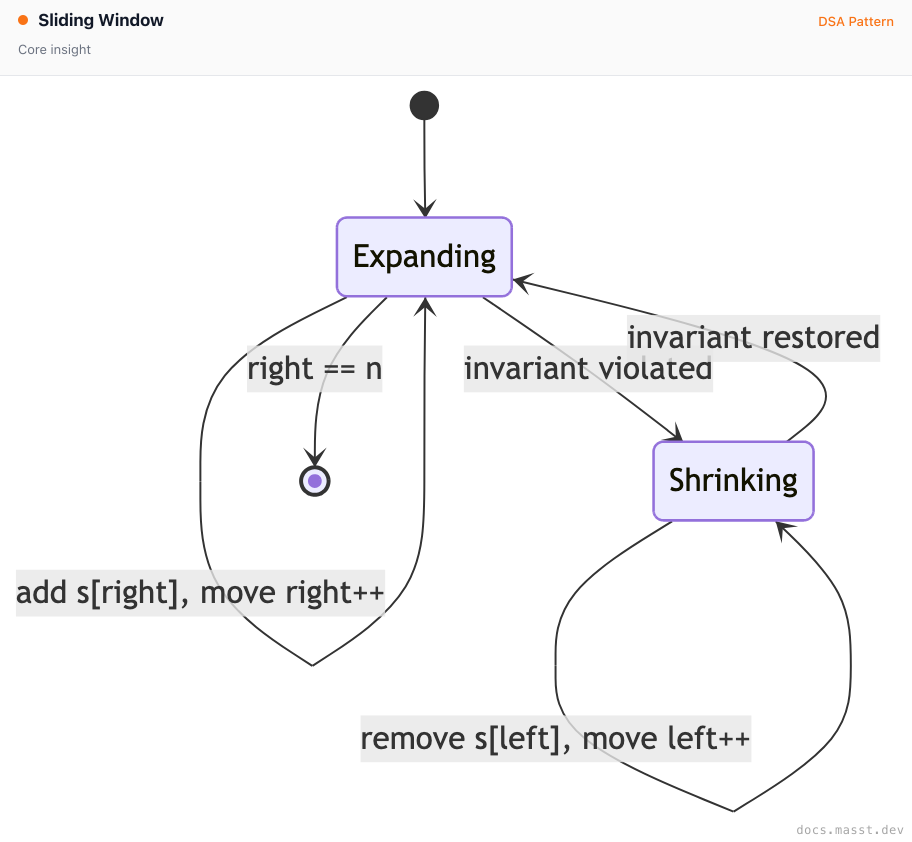
The state machine has two states: expanding (right is moving) and shrinking (left is catching up). The transition happens precisely when the invariant is violated.
Visual walkthrough
Let's trace the algorithm on s = "eceba", k = 2. The window is shown in brackets; below each step is the character counter.
Step 1. right = 0. Add 'e'. Window: [e]ceba. Counter: {e: 1}. 1 distinct ≤ 2 ✓. Length 1.
Step 2. right = 1. Add 'c'. Window: [ec]eba. Counter: {e: 1, c: 1}. 2 distinct ≤ 2 ✓. Length 2.
Step 3. right = 2. Add 'e'. Window: [ece]ba. Counter: {e: 2, c: 1}. 2 distinct ≤ 2 ✓. Length 3. (Best so far.)
Step 4. right = 3. Add 'b'. Window: [eceb]a. Counter: {e: 2, c: 1, b: 1}. 3 distinct > 2 — invariant violated. Shrink.
Step 4a. Remove s[0] = 'e'. Counter: {e: 1, c: 1, b: 1}. left = 1. Still 3 distinct. Shrink more.
Step 4b. Remove s[1] = 'c'. Counter: {e: 1, b: 1}. left = 2. 2 distinct ≤ 2 ✓. Window: ec[eb]a. Length 2.
Step 5. right = 4. Add 'a'. Window: ec[eba]. Counter: {e: 1, b: 1, a: 1}. 3 distinct > 2 — shrink.
Step 5a. Remove s[2] = 'e'. Counter: {b: 1, a: 1}. left = 3. 2 distinct ✓. Window: ece[ba]. Length 2.
Final answer: 3 (from step 3, the window "ece").
Notice what happened:
rightmoved from 0 to 4 — exactly 5 steps.leftmoved from 0 to 3 — exactly 3 steps.- Total work: 8 increments. That's O(n) amortized, not O(n²).

The template
This is the shape you should be able to write from memory. Every variable-size sliding-window problem instantiates this template by customizing three slots: expand, invariant_violated, shrink.
def sliding_window(s):
    left = 0
    window_state = ...   # whatever you need to track the constraint
    ans = 0

    for right in range(len(s)):
        # 1. Expand: include s[right] in the window
        window_state = include(window_state, s[right])

        # 2. Shrink while the window is invalid
        while invariant_violated(window_state):
            window_state = exclude(window_state, s[left])
            left += 1

        # 3. Update the answer
        ans = max(ans, right - left + 1)

    return ans
The three slots:
include/exclude— how you update window state when an element enters or leaves. Usually a counter, sum, or set.invariant_violated— the predicate that tells you when to shrink. For "at most K distinct":len(counter) > k. For "sum > target":current_sum > target.update ans— what to compute from(left, right). Usuallyright - left + 1(length) or the window's sum.
Why a while loop, not an if
The shrink step is a while, not an if, because a single expansion may require multiple shrinks. In our walkthrough, adding 'b' at step 4 required removing both 'e' and 'c' before the invariant held again. Using if would be a bug that silently passes most test cases but fails on inputs with long runs of distinct characters.
Worked example: Longest Substring with At Most K Distinct
Problem. Given a string
sand an integerk, return the length of the longest substring that contains at mostkdistinct characters. Example:s = "eceba",k = 2→ output3(the substring"ece").
Why this is a sliding-window problem. The keywords are "longest substring" (contiguous + extremal) and "at most k distinct" (a constraint that becomes harder as the window grows and easier as it shrinks). That monotonicity in the constraint is the signal.
What changes from the template. Three slots:
- State: a
Counterof character → frequency inside the window. - Invariant violated:
len(counter) > k— too many distinct chars. - Shrink: decrement the leftmost character's count; if it drops to zero, remove it from the counter (so
len(counter)reflects the actual distinct count).
def longest_k_distinct(s: str, k: int) -> int:
    counter, left, ans = {}, 0, 0

    for right, ch in enumerate(s):
        counter[ch] = counter.get(ch, 0) + 1           # expand

        while len(counter) > k:                         # invariant violated
            counter[s[left]] -= 1                       # shrink
            if counter[s[left]] == 0:
                del counter[s[left]]
            left += 1

        ans = max(ans, right - left + 1)                # update

    return ans
Dry-run on s = "eceba", k = 2:
| right | ch | counter | shrink? | left | ans |
|---|---|---|---|---|---|
| 0 | 'e' | {e:1} | no | 0 | 1 |
| 1 | 'c' | {e:1, c:1} | no | 0 | 2 |
| 2 | 'e' | {e:2, c:1} | no | 0 | 3 |
| 3 | 'b' | {e:2, c:1, b:1} | yes ×2 | 2 | 3 |
| 4 | 'a' | {e:0→del, b:1, a:1} | yes ×1 | 3 | 3 |
Final: 3.
Complexity. O(n) time — each character is added to and removed from counter at most once, so the total work across all expand and shrink steps is bounded by 2n. O(k) space — the counter holds at most k + 1 entries at any time.
Variants
Sliding window comes in two main flavors. Knowing both lets you pattern-match faster.
Variant 1 — Fixed-size window
The window has a known width k. No shrink loop is needed; you slide the window forward one step at a time, updating state by adding the new right element and subtracting the leaving left element.
def max_sum_k(arr, k):
    window_sum = sum(arr[:k])
    ans = window_sum
    for right in range(k, len(arr)):
        window_sum += arr[right] - arr[right - k]      # add new, remove old
        ans = max(ans, window_sum)
    return ans
Trigger phrases: "maximum sum of any subarray of size k", "average of every k-window", "number of anagrams of p in s".
Canonical problems: 643 Max Avg Subarray I, 567 Permutation in String, 438 Find All Anagrams in a String.
Variant 2 — Variable-size window (the template above)
The window grows from the right and shrinks from the left until a constraint is satisfied. This is the version that does most of the heavy lifting in interviews.
Trigger phrases: "longest substring with X", "shortest subarray sum ≥ target", "smallest window containing all chars of T".
Canonical problems: 3 Longest Substring Without Repeating, 76 Minimum Window Substring, 209 Min Size Subarray Sum, 159 Longest Substring with At Most 2 Distinct.
Variant 3 — "Exactly K" via "At Most K minus At Most K-1"
Some problems ask for exactly K (not at most). Direct sliding window doesn't work because the constraint isn't monotonic — adding a character can fix an "exactly K" condition (by adding the missing distinct char) and adding another can break it.
The trick: compute atMost(K) and atMost(K-1). Their difference is exactly(K).
def exactly_k(s, k):
    return at_most(s, k) - at_most(s, k - 1)
Canonical problem: 992 Subarrays with K Different Integers, 930 Binary Subarrays With Sum.
Variant 4 — Sliding window with auxiliary structure
When the constraint involves more than just count or sum — e.g., "max of every K-window" — a plain counter isn't enough. You use an auxiliary structure (often a monotonic deque) to maintain the aggregate efficiently.
# Sliding window maximum — uses a monotonic deque (next pattern)
from collections import deque
def max_sliding_window(nums, k):
    dq, ans = deque(), []
    for i, x in enumerate(nums):
        while dq and dq[0] <= i - k: dq.popleft()      # evict expired
        while dq and nums[dq[-1]] < x: dq.pop()         # maintain decreasing
        dq.append(i)
        if i >= k - 1: ans.append(nums[dq[0]])
    return ans
This composes Sliding Window with Monotonic Stack/Deque.
Canonical problem: 239 Sliding Window Maximum, 480 Sliding Window Median (uses two heaps instead).
Common pitfalls
| Trap | Fix |
|---|---|
Using if instead of while for the shrink step | Always while — a single expand can require multiple shrinks |
Updating ans outside the shrink loop on the wrong iteration | Update after the loop so [left, right] is guaranteed valid |
| Forgetting to remove the count from the dict when it hits 0 | len(counter) > k is wrong if you leave zero-count entries in |
| Off-by-one on window length | Length = right - left + 1, not right - left |
Using <= vs < in the invariant check | "at most k" → check > k; "more than k" → check <= k |
| Trying to shrink before expanding | Always expand first, then shrink. Otherwise the new element isn't accounted for in the invariant. |
| Reusing the template on non-contiguous problems | Sliding window requires contiguity. "Longest subsequence" is DP, not sliding window. |
Complexity
Time: O(n). Each index is visited at most twice — once when right reaches it, and once when left passes it. The total work in the shrink while loop is amortized: across the entire run of the algorithm, left cannot move more than n times.
Space: O(W) where W is the size of the auxiliary state. For "at most k distinct," that's O(k). For a sum-based variant, it's O(1). For "Min Window Substring," it's O(|alphabet|) = O(1) for ASCII.
The amortized analysis is the part that makes sliding window feel like magic. People mistakenly think "outer loop + inner loop = O(n²)." The reason it's not: the inner loop's total iterations across the whole outer loop are bounded by n, not by n per outer iteration.
When NOT to use sliding window
Sliding window is the wrong tool when:
- The selection isn't contiguous. "Longest subsequence with property X" is almost always DP or a hash map, not sliding window. The pattern relies on contiguity to make the amortized argument; if you can skip elements, that argument collapses.
- You need to access an arbitrary element inside the window. Sliding window gives you O(1) access to the boundaries, not the middle. "Find the median of every k-sized window" needs an auxiliary structure (two heaps) — it's not classic sliding window.
- The constraint is non-monotonic. Sliding window's correctness hinges on: if a window is valid, growing it can only make it invalid (and shrinking can only make it valid again). If your constraint can flip-flop as the window grows — e.g., "the window's XOR equals K" — sliding window won't terminate the inner shrink loop correctly. Use Prefix Sums + Hash Map instead.
- The window is over a different structure (tree, graph). Sliding window is for linear sequences. The analogous pattern on a tree is "sliding window on a path," which is its own niche.
Decision rule
| Symptom | Likely pattern |
|---|---|
| "Longest/shortest contiguous X with constraint Y" | Sliding Window |
| "Pair in sorted array summing to T" | Two Pointers |
| "Pair in unsorted array summing to T" | Hashing |
| "Number of subarrays with sum = K" | Prefix Sum + HashMap |
| "Longest subsequence (non-contiguous)" | DP |
| "Max in every K-window" | Sliding Window + Monotonic Deque |
Real-world applications
- Rate limiters. Token bucket / sliding-window log algorithms in production rate limiters maintain a window over recent request timestamps. See Rate Limiter (LLD) for a full implementation.
- Network packet aggregation. Routers maintain a sliding window of packets in flight (TCP congestion control uses exactly this).
- Stream analytics. "Compute the moving average of CPU usage over the last 60 seconds" is a fixed-size sliding window over time-stamped events.
- DNA/protein sequence analysis. K-mer counting in bioinformatics is sliding window over a string.
Curated practice problems
Order by difficulty. Star ★ = must-do for interview prep.
| # | Problem | Difficulty | Variant | Note |
|---|---|---|---|---|
| 1 | ★ 643 Max Avg Subarray I | Easy | Fixed-size | The simplest possible window |
| 2 | ★ 3 Longest Substring Without Repeating | Medium | Variable | The canonical variable-size problem |
| 3 | 567 Permutation in String | Medium | Fixed | Compare counter to target |
| 4 | 438 Find All Anagrams in a String | Medium | Fixed | Sliding fingerprint comparison |
| 5 | 209 Min Size Subarray Sum | Medium | Variable | Shortest instead of longest |
| 6 | 159 Longest Substring with At Most 2 Distinct | Medium | Variable | Generalizes to k distinct |
| 7 | ★ 76 Minimum Window Substring | Hard | Variable | The classic "shrink to minimal" problem |
| 8 | 340 Longest Substring with At Most K Distinct | Medium | Variable | This page's worked example |
| 9 | 904 Fruit Into Baskets | Medium | Variable | "At most 2 distinct" in disguise |
| 10 | 1004 Max Consecutive Ones III | Medium | Variable | "At most K zeros" — recognize the rewording |
| 11 | 424 Longest Repeating Character Replacement | Medium | Variable | Window valid when (length - max_freq) ≤ k |
| 12 | ★ 239 Sliding Window Maximum | Hard | Window + Deque | Composes with Monotonic Deque |
| 13 | 480 Sliding Window Median | Hard | Window + Two Heaps | Composes with Two Heaps |
| 14 | 992 Subarrays with K Different Integers | Hard | Variable | Use "At Most K - At Most K-1" trick |
| 15 | 1248 Count Number of Nice Subarrays | Medium | Variable | Same "exactly K" trick |
Related patterns
- Two Pointers — when both ends move independently toward each other (not a window)
- Prefix Sums — when the constraint is non-monotonic
- Monotonic Stack / Deque — when you need window-max or next-greater
- Hashing — used inside sliding window for state (counters, sets)
Quick-reference card
left, state, ans = 0, init(), 0
for right in range(len(s)):
    state = include(state, s[right])
    while violated(state):
        state = exclude(state, s[left])
        left += 1
    ans = max(ans, right - left + 1)
Triggers: "longest", "shortest", "at most K", "max sum of size K". Complexity: O(n) time, O(window state) space.
Finished reading?
Mark it done to track your progress in Interview.
Two Pointers
Move two indices through an array (opposite or same direction) to find pairs, partition in place, or detect cycles in O(n) instead of O(n²).
Prefix Sums & Difference Arrays
Precompute cumulative sums for O(1) range queries (prefix sum) and O(1) range updates (difference array). They are inverses of each other.