
Bit Manipulation
XOR for pairing/cancellation, n & (n-1) for popcount and lowest-bit-clear, masks-as-sets for subset enumeration. A small toolbox that unlocks elegant O(n)/O(1) solutions for a specific class of problems.
TL;DR — Bit Manipulation
Use when: the problem operates on integers but the "interesting" structure is in the bits — pairing identical values, counting set bits, enumerating subsets, or doing per-bit reasoning.
Trigger phrases: "single number", "missing number", "count set bits", "power of two", "subsets via bitmask", "reverse bits", "swap without temporary".
Five must-know tricks:
- XOR pairs cancel:
a ^ a = 0anda ^ 0 = a. Used for "find the unpaired number." n & (n-1)clears the lowest set bit. Used for popcount and "is power of 2."n & -nisolates the lowest set bit.1 << kgives the k-th bit;n | (1<<k)sets,n & ~(1<<k)clears,n ^ (1<<k)toggles.- Bitmask as a set: iterate
for sub = (sub - 1) & maskto walk subsets.
Complexity: usually O(n) time, O(1) extra space — but only for the right class of problems.
The problem that motivates this pattern
Single Number (LC 136). Given a non-empty array where every element appears twice except for one, find that single one. Your algorithm should have linear time complexity and use only constant extra space.
Example:
[4, 1, 2, 1, 2]→4.
Hash-set approach: O(n) time, O(n) space. We're told constant space.
Sort then scan adjacent: O(n log n) — too slow.
The XOR trick: XOR every element together. Because a ^ a = 0, every pair cancels to 0. The remaining value is the unpaired one.
def single_number(nums):
    result = 0
    for x in nums:
        result ^= x
    return result
O(n) time, O(1) space. That's it.
Why this works:
0 ^ 0 = 0,1 ^ 1 = 0→ identical bits cancel.0 ^ 1 = 1,1 ^ 0 = 1→ different bits stay.- XOR is associative and commutative, so the order of operations doesn't matter.
For [4, 1, 2, 1, 2]: 4 ^ 1 ^ 2 ^ 1 ^ 2 = 4 ^ (1 ^ 1) ^ (2 ^ 2) = 4 ^ 0 ^ 0 = 4. ✓
The deeper insight: bit manipulation isn't a single algorithm — it's a toolbox of identities you compose. When the right identity matches your problem, you get O(n)/O(1) solutions that hash sets and sorting can't match. The hard part is recognizing the trigger.
The core insight
Bit-level operations work because integers, viewed as bits, support fast set/clear/toggle/test operations and a powerful identity: a ^ a = 0.
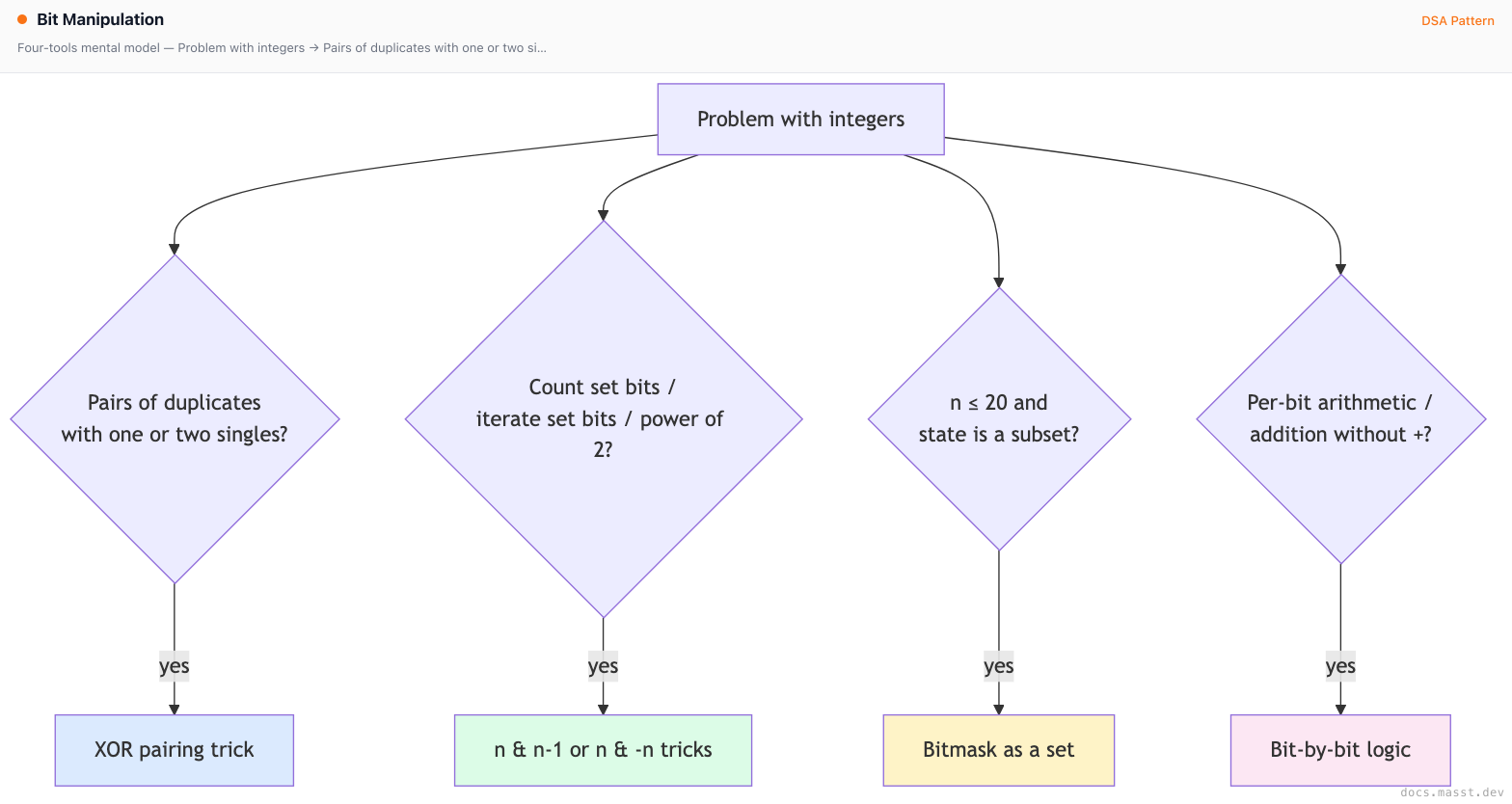
The four-tools mental model
Every bit-manipulation problem maps onto one of these tools:
- XOR cancellation — pairs of identical values vanish. Use when there's a "find the odd one out" or "find the difference" structure.
- Lowest-bit operations —
n & (n-1)clears the lowest set bit;n & -nextracts it. Use for popcount, power-of-2 checks, iterating set bits. - Single-bit set/clear/toggle/test —
1 << kis your friend. Use for explicit bit-by-bit work. - Bitmask as a set — for
n ≤ ~20, you can encode "subset of n elements" as an integer. Use for subset enumeration and Bitmask DP.
The invariant for XOR-based tricks:
XOR preserves "what's been seen an odd number of times" and discards "what's been seen an even number of times."
That's the entire theory behind the Single Number family of problems. Variations:
- Single Number II (every number appears 3 times except one): need a 3-counter trick (count bits mod 3 across all numbers).
- Single Number III (two singles, rest appear twice): XOR all → result =
a ^ b; partition by any set bit in the XOR; XOR each partition separately.
The invariant for n & (n-1):
n & (n-1)always clears the lowest set bit, producing a strictly smaller number with one fewer set bit.
This is the basis for:
- Popcount in O(set-bit count) — loop while
n, don &= n-1, count. - Power of 2 check —
n > 0 and (n & (n-1)) == 0. - Counting Bits (LC 338) — DP:
dp[n] = dp[n & (n-1)] + 1.
Visual walkthrough — XOR pairing
Trace XOR on [2, 3, 5, 4, 5, 3, 4] (every value appears twice except 2).
Step-by-step XOR (cumulative):

Initial:   result = 0  (binary: 000)
^= 2:      result = 0 ^ 010 = 010  (= 2)
^= 3:      result = 010 ^ 011 = 001  (= 1)
^= 5:      result = 001 ^ 101 = 100  (= 4)
^= 4:      result = 100 ^ 100 = 000  (= 0)
^= 5:      result = 000 ^ 101 = 101  (= 5)
^= 3:      result = 101 ^ 011 = 110  (= 6)
^= 4:      result = 110 ^ 100 = 010  (= 2)

Final: 2 ✓
The path is wild — the intermediate values jump around — but every pair cancels eventually, leaving only 2. The order doesn't matter; the result is deterministic.
For "two unique numbers" (Single Number III), XOR everything → result = a ^ b. Both bits of a and b are different where this XOR has a 1. Pick any such bit (e.g., the lowest, via result & -result). Partition the array by that bit: numbers with the bit set go to group A, others to group B. XOR each group separately → you get a and b.
Visual walkthrough — n & (n - 1) for popcount
Count set bits in n = 12 (binary 1100).
n = 1100, count = 0
n & (n-1) = 1100 & 1011 = 1000.   (cleared the rightmost set bit)
count = 1, n = 1000.

n & (n-1) = 1000 & 0111 = 0000.   (cleared the other set bit)
count = 2, n = 0000.

Loop ends. Result: 2 set bits. ✓
Each iteration clears exactly one set bit, so the loop runs once per set bit — O(popcount(n)) iterations, not O(log n). For sparse-bit integers this is much faster than naive "shift and test."
def popcount(n):
    count = 0
    while n:
        n &= n - 1
        count += 1
    return count
The full n & -n trick (isolating the lowest set bit) is the dual: 12 & -12 = 1100 & ...0100 = 0100 = 4 (the lowest set bit as a power of 2). Used in Fenwick trees (BIT).
The template
Template A — XOR cancellation
def single_number(nums):
    result = 0
    for x in nums:
        result ^= x
    return result
For two unique numbers in a sea of pairs:
def single_number_iii(nums):
    xor_all = 0
    for x in nums:
        xor_all ^= x                                   # xor_all = a ^ b

    diff_bit = xor_all & -xor_all                      # lowest differing bit

    a = b = 0
    for x in nums:
        if x & diff_bit:
            a ^= x
        else:
            b ^= x
    return [a, b]
Template B — Popcount / power-of-2 check
def hamming_weight(n):
    count = 0
    while n:
        n &= n - 1
        count += 1
    return count

def is_power_of_two(n):
    return n > 0 and (n & (n - 1)) == 0
Template C — Set / Clear / Toggle / Test bit k
set_bit(n, k)    = n | (1 << k)
clear_bit(n, k)  = n & ~(1 << k)
toggle_bit(n, k) = n ^ (1 << k)
test_bit(n, k)   = (n >> k) & 1
Template D — Iterate all subsets of a bitmask
sub = mask
while sub > 0:
    process(sub)
    sub = (sub - 1) & mask                            # next smaller subset
# Don't forget the empty subset (sub = 0)
process(0)
This iterates the subsets in decreasing numeric order, hitting each subset exactly once. Used in advanced bitmask DP — see Bitmask DP.
Template E — Generate all subsets via bitmask
For an array of length n, iterate mask from 0 to 2^n - 1. Each bit of mask corresponds to "include this element."
def all_subsets(nums):
    n = len(nums)
    result = []
    for mask in range(1 << n):
        subset = [nums[i] for i in range(n) if mask & (1 << i)]
        result.append(subset)
    return result
This is the iterative version of Backtracking subsets — no recursion needed.
Worked example: Counting Bits (LC 338)
Problem. Given an integer
n, return an arrayansof lengthn + 1whereans[i]is the number of1bits in the binary representation ofi. Solve in O(n) total time.Example:
n = 5→[0, 1, 1, 2, 1, 2](binary:0=0, 1=1, 10=1, 11=2, 100=1, 101=2).
Naive: for each i, compute popcount in O(log i). Total: O(n log n).
Better with bit manipulation: notice the recurrence popcount(i) = popcount(i & (i-1)) + 1. We've already computed popcount(i & (i-1)) since i & (i-1) < i. So dp[i] = dp[i & (i-1)] + 1. O(n) total time, O(n) space.
def count_bits(n: int) -> list[int]:
    dp = [0] * (n + 1)
    for i in range(1, n + 1):
        dp[i] = dp[i & (i - 1)] + 1
    return dp
Dry-run on n = 5:
| i | binary | i & (i-1) | dp[i & (i-1)] | dp[i] |
|---|---|---|---|---|
| 0 | 0 | — | — | 0 |
| 1 | 1 | 0 | 0 | 1 |
| 2 | 10 | 0 | 0 | 1 |
| 3 | 11 | 10 (= 2) | 1 | 2 |
| 4 | 100 | 0 | 0 | 1 |
| 5 | 101 | 100 (= 4) | 1 | 2 |
Result: [0, 1, 1, 2, 1, 2] ✓.
Why does this work? i & (i-1) removes the lowest set bit of i. So popcount(i) is exactly popcount(i with lowest bit removed) + 1. Since i & (i-1) < i, we always have the answer cached.
Alternative recurrence: dp[i] = dp[i >> 1] + (i & 1). Both work, both O(n).
Complexity. O(n) time, O(n) space.
Variants
Variant 1 — XOR Pairing (Single Number family)
The canonical: every value appears twice except one — XOR them all.
Canonical problems: 136 Single Number, 137 Single Number II (every value thrice except one — 3-counter or per-bit mod 3), 260 Single Number III (two singles — partition by differing bit), 268 Missing Number (XOR all indices and values).
Variant 2 — Popcount and Power-of-Two
n & (n-1) for popcount and "is exact power of 2."
Canonical problems: 191 Number of 1 Bits (Hamming weight), 338 Counting Bits (this page's worked example), 231 Power of Two, 342 Power of Four.
Variant 3 — Bit-by-Bit Arithmetic
Implement addition / subtraction / multiplication / division without using the operators. Use XOR for "sum without carry" and AND-shift for the carry.
# Add two integers without + or -
def add(a, b):
    while b != 0:
        carry = (a & b) << 1
        a = a ^ b
        b = carry
    return a
Canonical problems: 371 Sum of Two Integers, 29 Divide Two Integers (use bit shifts).
Variant 4 — Reverse Bits / Bit Reversal
def reverse_bits(n):
    result = 0
    for _ in range(32):
        result = (result << 1) | (n & 1)
        n >>= 1
    return result
Canonical problems: 190 Reverse Bits, 7 Reverse Integer.
Variant 5 — Bitmask as a Set (subset enumeration)
For n ≤ 20, encode subsets as integers; iterate via for mask in range(1 << n).
# Generate all subsets of nums
for mask in range(1 << len(nums)):
    subset = [nums[i] for i in range(len(nums)) if mask & (1 << i)]
Canonical problems: 78 Subsets (iterative bitmask version), 1239 Maximum Length of Concatenated String with Unique Characters (bitmask + DP).
Variant 6 — Bitmask DP
State = subset of "used" items as a bitmask. Transition: pick the next item to add.
This is its own pattern — see DP — Bitmask.
Canonical problems: 1879 Min XOR Sum of Two Arrays, 698 Partition to K Equal Sum Subsets, 847 Shortest Path Visiting All Nodes, TSP.
Variant 7 — Hamming Distance
Hamming distance between two integers = popcount of their XOR.
def hamming_distance(x, y):
    return bin(x ^ y).count('1')                       # or use n & (n-1) loop
Canonical problems: 461 Hamming Distance, 477 Total Hamming Distance.
Variant 8 — Bit Trie (Maximum XOR)
A binary trie supporting "find the integer that XORs to maximum with a given query." See Trie for the structure.
Canonical problems: 421 Maximum XOR of Two Numbers in an Array, 1707 Maximum XOR With Element ≤ M.
Common pitfalls
| Trap | Fix |
|---|---|
Confusing & with && (or ` | with||`) |
| Forgetting that XOR with 0 is identity | Initialize result = 0 for cumulative XOR |
| Sign-extension on right-shift of negative integers | In Java, use >>> for unsigned right shift. In Python, integers are arbitrary precision; right-shift of negatives is implementation-defined |
Off-by-one in shifts (1 << n vs 1 << (n-1)) | Bit k is 1 << k, not 1 << (k-1) |
Overflow on 1 << 31 in Java/C | Use 1L << 31 (long) or be explicit about integer width |
Using n % 2 for "is even" then if n / 2-style logic when n & 1 and n >> 1 would be cleaner | Both work; the bit version is sometimes faster and signals intent |
| Iterating bits of huge numbers | Set bit count via bin(n).count('1') is fine for one-off; loop with n &= n-1 is faster for many calls |
Confusing n & -n with n & (n-1) | n & -n isolates the lowest set bit; n & (n-1) clears it |
| Trying to use bitmask for n > 30 | 2^30 ≈ 10^9 — feasible in time but memory explodes. Bitmask techniques cap at n ≈ 20 |
| Using XOR for sorting / comparison | XOR doesn't preserve order; it's not a comparison primitive |
Complexity
XOR cumulative: O(n) time, O(1) space.
Popcount via n & (n-1) loop: O(popcount(n)) per call. Always ≤ O(log n).
Counting bits up to n via DP: O(n) total time.
Bitmask subset enumeration: O(2^n) for all subsets; O(3^n) for all (subset, sub-subset) pairs (e.g., bitmask DP over sub-subsets).
Bit-by-bit arithmetic: O(width) per operation (typically 32 or 64 iterations).
The patterns are usually fast — the question is whether your problem has the shape that admits them.
When NOT to use bit manipulation
- The bit-level structure isn't load-bearing. If you don't have pairs, sets, or powers of 2 in your problem, bit tricks usually add complexity without benefit. Use straightforward arithmetic.
- The integers are too wide for bitmasks.
n > 30means2^n > 10^9— generating all subsets is infeasible. - You need ordering / range queries. XOR doesn't preserve order. Don't use it for "max", "min", or "sort."
- The problem requires precise arithmetic on signed numbers. Bit shifts on negative integers have language-specific semantics; tread carefully.
- You're not comfortable with two's complement. Some tricks (
n & -n) rely on two's complement representation. Verify before using in languages with arbitrary-precision integers (Python). - The constant factor matters and you're not benchmarking. Sometimes clever bit tricks are slower in modern CPUs due to branch prediction and pipelining of simpler arithmetic.
Decision rule
| Symptom | Likely pattern |
|---|---|
| "Find single / unpaired number" | XOR pairing |
| "Count set bits / popcount" | n & (n-1) loop |
| "Power of 2 / 4 check" | n & (n-1) == 0 |
| "Generate all subsets" | Bitmask (or Backtracking) |
| "Subset enumeration with constraints" | DP — Bitmask |
| "Hamming distance / XOR sum" | XOR + popcount |
| "Maximum XOR pair / subset" | Trie (binary trie) |
| "Add / subtract without operators" | Bit-by-bit arithmetic |
| "Reverse bits" | Shift-and-OR |
| "Random integer / hash duplicates" | Hashing (not bit tricks) |
Real-world applications
- Hash functions. Bitwise operations are the foundation of every fast hash function (FNV, MurmurHash, SipHash).
- Compression algorithms. Huffman coding, LZ77 — all manipulate bit-level encodings.
- Cryptography. Block ciphers (AES), stream ciphers, hash functions — bit operations everywhere.
- Networking — IP routing. Subnet masks, CIDR notation, route aggregation — all bit operations on 32-bit addresses.
- Database query optimizers. Bloom filters use bit arrays; bitmap indexes use word-level AND/OR for fast filtering.
- Compilers. Constant folding, peephole optimizations, register allocation often use bitmasks.
- Operating systems. File permissions (rwx), CPU feature flags, scheduler priorities — all bit fields.
- Computer graphics. Color manipulation (ARGB packing), z-buffer operations, blend modes.
- Game engines. Collision detection (bitmask layers), state machines, save-state compaction.
Curated practice problems
| # | Problem | Difficulty | Variant | Note |
|---|---|---|---|---|
| 1 | ★ 136 Single Number | Easy | XOR all | The canonical |
| 2 | 137 Single Number II | Medium | Every value × 3 except one | Per-bit mod 3 |
| 3 | 260 Single Number III | Medium | Two singles | Partition by differing bit |
| 4 | 268 Missing Number | Easy | XOR indices + values | Or sum trick / cyclic sort |
| 5 | ★ 191 Number of 1 Bits | Easy | Popcount | n & (n-1) loop |
| 6 | ★ 338 Counting Bits | Medium | DP on bits | This page's worked example |
| 7 | 231 Power of Two | Easy | One-liner | n > 0 and (n & (n-1)) == 0 |
| 8 | 342 Power of Four | Easy | Power of 2 + bit position | Even position check |
| 9 | 461 Hamming Distance | Easy | XOR + popcount | Trivial composition |
| 10 | 190 Reverse Bits | Easy | Shift-and-OR | 32 iterations |
| 11 | 371 Sum of Two Integers | Medium | Add without + | XOR + carry-shift loop |
| 12 | ★ 78 Subsets (bitmask version) | Medium | Bitmask iteration | for mask in range(2^n) |
| 13 | 1239 Max Length of Concat Strings | Medium | Bitmask + DP | Each string ↔ bitmask of chars |
| 14 | 421 Maximum XOR of Two Numbers | Medium | Binary trie | See Trie |
| 15 | 477 Total Hamming Distance | Medium | Count per-bit contributions | Per-bit count of 0s × 1s |
Related patterns
- Cyclic Sort — alternative for "missing/duplicate in 1..n" problems
- Hashing — alternative when you have memory
- Trie — binary trie for max-XOR problems
- DP — Bitmask — bitmask as DP state for subset-based problems
- Backtracking — bitmask iteration is the iterative form of subset backtracking
Quick-reference card
# XOR all → cancels pairs
result = 0
for x in nums: result ^= x

# Popcount with n & (n-1) — O(popcount) iterations
count = 0
while n: n &= n - 1; count += 1

# Power of 2
n > 0 and (n & (n - 1)) == 0

# Lowest set bit
n & -n                                      # isolates: 12 → 4
n & (n - 1)                                  # clears: 12 → 8

# Single bit at position k
n |  (1 << k)                                # set
n & ~(1 << k)                                # clear
n ^  (1 << k)                                # toggle
(n >> k) & 1                                 # test

# Iterate all subsets of mask (decreasing order)
sub = mask
while sub > 0:
    process(sub)
    sub = (sub - 1) & mask
process(0)                                   # don't forget empty subset

# Generate all subsets of array
for mask in range(1 << n):
    subset = [arr[i] for i in range(n) if mask & (1 << i)]
Triggers: "single number", "popcount", "power of 2", "subsets via bitmask", "max XOR", "swap without temp". Complexity: O(n) time, O(1) extra (usually).
Finished reading?
Mark it done to track your progress in Interview.