
Rate Limiter (LLD)
Design an in-process rate limiter — token bucket, leaky bucket, fixed window, sliding window.
Interview practice: try designing this yourself before reading. Go to the exercise ↓
Problem Statement
Design a rate limiter that limits requests per client (per API key, IP, user). Needs to:
- Allow up to N requests per time window
- Reject (or queue) requests exceeding the limit
- Support multiple algorithms
- Be thread-safe and low-latency
The HLD case study is at /hld/rate-limiter. This page focuses on the algorithm and class design.
Algorithms Compared
| Algorithm | Burst behavior | Memory | Smoothness |
|---|---|---|---|
| Fixed Window | Allows 2× burst at boundary | O(1) per key | Bursty |
| Sliding Log | None | O(N) per key — keeps timestamps | Smooth |
| Sliding Window Counter | Limited burst | O(1) per key | Approximately smooth |
| Token Bucket | Allows bursts up to bucket size | O(1) per key | Smooth |
| Leaky Bucket | No bursts | O(1) per key | Constant rate |
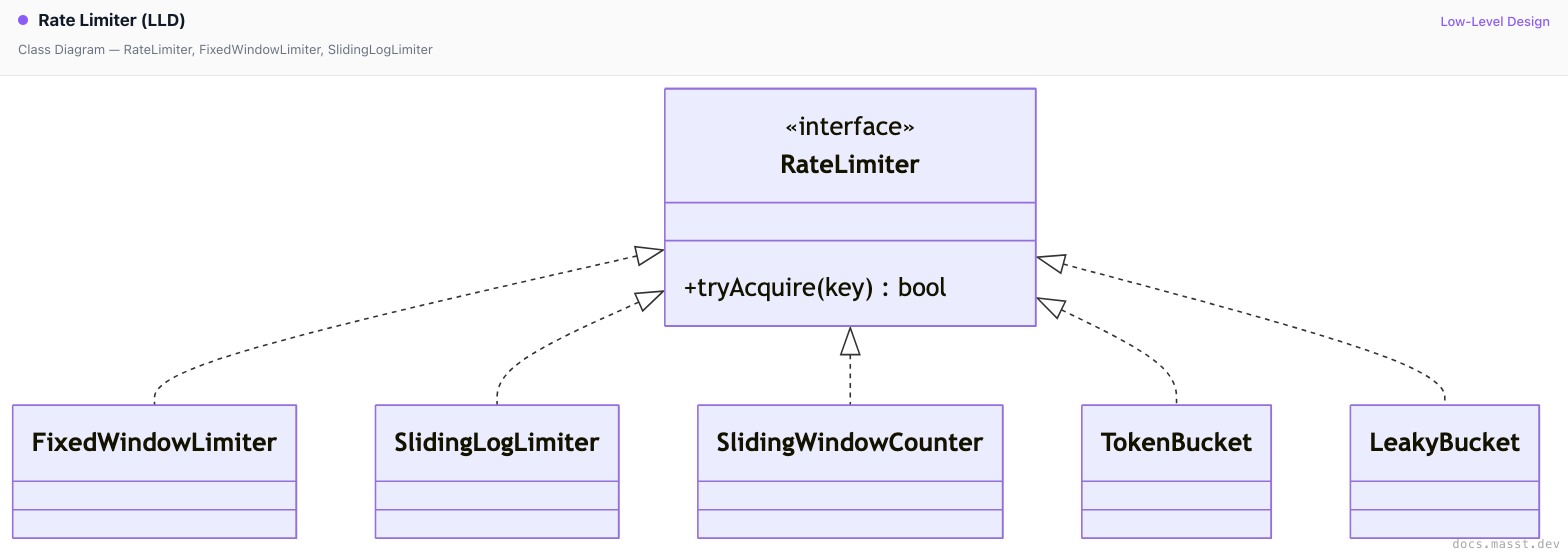
Common Interface
public interface RateLimiter {
    boolean tryAcquire(String clientKey);
}
Returns true if allowed, false if denied.
1. Fixed Window
Counts requests in the current 1-second (or N-second) window. Resets at boundary.
public class FixedWindowLimiter implements RateLimiter {
    private final int maxRequests;
    private final long windowMs;
    private final Map<String, WindowState> state = new ConcurrentHashMap<>();

    private static class WindowState {
        long windowStart;
        AtomicInteger count;
        WindowState(long start) {
            this.windowStart = start;
            this.count = new AtomicInteger(0);
        }
    }

    public FixedWindowLimiter(int max, long windowMs) {
        this.maxRequests = max;
        this.windowMs = windowMs;
    }

    @Override
    public boolean tryAcquire(String key) {
        long now = System.currentTimeMillis();
        WindowState w = state.computeIfAbsent(key, k -> new WindowState(now));
        synchronized (w) {
            if (now - w.windowStart >= windowMs) {
                w.windowStart = now;
                w.count.set(0);
            }
            return w.count.incrementAndGet() <= maxRequests;
        }
    }
}
Flaw: at window boundaries, allows 2× burst — N at the end of one window plus N at the start of the next.
2. Sliding Window Log
Store every request timestamp. On each request, drop expired and check count.
public class SlidingLogLimiter implements RateLimiter {
    private final int maxRequests;
    private final long windowMs;
    private final Map<String, Deque<Long>> log = new ConcurrentHashMap<>();

    public SlidingLogLimiter(int max, long windowMs) {
        this.maxRequests = max; this.windowMs = windowMs;
    }

    @Override
    public boolean tryAcquire(String key) {
        long now = System.currentTimeMillis();
        Deque<Long> q = log.computeIfAbsent(key, k -> new ArrayDeque<>());
        synchronized (q) {
            while (!q.isEmpty() && q.peekFirst() < now - windowMs) q.pollFirst();
            if (q.size() >= maxRequests) return false;
            q.addLast(now);
            return true;
        }
    }
}
Pro: exact. Con: O(N) memory per key (every timestamp in the window).
3. Sliding Window Counter
Two windows: current and previous. Estimate sliding count by linear interpolation.
public class SlidingWindowCounter implements RateLimiter {
    private final int maxRequests;
    private final long windowMs;
    private final Map<String, State> state = new ConcurrentHashMap<>();

    private static class State {
        long currentWindowStart;
        int currentCount;
        int previousCount;
    }

    @Override
    public synchronized boolean tryAcquire(String key) {
        long now = System.currentTimeMillis();
        State s = state.computeIfAbsent(key, k -> {
            State x = new State();
            x.currentWindowStart = now - (now % windowMs);
            return x;
        });

        long thisWindow = now - (now % windowMs);
        if (thisWindow != s.currentWindowStart) {
            s.previousCount = s.currentCount;
            s.currentCount = 0;
            s.currentWindowStart = thisWindow;
        }

        // Fraction of previous window that's still in the sliding view
        double fraction = 1.0 - ((now - thisWindow) / (double) windowMs);
        double estimate = s.previousCount * fraction + s.currentCount;

        if (estimate >= maxRequests) return false;
        s.currentCount++;
        return true;
    }
}
Pro: O(1) memory, smooth-ish. Con: estimate, not exact.
4. Token Bucket
A bucket of capacity C, refilled at rate R tokens/second. Each request consumes one token. If empty, request is denied.
public class TokenBucket implements RateLimiter {
    private final long capacity;
    private final double refillPerMs;
    private final Map<String, BucketState> buckets = new ConcurrentHashMap<>();

    private static class BucketState {
        double tokens;
        long lastRefillMs;
    }

    public TokenBucket(long capacity, double refillPerSec) {
        this.capacity = capacity;
        this.refillPerMs = refillPerSec / 1000.0;
    }

    @Override
    public boolean tryAcquire(String key) {
        long now = System.currentTimeMillis();
        BucketState b = buckets.computeIfAbsent(key, k -> {
            BucketState s = new BucketState();
            s.tokens = capacity;
            s.lastRefillMs = now;
            return s;
        });
        synchronized (b) {
            double elapsed = now - b.lastRefillMs;
            b.tokens = Math.min(capacity, b.tokens + elapsed * refillPerMs);
            b.lastRefillMs = now;
            if (b.tokens < 1.0) return false;
            b.tokens -= 1.0;
            return true;
        }
    }
}
Pro: smooth, allows bounded bursts. The most common production choice.
5. Leaky Bucket
Like token bucket but constant outflow — no bursts.
public class LeakyBucket implements RateLimiter {
    private final long capacity;
    private final double leakPerMs;
    private final Map<String, BucketState> buckets = new ConcurrentHashMap<>();

    private static class BucketState {
        double level;
        long lastLeakMs;
    }

    @Override
    public boolean tryAcquire(String key) {
        long now = System.currentTimeMillis();
        BucketState b = buckets.computeIfAbsent(key, k -> new BucketState());
        synchronized (b) {
            double elapsed = now - b.lastLeakMs;
            b.level = Math.max(0, b.level - elapsed * leakPerMs);
            b.lastLeakMs = now;
            if (b.level + 1 > capacity) return false;
            b.level += 1;
            return true;
        }
    }
}
Used for smoothing (constant downstream rate), not just limiting.
Class Diagram
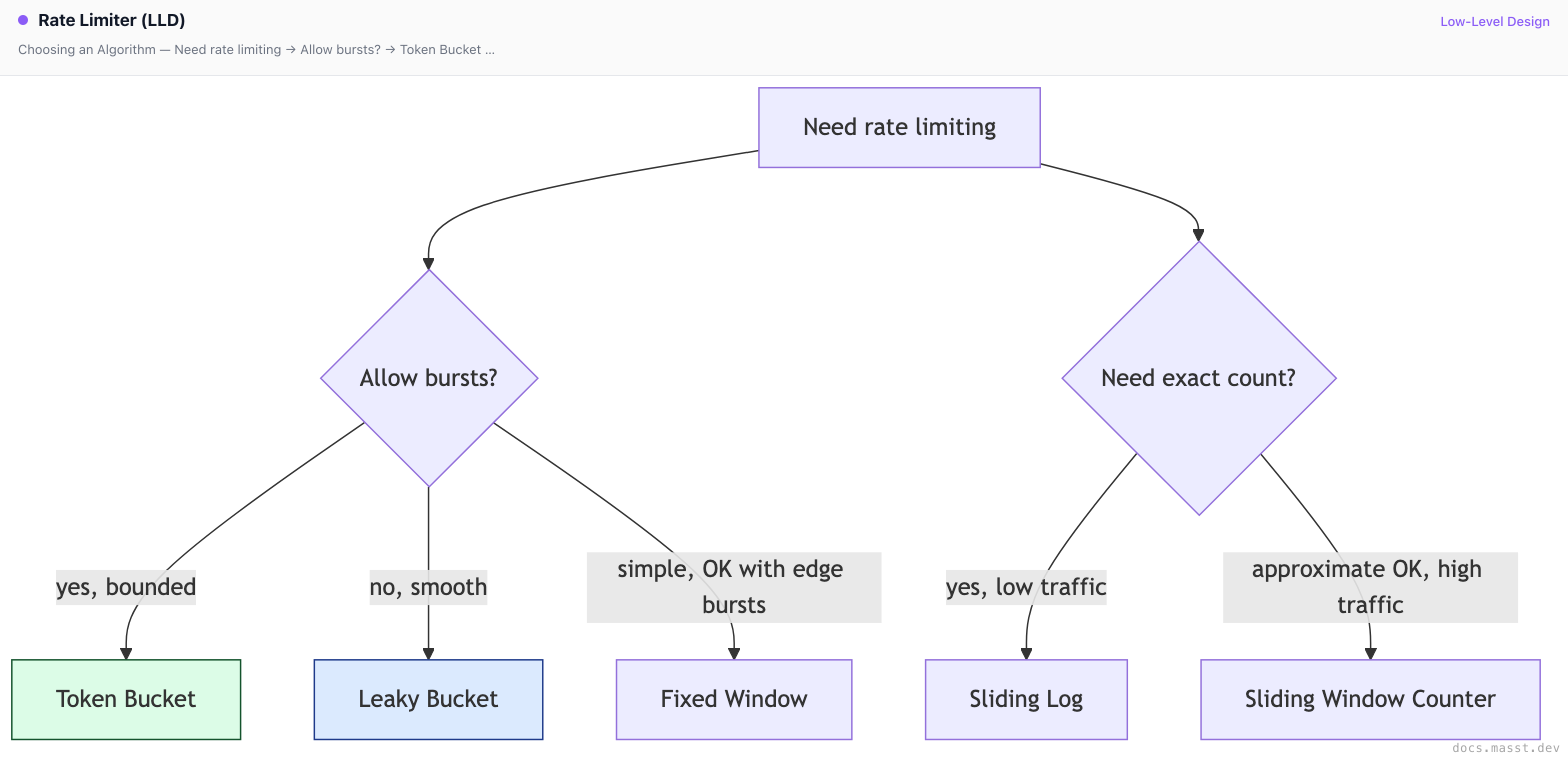
Choosing an Algorithm
Distributed Rate Limiting
For multiple servers behind a load balancer:
| Approach | Tradeoff |
|---|---|
| Per-server local | Easy; user can hit N × servers limit |
| Centralized Redis | Accurate; round-trip latency |
| Sticky sessions to one server | Local accuracy; load imbalance |
| Probabilistic (count-min sketch) | Approximate; very low memory |
Redis-based token bucket using Lua script (atomic):
-- atomic refill + consume
local tokens = redis.call("HGET", KEYS[1], "tokens")
local last = redis.call("HGET", KEYS[1], "last")
-- refill, consume, update
Edge Cases
| Case | Handling |
|---|---|
| First request from new key | Create state with full bucket / fresh window |
| Clock skew (distributed) | Use single source of truth (Redis time, NTP) |
| Memory leak from inactive keys | TTL on the key; periodic cleanup sweep |
| Thundering herd at window reset | Token bucket avoids; fixed window suffers |
| Limit changes at runtime | Volatile config; new limit applies to subsequent calls |
Design Patterns Used
| Pattern | Where |
|---|---|
| Strategy | Different rate-limiting algorithms behind one interface |
| Singleton | One limiter per application instance |
| Decorator | Wrap a limiter with logging, metrics, multi-tier |
| Factory | Construct limiter from config |
Interview Tips
- Pick token bucket by default — it's the right answer 90% of the time.
- Mention sliding-window-counter as an O(1)-memory approximation when interviewers push back on log-based approaches.
- For distributed, lead with Redis + Lua for atomicity.
- Be ready to discuss limit per key vs per user vs per endpoint — usually all three.
Practice
Try it yourself
Design an in-process rate limiter library with pluggable algorithms.
Your design should cover
- allow(clientId) returns true or false
- Support fixed window, sliding window and token bucket algorithms
- Different limits per client or per tier
- Thread-safe under concurrent calls
- Memory stays bounded with many clients
Finished reading?
Mark it done to track your progress in Designs.