
Movie Ticket Booking (BookMyShow)
Design a movie booking system with seat selection, holds, payments, concurrent users.
Interview practice: try designing this yourself before reading. Go to the exercise ↓
Problem Statement
Design a movie ticket booking system (BookMyShow / Fandango) that:
- Lists cities → cinemas → screens → shows for a movie
- Lets users select seats from a screen layout
- Holds seats for ~5 minutes during checkout
- Processes payment and confirms booking
- Handles concurrent users selecting the same seat
Requirements
Functional
- Browse movies by city / language / genre
- Search shows for a movie
- Pick seats (check availability, type)
- Hold and release seats
- Pay & confirm
- Cancel booking (refund per policy)
Non-Functional
- Two users can't book the same seat
- Hold expires automatically (no manual cleanup)
- High read traffic (everyone browsing); spiky write traffic on popular shows
Class Diagram
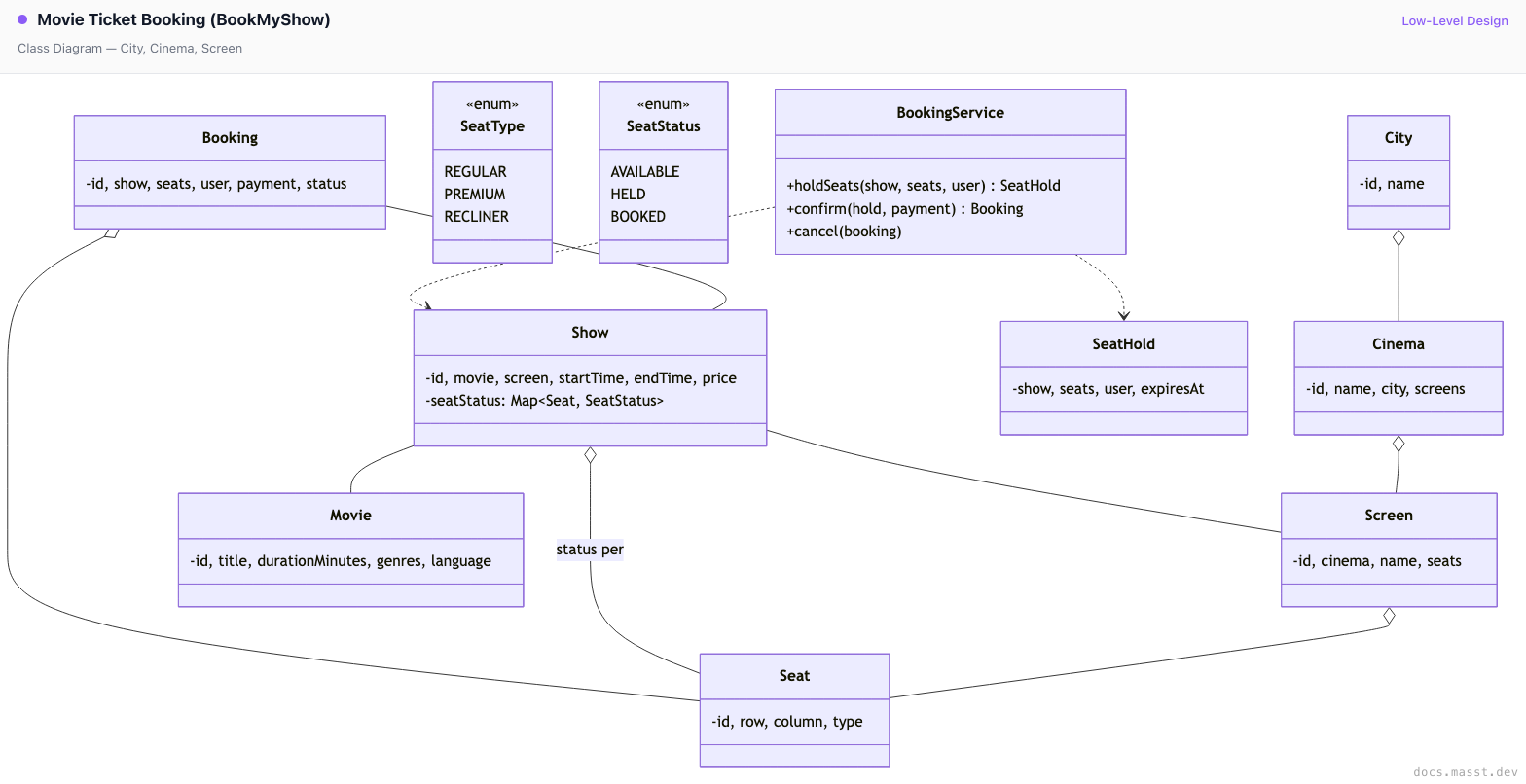
Show + Seat Layout
public enum SeatType { REGULAR, PREMIUM, RECLINER }

public class Seat {
    public final String id;
    public final int row;
    public final int column;
    public final SeatType type;
}

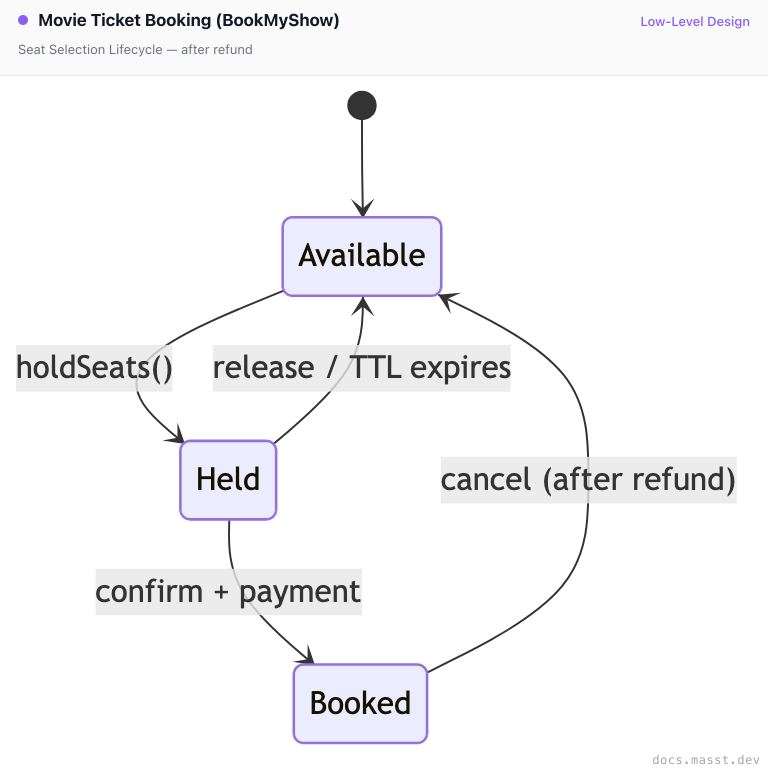
public enum SeatStatus { AVAILABLE, HELD, BOOKED }

public class Show {
    private final String id;
    private final Movie movie;
    private final Screen screen;
    private final Instant startTime;
    private final Map<SeatType, Money> pricing;

    // Per-show seat state — important to be per-show not per-seat
    private final ConcurrentMap<String, SeatState> seatStates = new ConcurrentHashMap<>();

    private static class SeatState {
        SeatStatus status = SeatStatus.AVAILABLE;
        String holdId;       // who holds it
        Instant heldUntil;
    }

    public Show(Movie m, Screen s, Instant start, Map<SeatType, Money> pricing) {
        this.movie = m; this.screen = s; this.startTime = start;
        this.pricing = pricing;
        this.id = UUID.randomUUID().toString();
        for (Seat seat : s.getSeats()) {
            seatStates.put(seat.id, new SeatState());
        }
    }

    public Money priceFor(Seat seat) { return pricing.get(seat.type); }

    SeatState getState(String seatId) { return seatStates.get(seatId); }
}
Seat status lives on the Show, not the Seat. The same physical seat is BOOKED in show A and AVAILABLE in show B simultaneously.
Seat Holds (the Critical Section)
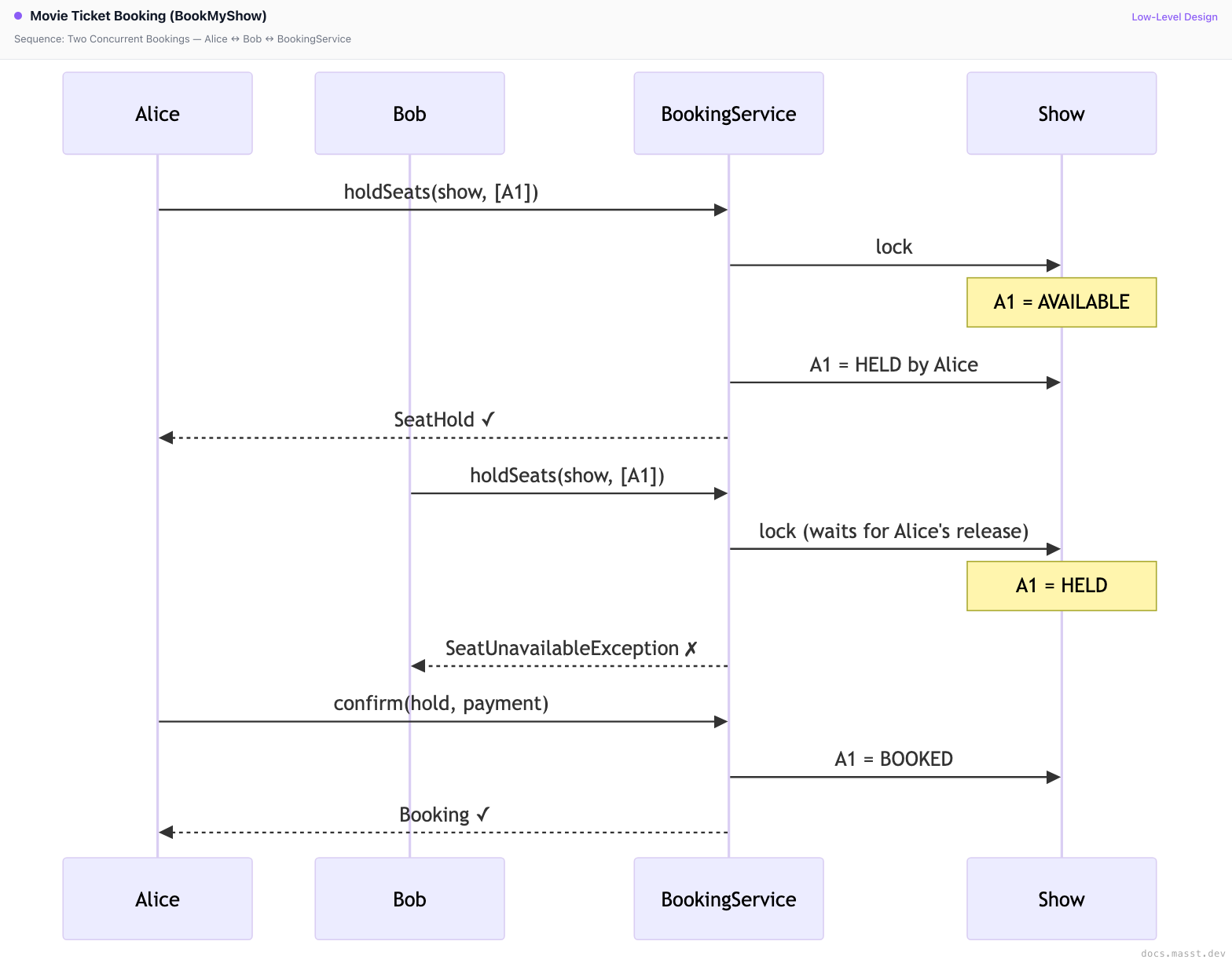
The classic concurrency bug: two users click the same seat at the same time. Solve with atomic state transition:
public class SeatHold {
    public final String id;
    public final Show show;
    public final List<String> seatIds;
    public final User user;
    public final Instant expiresAt;

    public SeatHold(Show show, List<String> seatIds, User user, Duration ttl) {
        this.id = UUID.randomUUID().toString();
        this.show = show;
        this.seatIds = List.copyOf(seatIds);
        this.user = user;
        this.expiresAt = Instant.now().plus(ttl);
    }

    public boolean isExpired() { return Instant.now().isAfter(expiresAt); }
}
public class BookingService {
private static final Duration HOLD_TTL = Duration.ofMinutes(5);
private final Map<String, SeatHold> holds = new ConcurrentHashMap<>();
private final ScheduledExecutorService cleaner = Executors.newSingleThreadScheduledExecutor();
public BookingService() {
cleaner.scheduleAtFixedRate(this::reapExpiredHolds, 30, 30, TimeUnit.SECONDS);
}
public SeatHold holdSeats(Show show, List<String> seatIds, User user) {
// Lock per-show to serialize hold operations on the same show
synchronized (show) {
// Check all are AVAILABLE
for (String sid : seatIds) {
Show.SeatState s = show.getState(sid);
if (s == null) throw new UnknownSeatException(sid);
if (s.status != SeatStatus.AVAILABLE) {
if (s.status == SeatStatus.HELD && Instant.now().isAfter(s.heldUntil)) {
// Lazy expire
s.status = SeatStatus.AVAILABLE;
} else {
throw new SeatUnavailableException(sid);
}
}
}
// Atomically flip to HELD
SeatHold hold = new SeatHold(show, seatIds, user, HOLD_TTL);
for (String sid : seatIds) {
Show.SeatState s = show.getState(sid);
s.status = SeatStatus.HELD;
s.holdId = hold.id;
s.heldUntil = hold.expiresAt;
}
holds.put(hold.id, hold);
return hold;
}
}
public Booking confirm(SeatHold hold, Payment payment) {
synchronized (hold.show) {
if (hold.isExpired()) throw new HoldExpiredException();
// Re-verify seats still belong to this hold
for (String sid : hold.seatIds) {
Show.SeatState s = hold.show.getState(sid);
if (s.status != SeatStatus.HELD || !hold.id.equals(s.holdId))
throw new IllegalStateException("hold lost");
}
payment.process(); // throws on failure
for (String sid : hold.seatIds) {
Show.SeatState s = hold.show.getState(sid);
s.status = SeatStatus.BOOKED;
s.holdId = null;
s.heldUntil = null;
}
holds.remove(hold.id);
Money total = hold.seatIds.stream()
.map(sid -> hold.show.priceFor(seatFor(sid)))
.reduce(Money.zero(), Money::plus);
return new Booking(hold.show, hold.seatIds, hold.user, payment, total);
}
}
public void release(SeatHold hold) {
synchronized (hold.show) {
for (String sid : hold.seatIds) {
Show.SeatState s = hold.show.getState(sid);
if (hold.id.equals(s.holdId)) {
s.status = SeatStatus.AVAILABLE;
s.holdId = null;
s.heldUntil = null;
}
}
holds.remove(hold.id);
}
}
private void reapExpiredHolds() {
for (SeatHold h : holds.values()) {
if (h.isExpired()) release(h);
}
}
}Seat Selection Lifecycle
Sequence: Two Concurrent Bookings
Concurrency Strategy
The service uses per-show synchronization for holds. This means:
- Different shows don't block each other (high parallelism overall).
- Heavily-booked shows do serialize, but each hold operation is millisecond-level.
Alternative: use a distributed lock (Redis SETNX) for multi-server deployments.
For DB-backed implementations: row-level locking (SELECT ... FOR UPDATE) on the seat row.
Booking & Cancellation
public class Booking {
    public final String id;
    public final Show show;
    public final List<String> seatIds;
    public final User user;
    public final Payment payment;
    public final Money total;
    private BookingStatus status = BookingStatus.CONFIRMED;
    public final Instant createdAt = Instant.now();
}

public enum BookingStatus { CONFIRMED, CANCELLED }
Cancellation:
- Compute refund per policy (e.g., full refund if > 24h before show, partial if closer)
- Process refund through payment gateway
- Mark booking
CANCELLED - Set seats back to
AVAILABLE
Edge Cases
| Case | Handling |
|---|---|
| Hold expires mid-payment | confirm() throws; user retries from seat selection |
| Network split during confirm | Idempotency key on payment to avoid double-charge |
| Show starts during browse | Reject hold for past shows |
| Group booking — all-or-nothing | Hold all seats atomically; if any fails, release all |
| Refund after partial show start | Policy decision; usually no refund |
| Payment succeeds but DB write fails | Reconciliation job; refund or replay |
Design Patterns Used
| Pattern | Where |
|---|---|
| State | SeatStatus lifecycle (Available / Held / Booked) |
| Strategy | Pricing per seat type; cancellation refund policy |
| Facade | BookingService |
| Observer | Show countdown to hold expiry on user UI |
| Singleton | One BookingService per app |
| Repository | Persistence for shows, holds, bookings |
Interview Tips
- The seat hold is the central design challenge — interviewers ask about concurrency here.
- Per-show locking is fine; mention scaling via row-level DB locks or distributed locks (Redis).
- Lazy expiration on read + scheduled sweep covers both correctness and cleanup.
- Mention idempotency for payments — the payment must not double-charge if the user retries.
- Distinguish from generic ticket booking: movie has fixed seat layout; some events (concerts) have GA sections that just need a counter.
Practice
Try it yourself
Design the classes for a movie booking system with seat selection and payment.
Your design should cover
- Cinemas, screens, shows and a seat layout per screen
- Select seats and hold them for a few minutes during payment
- Two users can never book the same seat
- Holds expire automatically if payment does not complete
- Cancel a booking and release the seats
Finished reading?
Mark it done to track your progress in Designs.