
Composite
Treat individual objects and compositions of objects uniformly through a common interface.
Intent
Compose objects into tree structures, and let clients work with leaves and branches the same way.
Use when:
- Your data forms a part-whole hierarchy (file system, GUI tree, org chart, expression tree).
- You want clients to ignore the difference between a leaf and a group.
Real-world Analogy
A folder. It contains files (leaves) and other folders (composites). When you ask for the size of a folder, you get the sum of everything inside, regardless of whether each child is a file or another folder. Clients say "give me the size" without caring which it is.
Structure
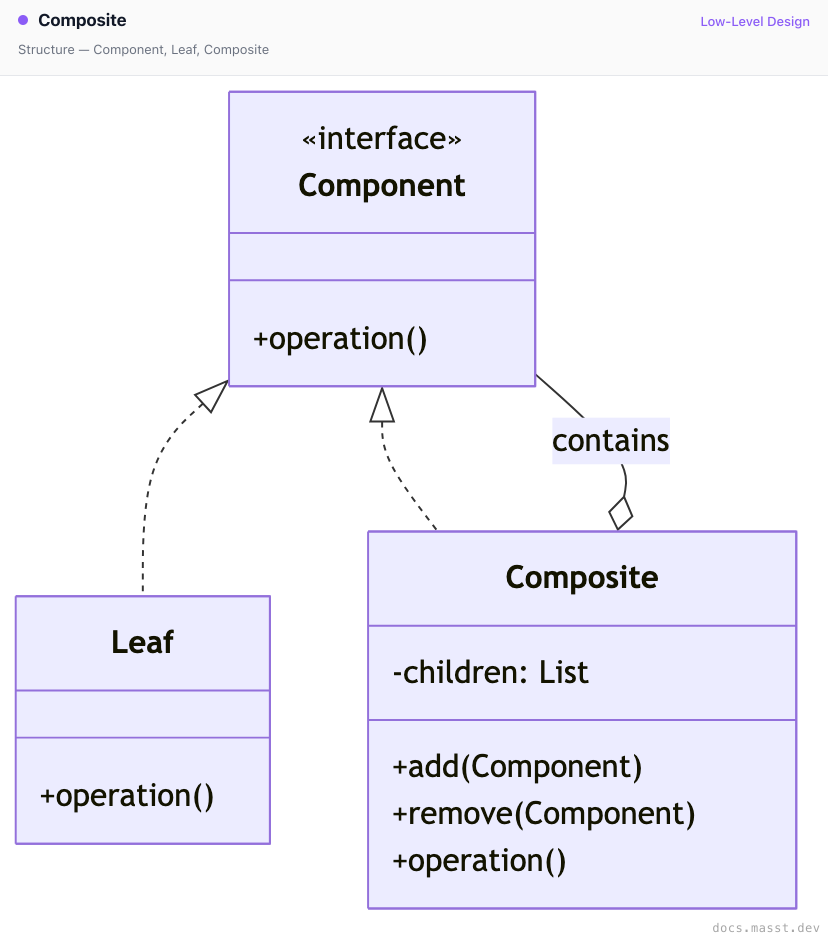
Example: File System
public interface FsNode {
    String name();
    long sizeBytes();
}

public class File implements FsNode {
    private final String name;
    private final long size;

    public File(String name, long size) {
        this.name = name;
        this.size = size;
    }

    public String name() { return name; }
    public long sizeBytes() { return size; }
}

public class Directory implements FsNode {
    private final String name;
    private final List<FsNode> children = new ArrayList<>();

    public Directory(String name) { this.name = name; }

    public void add(FsNode node) { children.add(node); }
    public void remove(FsNode node) { children.remove(node); }

    public String name() { return name; }

    @Override
    public long sizeBytes() {
        return children.stream().mapToLong(FsNode::sizeBytes).sum();   // recursion!
    }
}
Usage
Directory root = new Directory("/");
root.add(new File("readme.md", 1024));

Directory src = new Directory("src");
src.add(new File("Main.java", 4096));
src.add(new File("Utils.java", 2048));

root.add(src);

System.out.println(root.sizeBytes());   // 7168 — handles arbitrary depth
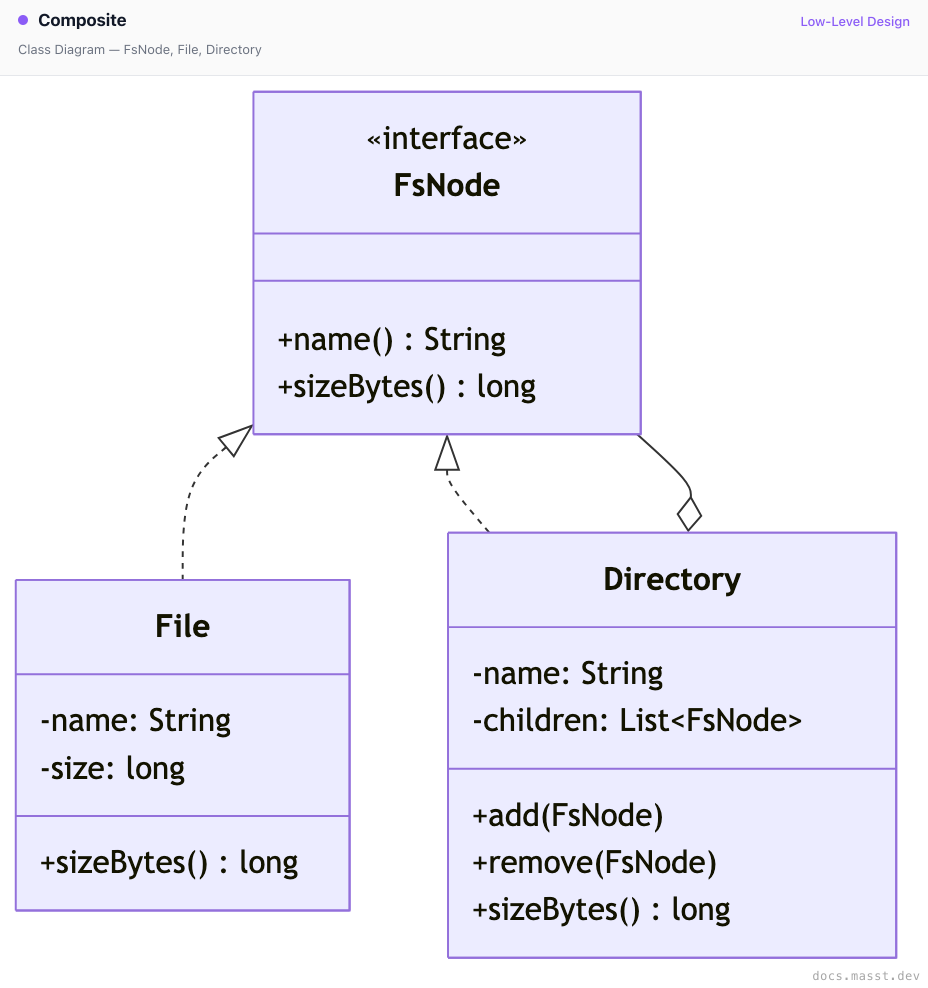
The caller treats File and Directory identically through FsNode.sizeBytes(). The recursion lives inside Directory.
Class Diagram
Other Examples
GUI Tree
interface UIComponent { void render(); }
class Label implements UIComponent { public void render() { /*...*/ } }
class Panel implements UIComponent {
    List<UIComponent> children;
    public void render() { children.forEach(UIComponent::render); }
}
Expression Tree
interface Expr { int eval(); }
class Num implements Expr { int v; public int eval() { return v; } }
class Add implements Expr {
    Expr left, right;
    public int eval() { return left.eval() + right.eval(); }
}
class Mul implements Expr {
    Expr left, right;
    public int eval() { return left.eval() * right.eval(); }
}

// (2 + 3) * 4
Expr e = new Mul(new Add(new Num(2), new Num(3)), new Num(4));
e.eval();  // 20
Org Chart
interface Employee { double totalSalary(); }
class IndividualContributor implements Employee {
    double salary;
    public double totalSalary() { return salary; }
}
class Manager implements Employee {
    double salary;
    List<Employee> reports;
    public double totalSalary() {
        return salary + reports.stream().mapToDouble(Employee::totalSalary).sum();
    }
}
The Add/Remove Trade-off
The classic question: should add() / remove() live on the Component interface (uniform but unsafe) or only on Composite (type-safe but non-uniform)?
| Approach | Pro | Con |
|---|---|---|
On Component | Caller doesn't need to downcast | Leaf.add() either no-ops, throws, or awkwardly succeeds |
On Composite only | Type-safe — Leaf has no add | Caller may need to check type and cast |
GoF prefers transparency (on Component); modern Java tends toward safety (on Composite). Your call.
Real-world Examples
| Use case | Composite |
|---|---|
| File system | File / Directory |
| GUI tree | Component / Container |
| HTML / XML DOM | Text / Element |
| Org chart | Employee / Manager |
| Math expressions | Number / BinaryOp |
| Menu hierarchy | MenuItem / Menu |
Trade-offs
✅ Pros:
- Uniform treatment of leaves and composites — clients are simpler
- Easy to add new node types (open/closed)
- Recursion is contained inside composites
❌ Cons:
- Can be hard to constrain children types (e.g., a
MathExprshouldn't accept arbitrary children) - Add/remove on
Componentweakens type safety - Deep trees have stack overhead during recursion
Interview Tips
- Use composite when the interviewer's domain is naturally tree-shaped: files, GUI, expressions, hierarchies.
- Mention the recursion is inside
Composite— the leaf is trivial. - Bring up the add/remove placement question proactively; it shows you've thought about API design.
Finished reading?
Mark it done to track your progress in Designs.