
Adapter
Convert the interface of a class into another interface clients expect.
Intent
Make incompatible interfaces work together by wrapping one in a class that exposes the expected interface.
Use when:
- You have legacy code or a third-party library with a different API.
- You can't change the existing class (no source, or many callers depend on it).
- You want to integrate without rewriting either side.
Real-world Analogy
A power adapter — your laptop has a US plug, the wall has an EU socket. You don't rewire the laptop or the building; you put a small adapter between them.
Structure
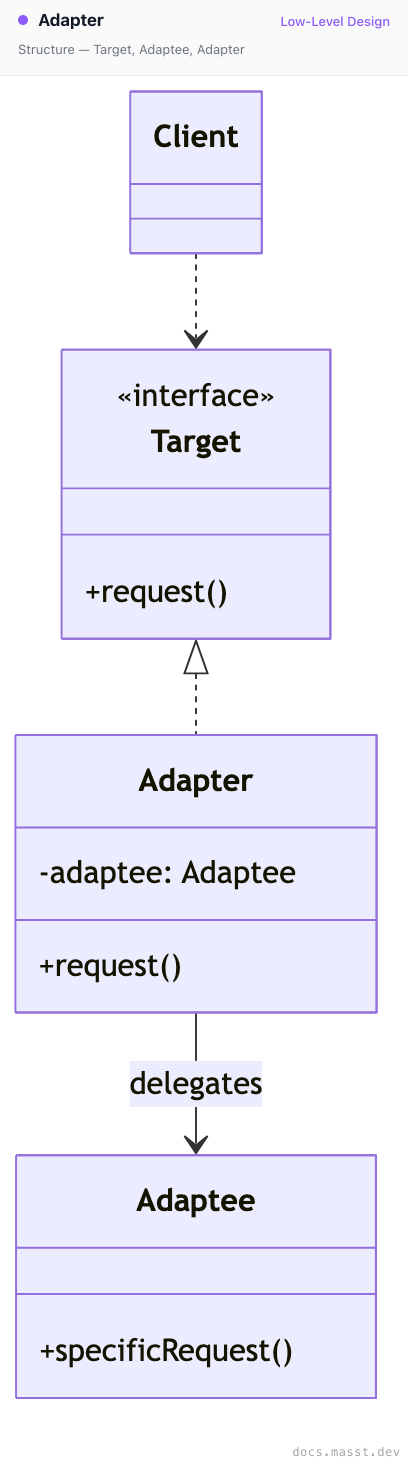
Example: Adapting a Legacy Payment API
The new system expects:
public interface PaymentProcessor {
    PaymentResult charge(Money amount, Card card);
}
The legacy library only offers:
public class LegacyPayments {
    // returns 0 = ok, 1 = declined, 2 = error
    public int makePayment(double dollars, String cardNumber, String cvv) { /* ... */ }
}
Wrap it:
public class LegacyPaymentAdapter implements PaymentProcessor {
    private final LegacyPayments legacy;

    public LegacyPaymentAdapter(LegacyPayments legacy) {
        this.legacy = legacy;
    }

    @Override
    public PaymentResult charge(Money amount, Card card) {
        int code = legacy.makePayment(
            amount.toDollars(),
            card.number(),
            card.cvv()
        );
        return switch (code) {
            case 0  -> PaymentResult.success();
            case 1  -> PaymentResult.declined("Card declined");
            default -> PaymentResult.error("Gateway error");
        };
    }
}
The rest of the codebase only sees PaymentProcessor. The legacy mess is contained.
Object Adapter vs Class Adapter
| Variant | Mechanism | Pros | Cons |
|---|---|---|---|
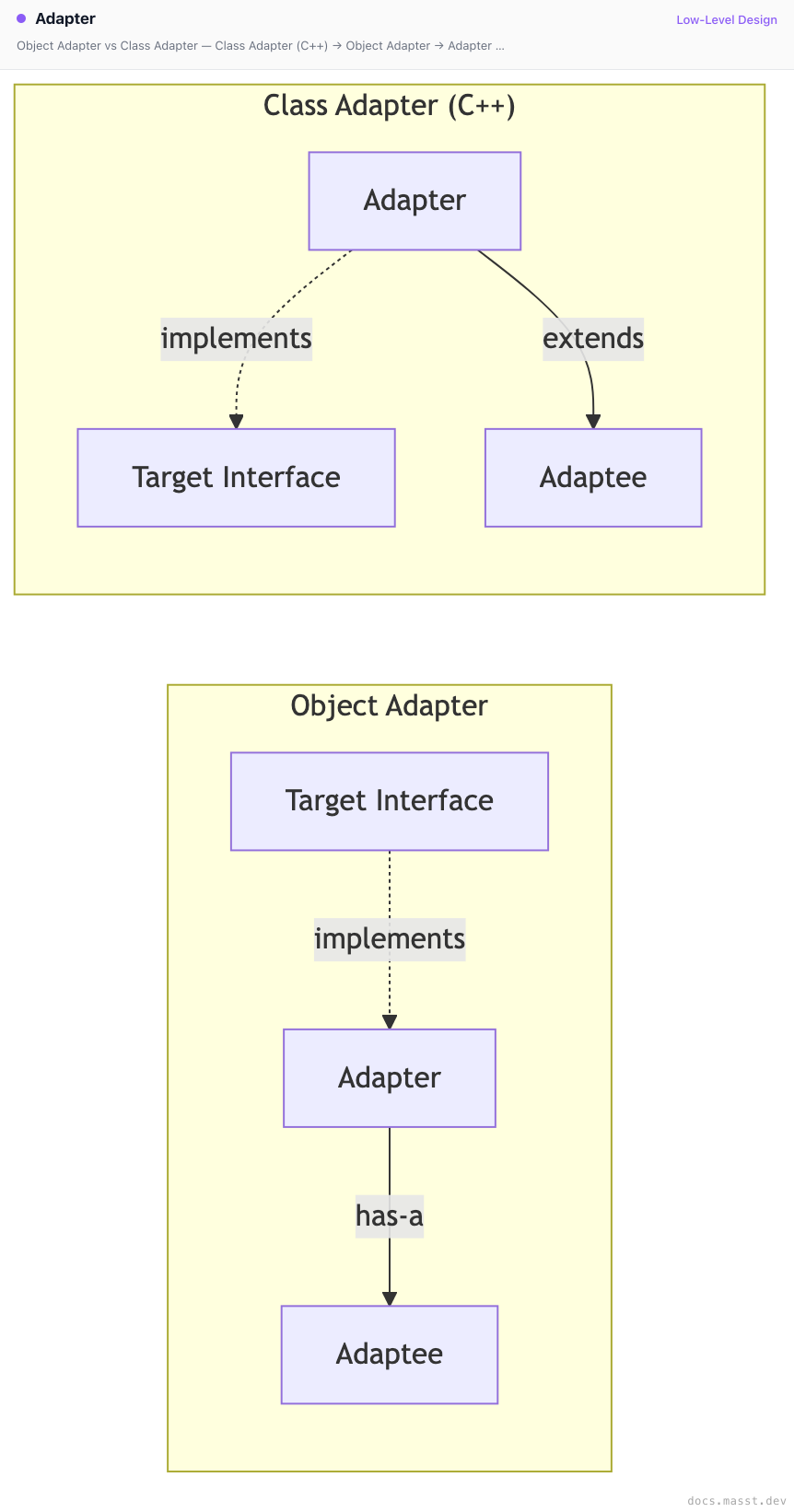
| Object adapter | Composition (holds a reference to adaptee) | Works in any language, can adapt subclasses too | One extra indirection |
| Class adapter | Multiple inheritance (extends both target and adaptee) | Slightly faster, can override adaptee methods | Requires multiple inheritance (not Java) |
Java only supports object adapters. C++ supports both.
Adapter vs Facade vs Decorator
These are easy to confuse. The difference is intent:
| Pattern | Intent | Interface |
|---|---|---|
| Adapter | Make existing interface match an expected one | Different from adaptee |
| Facade | Simplify a complex subsystem | New, simpler |
| Decorator | Add behavior dynamically | Same as wrapped object |
Two-way Adapter
Sometimes you need both directions: legacy code calling new code, and new code calling legacy. Implement both interfaces:
public class TwoWayAdapter implements NewApi, LegacyApi {
    // delegates each interface to the right backend
}
Use sparingly — it's a strong signal that the migration should just finish.
Real-world Examples
| Use case | What's adapted |
|---|---|
Arrays.asList(arr) | Java array → List |
InputStreamReader | Byte stream → character stream |
| JDBC drivers | Vendor-specific protocol → JDBC interface |
| Wrapper around a third-party SDK | SDK API → your domain interface |
java.io.PrintStream adapting OutputStream | Raw bytes → formatted text |
Trade-offs
✅ Pros:
- Integrate legacy / third-party code without modifying it
- Single Responsibility — adapter handles only translation
- Open/Closed — add new adaptees without changing existing code
❌ Cons:
- Indirection — readers must look at the adapter to see what's happening
- Can mask design problems (a forest of adapters is a smell)
- One adapter per adaptee × per target interface gets multiplicative
Interview Tips
- Mention adapter when the interviewer introduces a "legacy system we can't change" or "third-party library."
- Distinguish adapter from facade: adapter changes the shape of an interface; facade simplifies a set of interfaces.
- Acknowledge that overuse is a smell — adapters should be a bridge during migration, not a permanent layer.
Finished reading?
Mark it done to track your progress in Designs.