
Coupling & Cohesion
Two metrics that predict whether your design will age well.
The Goal
Low coupling. High cohesion.
| Term | Definition | Want |
|---|---|---|
| Coupling | How much one module depends on another | low |
| Cohesion | How focused a single module is on one job | high |
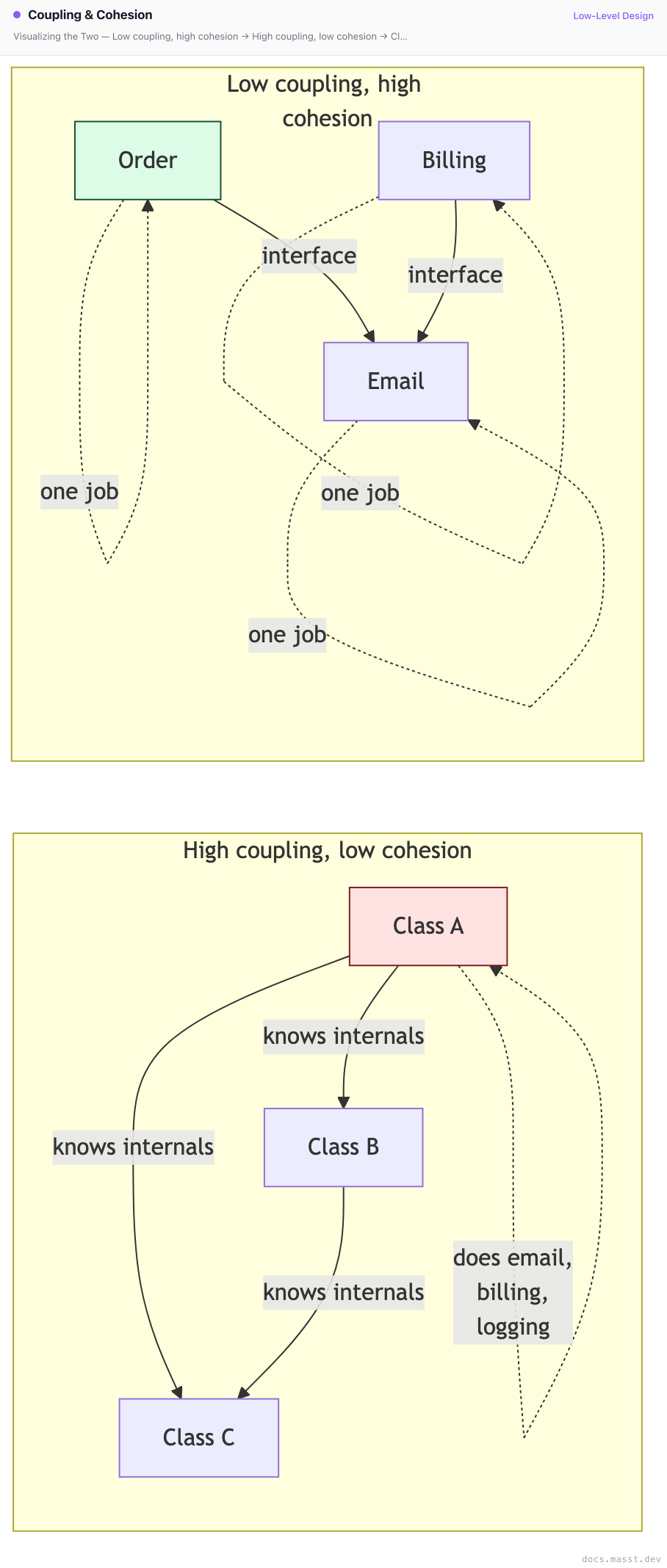
A class with high cohesion does one thing. A system with low coupling lets you change one class without rippling changes across many.
Cohesion (within a class)
Low cohesion — bad
public class UserManager {
    void createUser(User u) { ... }
    void sendWelcomeEmail(User u) { ... }
    void generateInvoice(User u) { ... }
    void exportToCsv(List<User> users) { ... }
    void compressLogFile(File f) { ... }
}
This class does five unrelated things. A change to email templating forces a redeploy of CSV export.
High cohesion — good
class UserService    { void createUser(User u); }
class EmailService   { void send(EmailTemplate t, User u); }
class InvoiceService { Invoice generate(User u); }
class UserExporter   { byte[] toCsv(List<User> users); }
class LogArchiver    { void compress(File f); }
Each class has one reason to change (Single Responsibility Principle).
Cohesion levels (Yourdon-Constantine)
| Level | Description | Quality |
|---|---|---|
| Functional | All elements contribute to one well-defined task | ✅ best |
| Sequential | Output of one element is input to the next | ✅ good |
| Communicational | Elements operate on the same data | 🟡 ok |
| Procedural | Elements follow a sequence but don't share data | 🟡 weak |
| Temporal | Elements happen at the same time (e.g., init) | 🟠 weak |
| Logical | Elements categorically similar but unrelated | ❌ bad |
| Coincidental | Random grouping (utility classes) | ❌ worst |
Coupling (between classes)
Tight coupling — bad
class OrderService {
    private MySqlOrderRepository repo = new MySqlOrderRepository();
    private SmtpEmailClient email = new SmtpEmailClient("smtp.gmail.com");

    void place(Order o) {
        repo.insert(o);                // depends on MySQL
        email.send(o.customer.email);   // depends on SMTP, Gmail
    }
}
OrderService is glued to MySQL and Gmail. You can't unit-test it without a real DB and SMTP server.
Loose coupling — good
class OrderService {
    private final OrderRepository repo;        // interface
    private final EmailGateway email;          // interface

    OrderService(OrderRepository r, EmailGateway e) {
        this.repo = r;
        this.email = e;
    }
}
Now you can plug in InMemoryOrderRepository for tests, switch to Postgres in prod, or swap email providers — all without touching OrderService.
Coupling levels (Stevens-Myers)
| Level | Description | Quality |
|---|---|---|
| None | Modules don't communicate | ✅ best (when possible) |
| Data | Modules share simple parameters | ✅ good |
| Stamp | Modules share a structured value object | ✅ ok |
| Control | One module controls another's behavior via flags | 🟡 weak |
| External | Shared external format (file, protocol) | 🟠 weak |
| Common | Shared global/mutable state | ❌ bad |
| Content | One module accesses another's internals | ❌ worst |
Visualizing the Two
Practical Levers
To reduce coupling
- Depend on abstractions (interfaces, not concrete classes) — DIP
- Inject dependencies rather than constructing them inside
- Avoid global state — singletons, statics, mutable module-level vars
- Hide internals —
privateby default,publicdeliberately
To increase cohesion
- Single Responsibility Principle — one reason to change per class
- Group by feature, not by layer —
Order/{controller, service, repo}beatscontrollers/,services/,repos/ - Delete utility/helper classes — they're cohesion graveyards. Move methods to the class that owns the data.
Tension
You can't always have both maxed. Sometimes pulling something out of a class (raising cohesion) introduces a new dependency (raising coupling). The art is the balance:
Tolerate slightly more coupling to keep classes single-purpose. Cohesion comes first.
Interview Tips
- If asked "is this design good?" answer in terms of coupling and cohesion, not vague "clean code" praise.
- Smell test: can you describe a class's purpose in one sentence without using "and"? If not, cohesion is low.
- Smell test: can you unit-test the class without spinning up databases or networks? If not, coupling is high.
Finished reading?
Mark it done to track your progress in Designs.