
OOP Principles
The four pillars of object-oriented programming — encapsulation, inheritance, polymorphism, and abstraction.
The Four Pillars
| Pillar | One-line Definition | Mechanism |
|---|---|---|
| Encapsulation | Bundle data and behavior; hide internals | private fields + public methods |
| Inheritance | Subclass reuses & specializes a parent | extends, implements |
| Polymorphism | One interface, many implementations | Method overriding, interfaces |
| Abstraction | Expose what, hide how | Abstract classes, interfaces |
1. Encapsulation
Bundle state with behavior, and prevent external code from mucking with internals directly.
public class BankAccount {
    private double balance;          // hidden
    private final String accountId;

    public BankAccount(String id, double opening) {
        this.accountId = id;
        this.balance = opening;
    }

    public void deposit(double amount) {
        if (amount <= 0) throw new IllegalArgumentException();
        this.balance += amount;
    }

    public double getBalance() { return balance; }
}
The caller cannot do account.balance = -1000 — they must go through deposit() which enforces the invariant balance >= 0 (when combined with a withdraw method).
Why it matters: invariants live in one place. Change the rule once, not in every caller.
2. Inheritance
A subclass reuses fields/methods of its parent and can specialize them.
public abstract class Vehicle {
    protected String licensePlate;
    public abstract double tollRate();
}

public class Car extends Vehicle {
    public double tollRate() { return 5.0; }
}

public class Truck extends Vehicle {
    private int axles;
    public double tollRate() { return 5.0 + axles * 2.0; }
}
Caution: prefer composition over inheritance. Inheritance creates strong coupling — a subclass depends on the parent's implementation, not just its interface.
3. Polymorphism
The same call site behaves differently depending on the runtime type.
List<Vehicle> queue = List.of(new Car(), new Truck());
double total = queue.stream().mapToDouble(Vehicle::tollRate).sum();
Two flavors:
| Flavor | Resolved at | Example |
|---|---|---|
| Compile-time (overloading) | compile | add(int, int) vs add(String, String) |
| Runtime (overriding) | runtime | Vehicle::tollRate dispatched to Car or Truck |
4. Abstraction
Expose a stable contract; hide the noise behind it.
public interface PaymentGateway {
    PaymentResult charge(Money amount, Card card);
}

// Caller doesn't care which provider — Stripe, Razorpay, mock.
class CheckoutService {
    private final PaymentGateway gateway;
    void checkout(Order o) { gateway.charge(o.total(), o.card()); }
}
The CheckoutService is testable (swap a mock gateway) and replaceable (switch providers without touching checkout logic).
Encapsulation vs Abstraction (commonly confused)
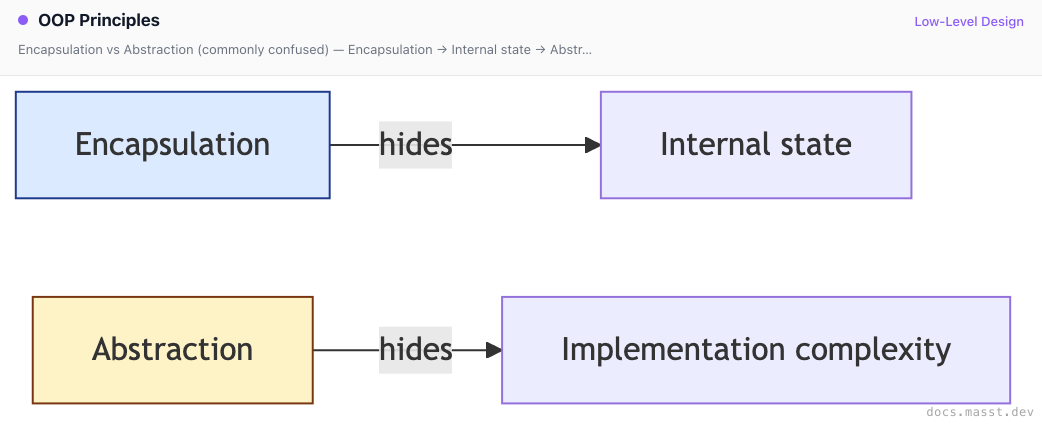
- Encapsulation: "you don't get to read/write
balancedirectly." - Abstraction: "you don't need to know how the payment happens, just call
charge()."
Class Relationships (cheat sheet)
| Relationship | UML | Example |
|---|---|---|
| Inheritance (is-a) | hollow triangle | Car is-a Vehicle |
| Composition (owns) | filled diamond | Car owns Engine (engine dies with car) |
| Aggregation (has) | hollow diamond | Team has Player (players outlive team) |
| Association (uses) | plain arrow | Order uses Customer |
| Dependency (uses temporarily) | dashed arrow | method param |
Interview Tips
- Don't recite the four pillars — demonstrate them in your design.
- When asked "why this class?" answer in terms of single responsibility, not OOP buzzwords.
- Be ready to defend composition over inheritance with a concrete example.
Finished reading?
Mark it done to track your progress in Designs.