
Case Studies
In-Memory File System
Design a Unix-like in-memory file system supporting ls, mkdir, addContent, readContent.
4 min readDesigns · LLD & Patterns
Interview practice: try designing this yourself before reading. Go to the exercise ↓
Problem Statement
Design an in-memory file system supporting:
ls(path)— list directory contents (or a single file)mkdir(path)— create directories (recursive)addContentToFile(path, content)— create or append to a filereadContentFromFile(path)— read file contentsdelete(path)— remove file or directory (recursive)
LeetCode #588.
Requirements
Functional
- Tree-structured paths (
/a/b/c.txt) lsreturns sorted children of a directory or[filename]for a filemkdircreates intermediate directories silentlyaddContentToFileappends to existing or creates new- File and directory are distinct types
Non-Functional
- All ops O(depth × children) at worst
- Thread-safe (read-heavy workload)
Class Diagram
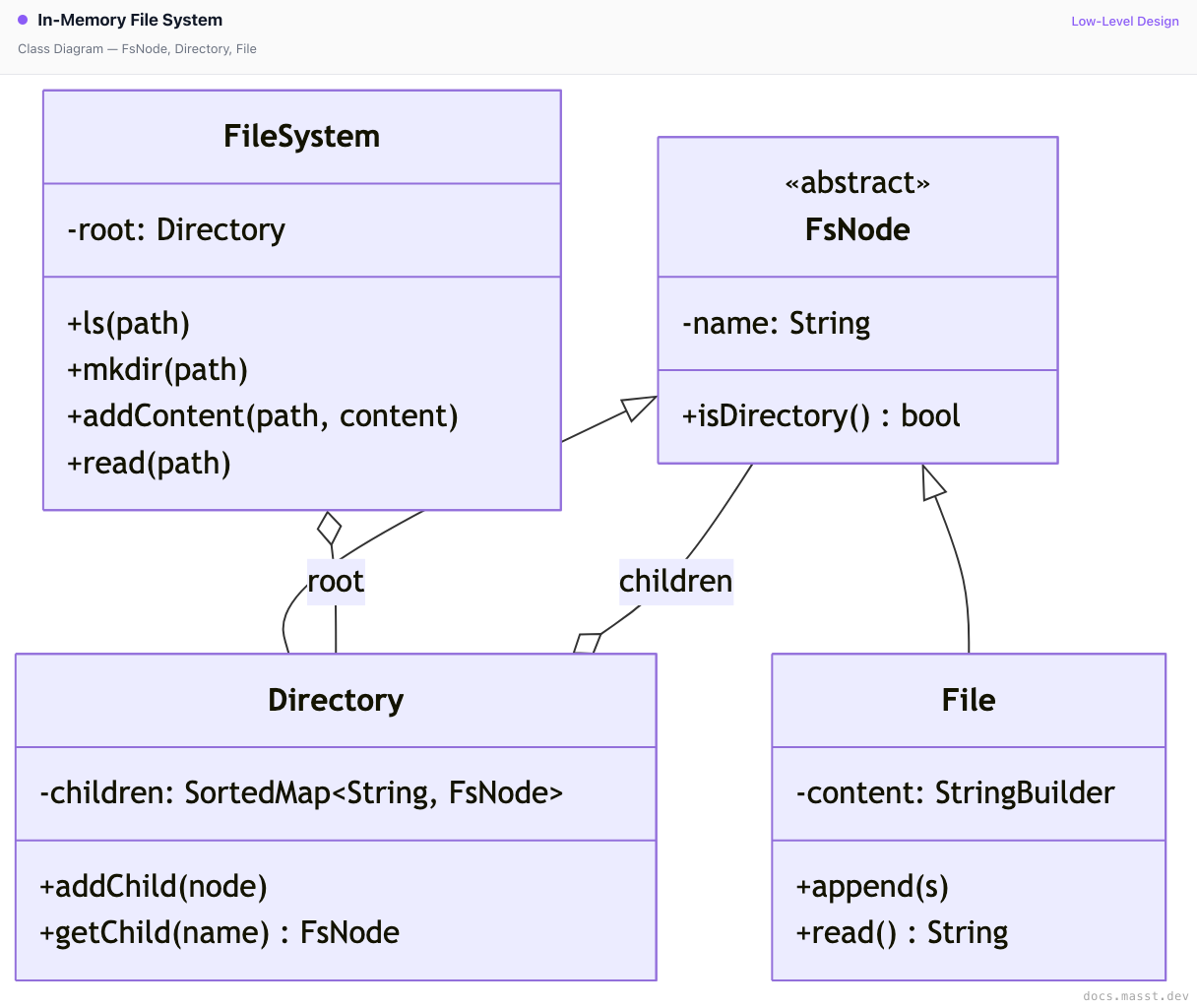
This is the Composite pattern — Directory and File share a base type.
Core Classes
public abstract class FsNode {
    protected final String name;

    protected FsNode(String name) { this.name = name; }

    public abstract boolean isDirectory();
    public String getName() { return name; }
}

public class File extends FsNode {
    private final StringBuilder content = new StringBuilder();

    public File(String name) { super(name); }

    @Override
    public boolean isDirectory() { return false; }

    public synchronized void append(String s) { content.append(s); }
    public synchronized String read() { return content.toString(); }
}

public class Directory extends FsNode {
    private final TreeMap<String, FsNode> children = new TreeMap<>();

    public Directory(String name) { super(name); }

    @Override
    public boolean isDirectory() { return true; }

    public synchronized FsNode getChild(String n) { return children.get(n); }
    public synchronized void addChild(FsNode n) { children.put(n.getName(), n); }
    public synchronized void removeChild(String n) { children.remove(n); }
    public synchronized List<String> listSorted() {
        return new ArrayList<>(children.keySet());
    }
}
TreeMap keeps children alphabetically — ls is naturally sorted.
FileSystem Service
public class FileSystem {
    private final Directory root = new Directory("");

    public List<String> ls(String path) {
        FsNode node = traverse(path, false);
        if (node == null) return Collections.emptyList();
        if (!node.isDirectory()) {
            // ls on a file returns [filename]
            return List.of(node.getName());
        }
        return ((Directory) node).listSorted();
    }

    public void mkdir(String path) {
        traverse(path, true);   // create intermediate dirs
    }

    public void addContentToFile(String path, String content) {
        String[] parts = split(path);
        Directory parent = traverseToParent(parts, true);
        String fileName = parts[parts.length - 1];

        FsNode existing = parent.getChild(fileName);
        File file;
        if (existing == null) {
            file = new File(fileName);
            parent.addChild(file);
        } else if (existing.isDirectory()) {
            throw new IllegalStateException(path + " is a directory");
        } else {
            file = (File) existing;
        }
        file.append(content);
    }

    public String readContentFromFile(String path) {
        FsNode node = traverse(path, false);
        if (node == null || node.isDirectory())
            throw new IllegalArgumentException("not a file: " + path);
        return ((File) node).read();
    }

    public void delete(String path) {
        String[] parts = split(path);
        Directory parent = traverseToParent(parts, false);
        if (parent == null) return;
        parent.removeChild(parts[parts.length - 1]);
    }

    /* ---------- helpers ---------- */

    private String[] split(String path) {
        if (path.equals("/")) return new String[0];
        return Arrays.stream(path.split("/"))
            .filter(s -> !s.isEmpty())
            .toArray(String[]::new);
    }

    private FsNode traverse(String path, boolean createMissing) {
        String[] parts = split(path);
        FsNode node = root;
        for (String p : parts) {
            if (!node.isDirectory()) return null;
            Directory dir = (Directory) node;
            FsNode child = dir.getChild(p);
            if (child == null) {
                if (!createMissing) return null;
                child = new Directory(p);
                dir.addChild(child);
            }
            node = child;
        }
        return node;
    }

    private Directory traverseToParent(String[] parts, boolean createMissing) {
        FsNode node = root;
        for (int i = 0; i < parts.length - 1; i++) {
            Directory dir = (Directory) node;
            FsNode child = dir.getChild(parts[i]);
            if (child == null) {
                if (!createMissing) return null;
                child = new Directory(parts[i]);
                dir.addChild(child);
            }
            node = child;
        }
        return (Directory) node;
    }
}
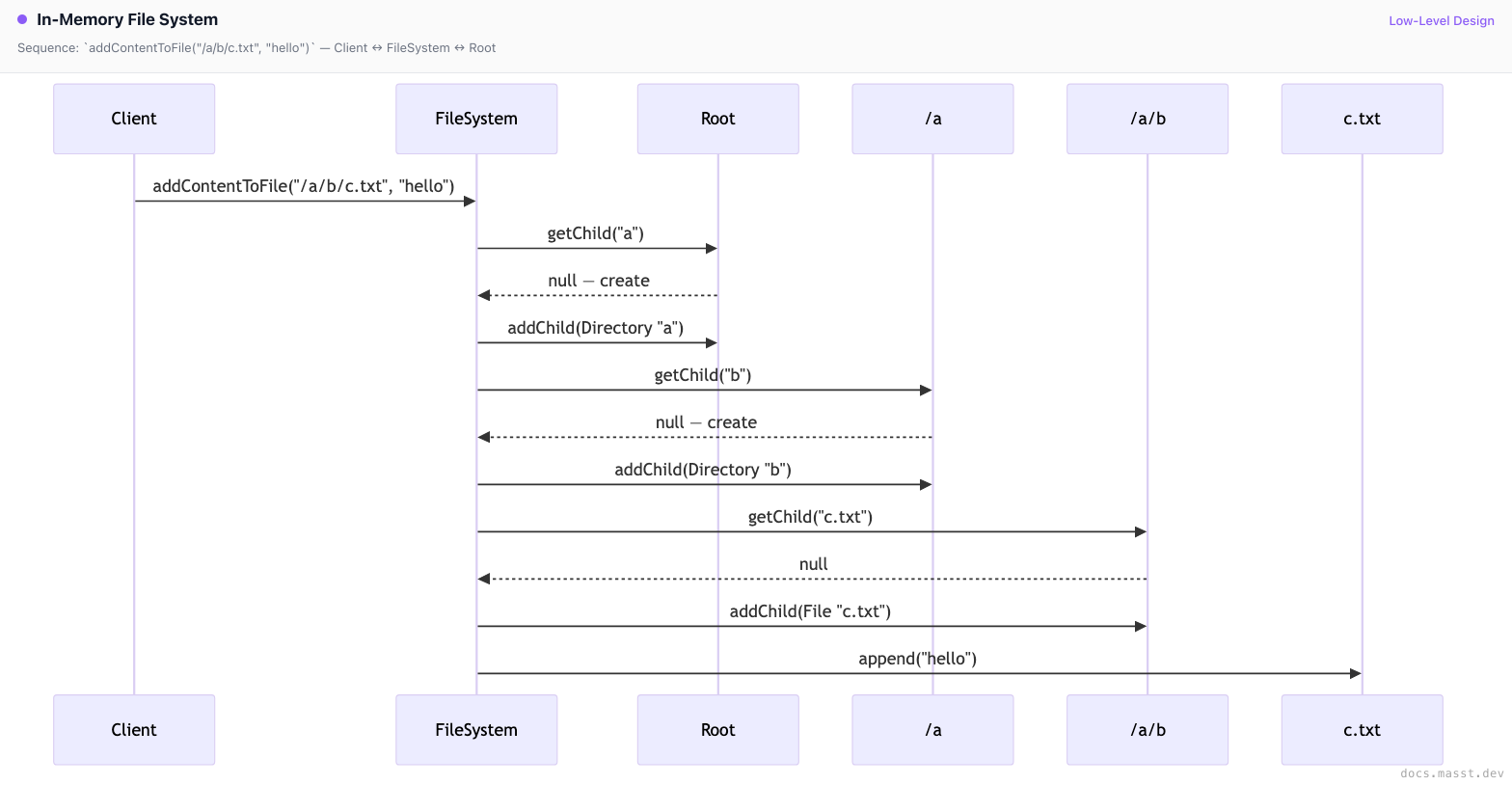
Sequence: addContentToFile("/a/b/c.txt", "hello")
Concurrency
- Per-node synchronization (above) — simple, locks one node at a time.
- For high concurrency, use a
ReentrantReadWriteLockper directory: many readers canlssimultaneously, exclusive onmkdir/addChild. - Or copy-on-write the tree on each write. Cheap reads, expensive writes.
- Linearizability across paths is a harder problem (see ZooKeeper).
Edge Cases
| Case | Handling |
|---|---|
ls("/") on empty tree | [] |
ls(path) on a file | [filename] (LeetCode #588 spec) |
addContentToFile on existing dir path | Throw |
mkdir on existing path | No-op |
| Trailing slash | Normalize (strip) |
Path with empty segments (//a) | Split skips empties |
| Delete non-existent path | No-op (or throw, by spec) |
Extensions
| Extension | Approach |
|---|---|
| File metadata (size, mtime) | Add fields to FsNode |
| Symlinks | New SymlinkNode storing target path |
| Permissions (Unix mode) | Add mode to FsNode + check on ops |
| Hard links | Reference-count files; node has multiple parents |
| Persistence | Snapshot the tree to disk; replay on load |
Design Patterns Used
| Pattern | Where |
|---|---|
| Composite | Directory / File share FsNode |
| Singleton | One FileSystem per app |
| Visitor | Walk the tree for stats, search, du |
| Iterator | Iterate descendants (DFS / BFS) |
Interview Tips
- Identify composite pattern out loud — that's the architectural insight.
- Use
TreeMapfor children to get sortedlsfor free. - Walk through edge cases:
lson a file,addContentToFileto existing dir. - Discuss path normalization (
//a/,/a/./b,..) if asked — most interviews don't require it. - Mention extensibility for symlinks, metadata, permissions.
Practice
Try it yourself
Design an in-memory Unix-like file system.
Your design should cover
- mkdir with nested paths
- ls on a file or a directory, in sorted order
- Create a file and append content to it
- Read a file's content
- Path parsing handles edge cases like the root and trailing slashes
0 / 8,000 characters · saved in this browser
Finished reading?
Mark it done to track your progress in Designs.