
DRY, KISS, YAGNI
Three rules of thumb that keep code small, simple, and unspeculative.
The Three Rules
| Acronym | Stands for | Core message |
|---|---|---|
| DRY | Don't Repeat Yourself | Each piece of knowledge should have one authoritative representation |
| KISS | Keep It Simple, Stupid | The simplest design that works is the right design |
| YAGNI | You Ain't Gonna Need It | Don't build for hypothetical future requirements |
These often pull in opposite directions — knowing when to apply each is the skill.
DRY — Don't Repeat Yourself
Bad:
double calculateUSPrice(Item i) { return i.price * 1.07; }   // 7% sales tax
double calculateInvoice(Item i) { return i.price * 1.07; }   // duplicated
Good:
private static final double US_TAX = 0.07;
double withTax(Item i) { return i.price * (1 + US_TAX); }
If the tax rate changes, you fix it once.
What DRY is not
DRY is about knowledge, not lines of text. Two methods that happen to look identical today but represent different concepts shouldn't be merged.
// These look identical but represent different rules — DON'T merge them
double calculateLateFee(Loan l)  { return l.amount * 0.05; }
double calculateProcessingFee(Loan l) { return l.amount * 0.05; }
When the late fee changes to 6% but the processing fee stays at 5%, you'll be glad they were separate.
KISS — Keep It Simple, Stupid
The simplest thing that solves the problem is the right thing.
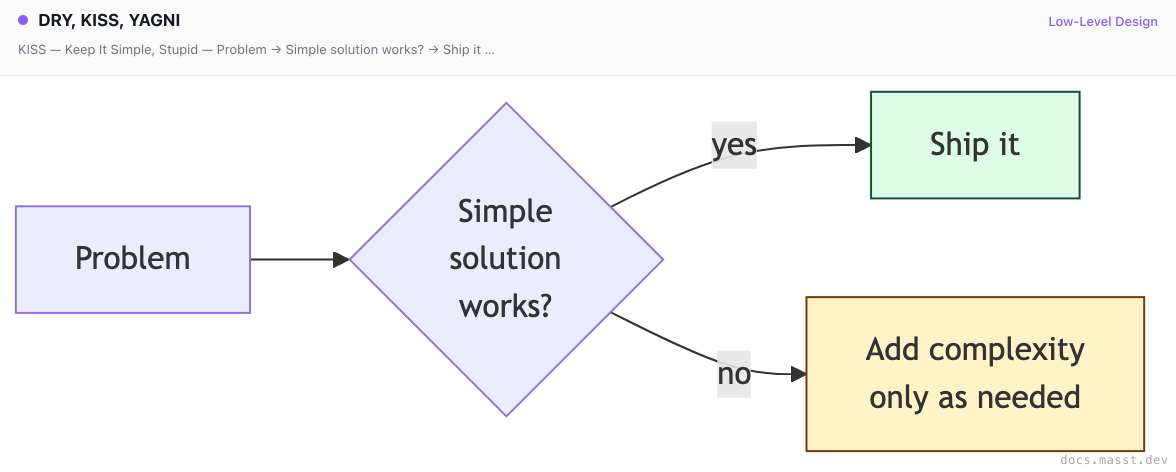
Anti-patterns KISS rejects
| Anti-pattern | Symptom |
|---|---|
| Over-engineering | 5 layers of abstraction for a CRUD endpoint |
| Premature optimization | Bit-packing booleans before profiling |
| Cleverness for its own sake | One-line stream chain that nobody can read |
| Configurable everything | 40 config flags for things that never change |
Example
Over-engineered:
public interface UserNameStrategy { String generate(User u); }
public class FirstLastNameStrategy implements UserNameStrategy { ... }
public class UserNameContext {
    private UserNameStrategy strategy;
    public String getName(User u) { return strategy.generate(u); }
}
KISS:
String fullName(User u) { return u.first + " " + u.last; }Add the strategy when you have a second strategy, not before.
YAGNI — You Ain't Gonna Need It
Don't add features, parameters, or extension points speculating about the future.
| Speculation | Reality |
|---|---|
| "We might need to support multiple databases someday" | You won't. And if you do, the abstraction you built today won't fit. |
| "What if we want to make this configurable?" | It will stay hardcoded for 4 years until somebody needs to change it, then they'll just change it. |
| "Let me add a hook so future-me can extend this" | Future-you won't remember the hook exists. |
Why YAGNI is hard
It feels responsible to build for the future. But:
- Most predictions are wrong. The future feature never gets built, or gets built differently.
- Speculation costs maintenance. Every unused abstraction is code to read, test, and break.
- Real requirements are sharper. When you actually need a feature, you'll know exactly what it should look like — better than today's guess.
When the Three Conflict
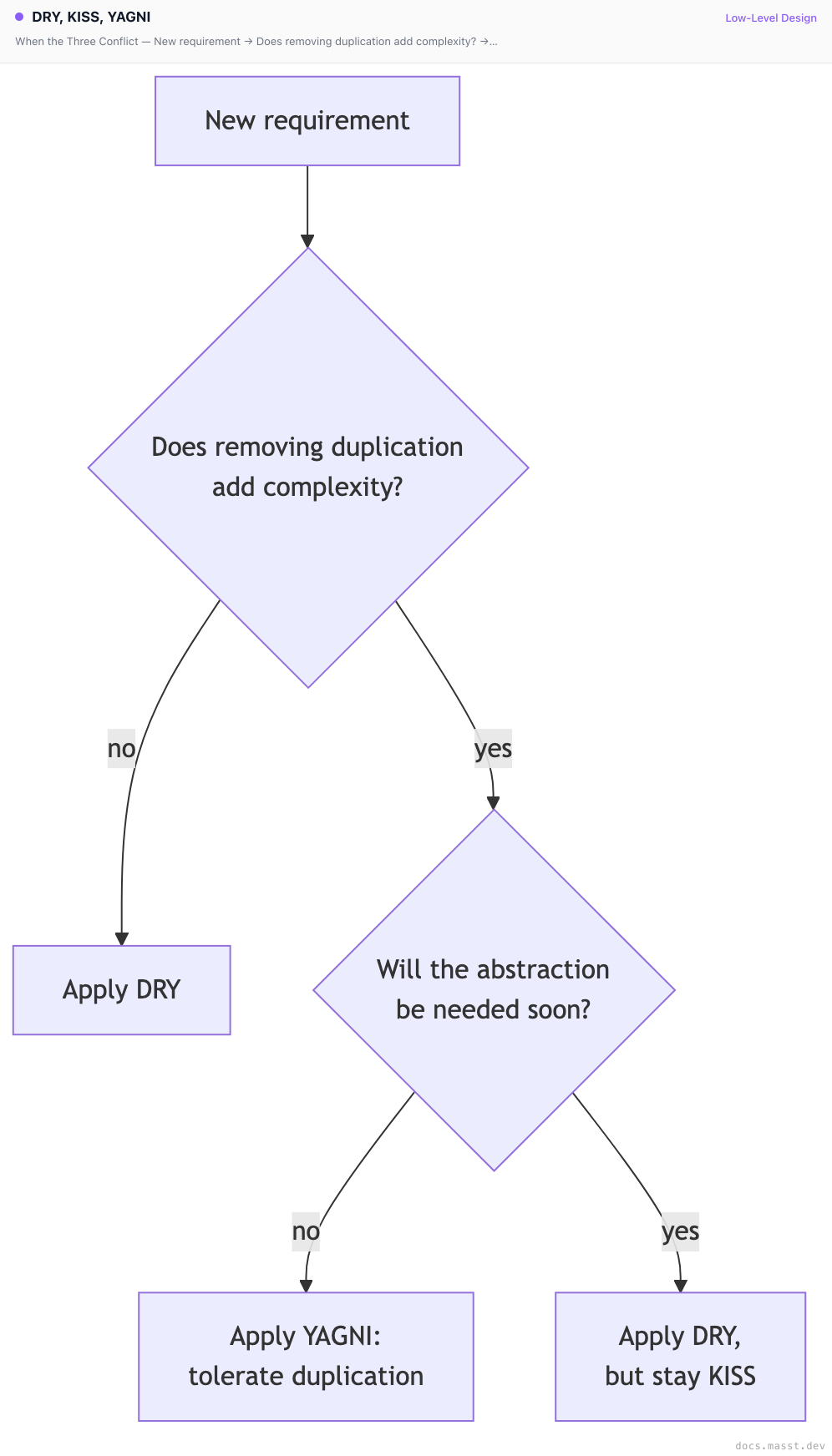
A common conflict: you have two functions that share 80% of their logic. DRY says merge. But the merge requires a parameter, a flag, and an if. KISS and YAGNI say keep them separate until you have a third caller.
Rule of three: wait until something appears three times before extracting it.
Interview Tips
- When asked "would you abstract this?" don't auto-answer yes. Say: "I'd wait for a second use case before abstracting — premature abstraction is hard to undo."
- Cite YAGNI when the interviewer pushes you to add features you don't need yet ("what if we wanted to support N currencies?" → "I'd add it when we onboard the second currency; today, hardcoding USD is fine").
- KISS is the default. Justify every layer of abstraction you add.
Finished reading?
Mark it done to track your progress in Designs.