
Composition vs Inheritance
When to extend a class and when to embed one — the most consequential design choice in OOP.
The Two Tools
| Mechanism | Reads as | Coupling |
|---|---|---|
| Inheritance | "is-a" | tight — subclass depends on parent's implementation |
| Composition | "has-a" | loose — class depends only on the embedded interface |
The Classic Trap
Inheritance abuse:
public class Stack<T> extends ArrayList<T> {
    public void push(T item) { add(item); }
    public T pop() { return remove(size() - 1); }
}
This compiles, but Stack now exposes add(int index, T), remove(int), set(int, T) — every list method. A caller can violate stack semantics by inserting in the middle.
Composition fix:
public class Stack<T> {
    private final List<T> data = new ArrayList<>();
    public void push(T item) { data.add(item); }
    public T pop() { return data.remove(data.size() - 1); }
}
Now the public surface is exactly push and pop. The List is an implementation detail.
Why "Favor Composition Over Inheritance"
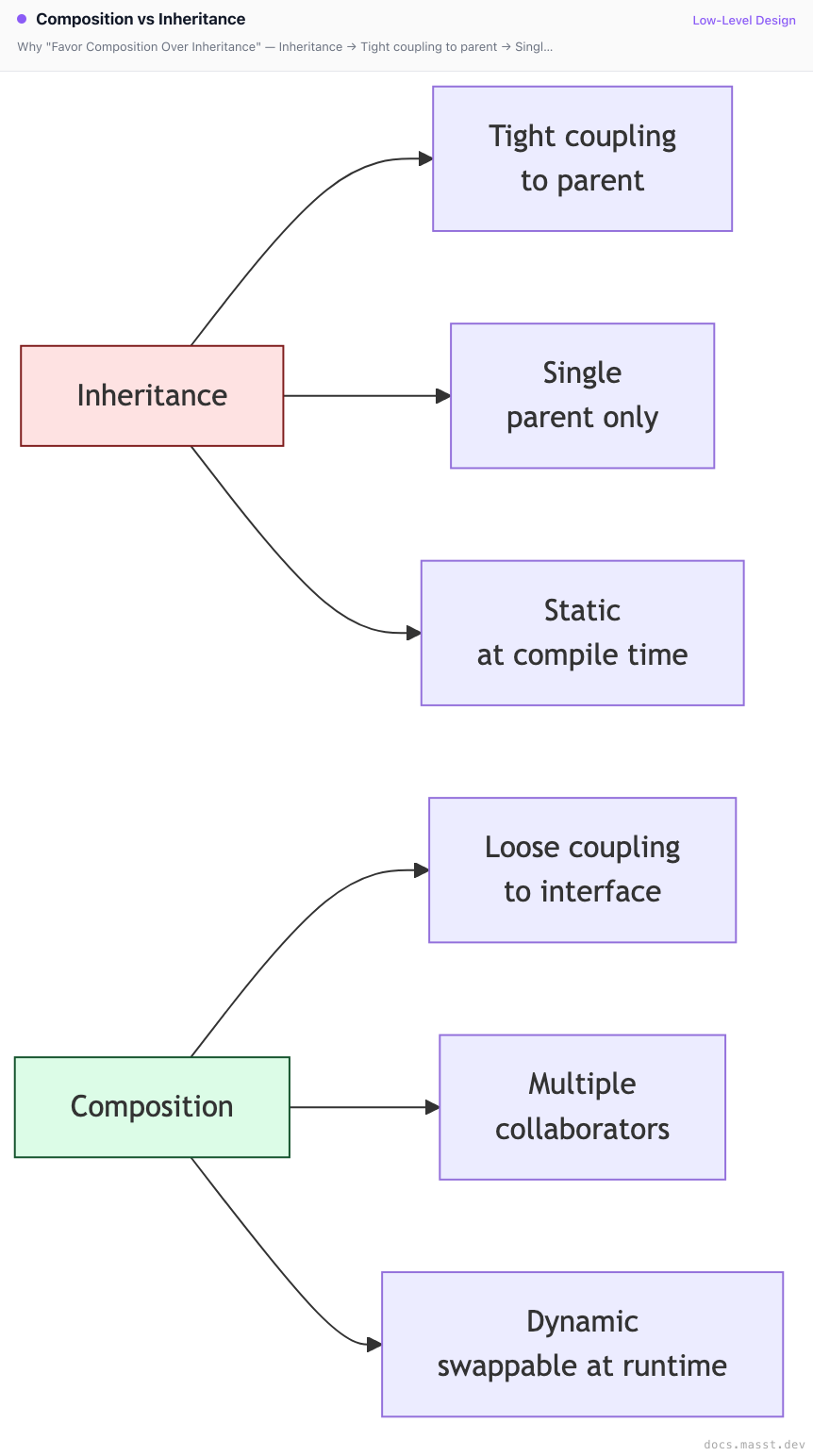
1. The Fragile Base Class Problem
A change in the parent can break subclasses in non-obvious ways:
public class CountingList<T> extends ArrayList<T> {
    private int adds = 0;

    @Override
    public boolean add(T item) {
        adds++;
        return super.add(item);
    }

    @Override
    public boolean addAll(Collection<? extends T> c) {
        adds += c.size();
        return super.addAll(c);  // BUG: addAll internally calls add()
    }
}
If ArrayList.addAll is implemented as a loop calling add, the count is doubled. The subclass is correct in isolation but couples to the parent's implementation.
2. Multiple Inheritance / Hierarchy Explosion
You want a LoggedRetryableCachedClient. With inheritance you'd need a class for every combination. With composition you wrap:
Client c = new LoggedClient(new RetryableClient(new CachedClient(real)));(This is the Decorator pattern — composition in disguise.)
3. Runtime Flexibility
Composition lets you swap behavior at runtime:
class PaymentService {
    private PricingStrategy pricing;          // can change at runtime
    void setPricing(PricingStrategy p) { this.pricing = p; }
}
Inheritance is fixed at compile time — once class WeekendPricing extends BasePricing, the relationship is permanent.
When Inheritance Is Right
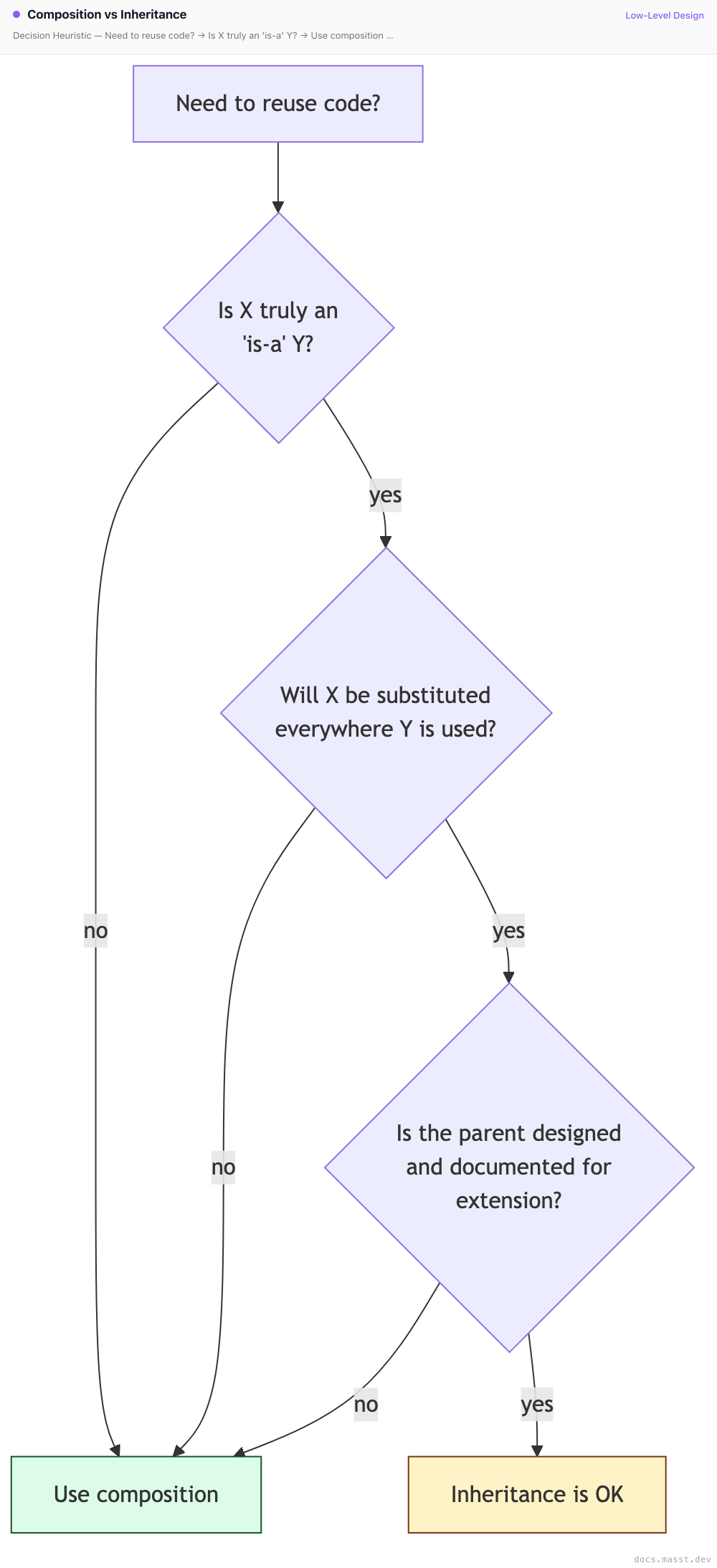
Use inheritance when all three are true:
- The relationship is genuinely is-a, not "looks like".
- The subclass is a true subtype — Liskov-substitutable for the parent.
- The parent class was designed for inheritance (documented, with stable hooks).
Examples where inheritance fits:
- Abstract classes you control:
AbstractList,BaseHandler - Sealed/closed hierarchies:
Shape -> {Circle, Square}where you enumerate every case - Framework extension points:
extends Activity,extends ViewModel
Decision Heuristic
Side-by-Side
| Scenario | Inheritance | Composition |
|---|---|---|
Car and Engine | ❌ a car has an engine | ✅ Car { Engine engine; } |
Square and Shape | ✅ a square is a shape | – |
Stack and List | ❌ a stack is not a list | ✅ Stack { List data; } |
Manager and Employee | ✅ a manager is an employee | – |
Logger adds logging to Client | ❌ logger is not a client | ✅ Decorator |
Interview Tips
- When you reach for
extends, ask yourself: would this still make sense if the parent's implementation changed completely? - If you find yourself writing
super.method()to "tweak" parent behavior, you probably want composition. - Mention delegation (a fancy word for composition + forwarding methods) when the interviewer asks how to "share code" without inheritance.
Finished reading?
Mark it done to track your progress in Designs.