
State
Allow an object to alter its behavior when its internal state changes — appearing as if it changed class.
Intent
Replace
if (state == X) ... else if (state == Y) ...cascades by giving each state its own class with state-specific behavior.
Use when:
- An object behaves very differently depending on a small set of states.
- State transitions follow well-defined rules.
- You're tired of giant
switchstatements scattered across many methods.
The Smell It Replaces
public class TrafficLight {
    enum Color { RED, YELLOW, GREEN }
    private Color color = Color.RED;

    public void next() {
        switch (color) {
            case RED:    color = Color.GREEN; break;
            case GREEN:  color = Color.YELLOW; break;
            case YELLOW: color = Color.RED; break;
        }
    }

    public int waitSeconds() {
        switch (color) {
            case RED:    return 30;
            case YELLOW: return 5;
            case GREEN:  return 25;
        }
        throw new IllegalStateException();
    }
}
Every method is a switch. Add a new state (BLINKING_RED) and you must edit every method.
State Pattern Solution
public interface TrafficLightState {
    TrafficLightState next();
    int waitSeconds();
}

public class RedState implements TrafficLightState {
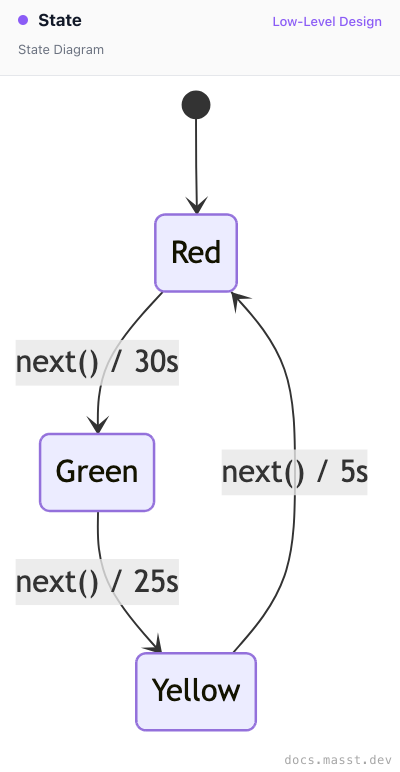
    public TrafficLightState next() { return new GreenState(); }
    public int waitSeconds() { return 30; }
}
public class GreenState implements TrafficLightState {
    public TrafficLightState next() { return new YellowState(); }
    public int waitSeconds() { return 25; }
}
public class YellowState implements TrafficLightState {
    public TrafficLightState next() { return new RedState(); }
    public int waitSeconds() { return 5; }
}

public class TrafficLight {
    private TrafficLightState state = new RedState();

    public void next() { state = state.next(); }
    public int waitSeconds() { return state.waitSeconds(); }
}
Adding BlinkingRed = one new class, no edits to existing classes.
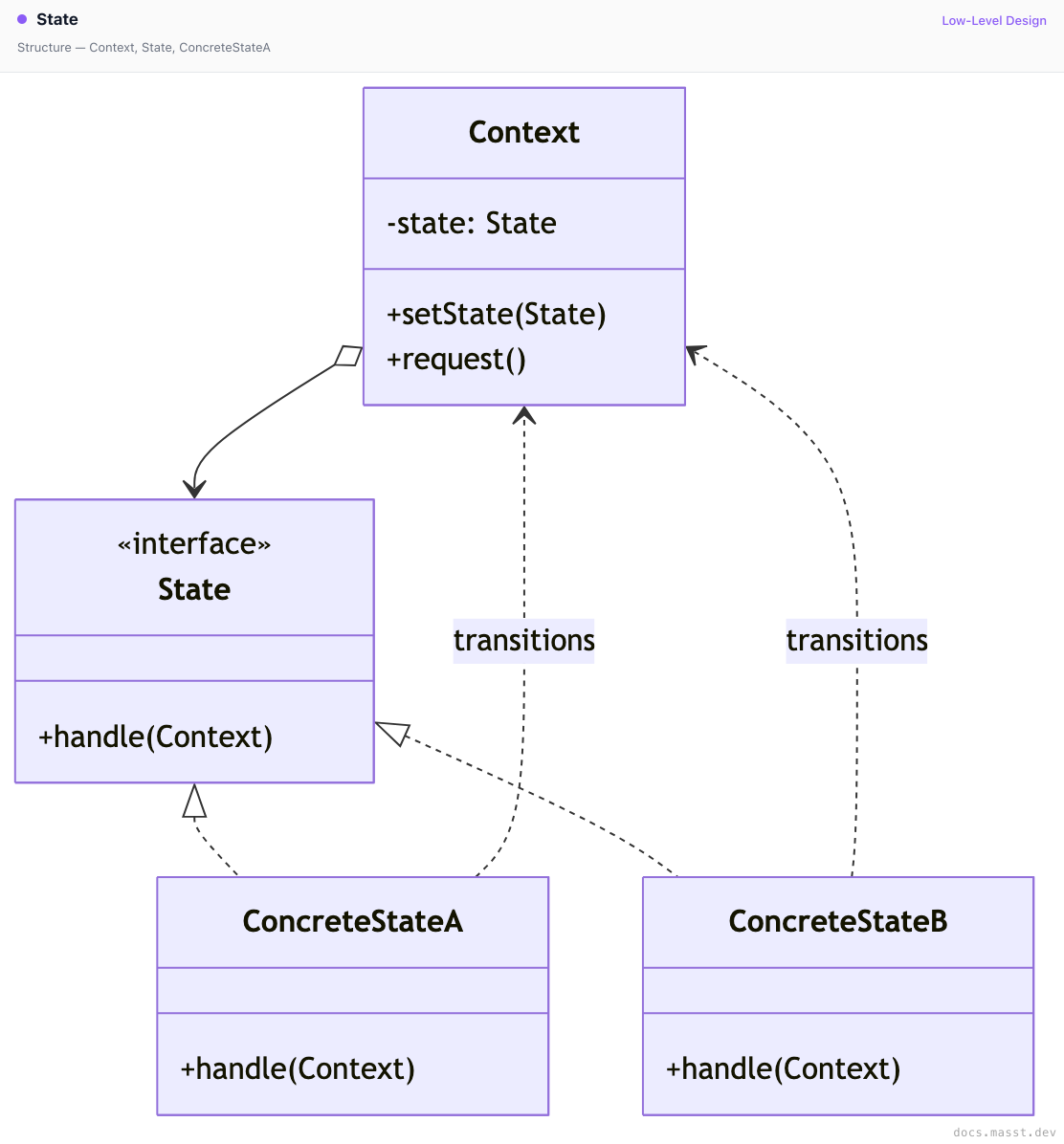
Structure
State Diagram
Example: TCP Connection
public interface ConnectionState {
    void open(Connection c);
    void close(Connection c);
    void send(Connection c, byte[] data);
}

class ClosedState implements ConnectionState {
    public void open(Connection c) {
        System.out.println("Opening...");
        c.setState(new OpenState());
    }
    public void close(Connection c) { /* already closed */ }
    public void send(Connection c, byte[] data) {
        throw new IllegalStateException("Cannot send: connection closed");
    }
}

class OpenState implements ConnectionState {
    public void open(Connection c) { /* already open */ }
    public void close(Connection c) {
        System.out.println("Closing...");
        c.setState(new ClosedState());
    }
    public void send(Connection c, byte[] data) {
        System.out.println("Sending " + data.length + " bytes");
    }
}

public class Connection {
    private ConnectionState state = new ClosedState();
    public void setState(ConnectionState s) { this.state = s; }

    public void open()  { state.open(this); }
    public void close() { state.close(this); }
    public void send(byte[] d) { state.send(this, d); }
}
The Connection doesn't have a single if checking which state it's in. Each state object knows what's legal in its world.
State vs Strategy
These are structurally identical (a context delegating to an interface). The difference is who decides the change:
| Pattern | Who picks the next behavior? |
|---|---|
| Strategy | Caller picks once, doesn't change |
| State | Object self-transitions based on internal events |
A strategy is set externally and stays. A state mutates as the object's lifecycle progresses.
State Transitions: Where to Put Them?
| Approach | Pro | Con |
|---|---|---|
| State objects decide transitions | States are self-contained | States must know about each other |
| Context decides transitions (with table) | States stay simple | Context grows |
Both are common. Hybrid: states return the next state; context applies it.
Stateless States
If state classes have no per-instance data, they can be singletons to avoid allocation churn:
public final class RedState implements TrafficLightState {
    public static final RedState INSTANCE = new RedState();
    private RedState() {}
    public TrafficLightState next() { return GreenState.INSTANCE; }
    public int waitSeconds() { return 30; }
}
Real-world Examples
| Use case | States |
|---|---|
| Order lifecycle | Pending → Paid → Shipped → Delivered |
| TCP connection | Closed → Listen → SynRcvd → Established → ... |
| Game character | Idle → Walking → Running → Jumping → Falling |
| Document workflow | Draft → InReview → Approved → Published |
| Player media | Stopped → Playing → Paused |
Thread.State (Java) | New, Runnable, Blocked, Waiting, Terminated |
Trade-offs
✅ Pros:
- Eliminates state-checking conditionals
- Each state's logic is isolated and testable
- Adding a state doesn't touch existing states (open/closed)
- Behavior tracks state automatically
❌ Cons:
- More classes — overkill for 2-state cases
- Transitions are spread across state classes (or centralized but rigid)
- Shared data needs thoughtful placement (context vs state)
Interview Tips
- Reach for state when the interviewer describes a workflow with a small set of clearly-named stages.
- Draw the state diagram first — interviewers love seeing the transitions visualized.
- Mention LSP: each state must honor the same contract (don't have one state throw on a method others handle).
Finished reading?
Mark it done to track your progress in Designs.