
Observer
Define a one-to-many dependency so that when one object changes state, all its dependents are notified automatically.
Intent
Let an object (the subject) broadcast changes to interested parties (observers) without knowing who they are.
Use when:
- One object's state change has many downstream effects.
- The number/type of dependents may grow over time.
- You want to decouple the producer from the consumers.
Real-world Analogy
A newsletter. The publisher doesn't know who's subscribed; subscribers come and go. When a new issue is published, everyone on the list gets a copy automatically.
Structure
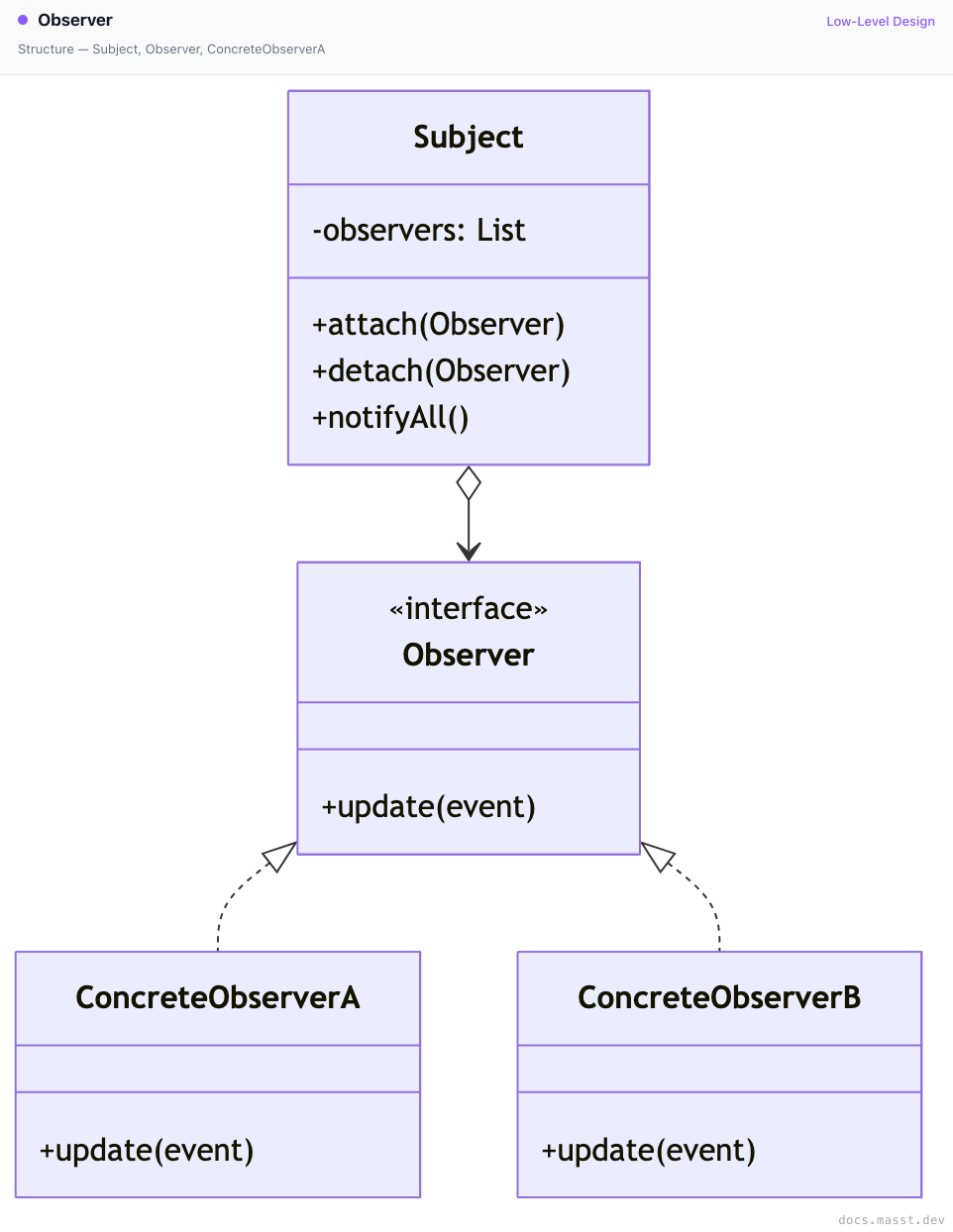
Example: Stock Price Updates
public interface PriceObserver {
    void onPriceChanged(String symbol, double newPrice);
}

public class StockTicker {
    private final Map<String, Double> prices = new HashMap<>();
    private final List<PriceObserver> observers = new CopyOnWriteArrayList<>();

    public void subscribe(PriceObserver o)   { observers.add(o); }
    public void unsubscribe(PriceObserver o) { observers.remove(o); }

    public void updatePrice(String symbol, double price) {
        prices.put(symbol, price);
        for (PriceObserver o : observers) {
            o.onPriceChanged(symbol, price);
        }
    }
}

class ChartUpdater implements PriceObserver {
    public void onPriceChanged(String s, double p) { /* redraw chart */ }
}

class AlertBot implements PriceObserver {
    public void onPriceChanged(String s, double p) {
        if (p > threshold) sendAlert(s, p);
    }
}

// Wiring
StockTicker ticker = new StockTicker();
ticker.subscribe(new ChartUpdater());
ticker.subscribe(new AlertBot());

ticker.updatePrice("AAPL", 175.50);   // both observers notified
The StockTicker doesn't know about charts or bots. New observer types come and go without touching the ticker.
Push vs Pull
| Style | Mechanism | Pro | Con |
|---|---|---|---|
| Push | Subject sends data: update(event) | Observer doesn't query | Couples subject to what observers want |
| Pull | Subject sends signal: update(), observer queries subject | Subject stays simple | Observer must hold a reference to subject |
// Push
interface Observer { void update(StockEvent e); }

// Pull
interface Observer { void update(); }
class ChartUpdater implements Observer {
    private StockTicker ticker;
    public void update() { redrawWith(ticker.getPrices()); }
}
Push is simpler when observers all want the same data. Pull is more flexible.
Threading & Memory Hazards
Concurrent modification
If an observer's callback subscribes/unsubscribes during notification, you'll get ConcurrentModificationException. Use CopyOnWriteArrayList (above) or copy the list before iterating.
Memory leaks
If Subject holds strong references to observers and observers don't unsubscribe, they're kept alive forever. Common in Android, Swing, mobile.
Fix options:
- Document an explicit
unsubscribe()requirement. - Use
WeakReferencefor observers. - Tie subscription to a lifecycle (e.g.,
LiveDataobservers in Android scoped to a Lifecycle).
Synchronous notification
By default, observers run on the subject's thread, in registration order. A slow observer blocks all others. Consider:
- Async dispatch via an executor
- Event bus / message queue (out of process)
Java Built-in Support
// PropertyChangeSupport — built into JavaBeans
private final PropertyChangeSupport pcs = new PropertyChangeSupport(this);
public void addPropertyChangeListener(PropertyChangeListener l) { pcs.addPropertyChangeListener(l); }

void setPrice(double p) {
    double old = this.price;
    this.price = p;
    pcs.firePropertyChange("price", old, p);
}
Note: java.util.Observable and Observer are deprecated since Java 9 — don't use them. Use Flow.Publisher/Subscriber (reactive streams) for modern async observers.
Real-world Examples
| Use case | Subject | Observers |
|---|---|---|
| GUI events | Button | Click handlers |
| MVC | Model | Views |
| Pub/sub | Topic | Subscribers |
Spring ApplicationEvent | Publisher | @EventListener methods |
| RxJava / Reactor | Observable / Flux | Subscriber |
addEventListener (DOM) | DOM element | Listener functions |
Trade-offs
✅ Pros:
- Subject doesn't know about observers — open/closed
- Add/remove observers at runtime
- Many-to-one relationships (multiple subjects, one observer) work too
❌ Cons:
- Order of notification is implicit and easy to depend on accidentally
- Memory leaks if observers don't unsubscribe
- Cascading updates can be hard to trace
- Slow observer blocks chain (without async)
Interview Tips
- Use observer when the interviewer says "notify when X happens" or "multiple things should react to ...".
- Mention
CopyOnWriteArrayListto handle concurrent modification. - For large-scale, mention upgrade paths: event bus → message queue → kafka.
Finished reading?
Mark it done to track your progress in Designs.