
Architecture
Backend for Frontend (BFF)
Understanding the BFF pattern for frontend-specific backends.
3 min readConcepts · System Design
What is BFF?
The Backend for Frontend (BFF) pattern creates separate backend services for each frontend application. Each BFF is tailored to the specific needs of its client (web, mobile, IoT).
The Problem
A single generic API struggles to serve different clients:

Issues:
- Mobile needs less data but web needs more
- Different authentication flows
- API becomes bloated serving all clients
- Changes for one client risk breaking others
The BFF Solution
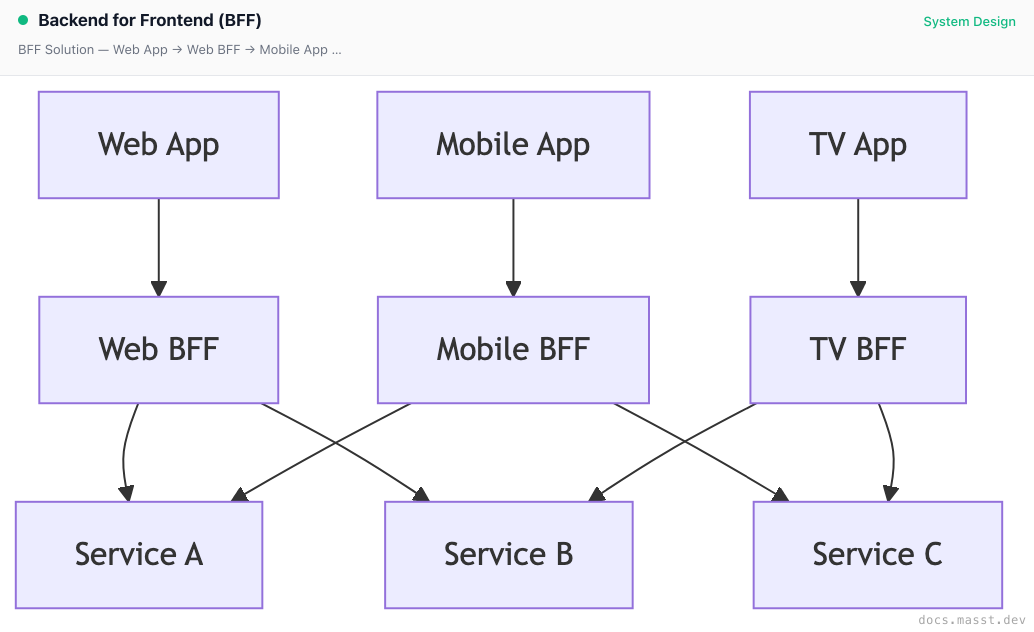
Each BFF:
- Aggregates data for its specific client
- Returns only what the client needs
- Handles client-specific auth
- Transforms responses to optimal format
What a BFF Does
| Function | Example |
|---|---|
| Response shaping | Mobile gets thumbnails, web gets full images |
| Data aggregation | Combine 3 API calls into 1 response |
| Auth translation | OAuth for web, biometric for mobile |
| Protocol adaptation | GraphQL for web, REST for mobile |
| Caching strategy | Different TTLs per client |
Example: E-Commerce Dashboard
Web BFF Response
{
  "user": { "name": "Alice", "avatar": "full-size.jpg" },
  "orders": [
    {
      "id": 1,
      "items": [{ "name": "Widget", "price": 29.99, "image": "widget-lg.jpg" }],
      "tracking": { "carrier": "FedEx", "eta": "2026-03-18", "map_url": "..." }
    }
  ],
  "recommendations": [{ "id": 5, "name": "Gadget", "reviews": 142 }]
}
Mobile BFF Response
{
  "user": { "name": "Alice", "avatar": "thumb.jpg" },
  "orders": [
    { "id": 1, "status": "In Transit", "eta": "Mar 18" }
  ]
}
Same data, different shape — each optimized for its client.
BFF vs API Gateway
| Aspect | API Gateway | BFF |
|---|---|---|
| Purpose | Routing, auth, rate limiting | Client-specific logic |
| Scope | All clients share one | One per client type |
| Logic | Cross-cutting concerns | Business aggregation |
| Ownership | Platform team | Frontend team |
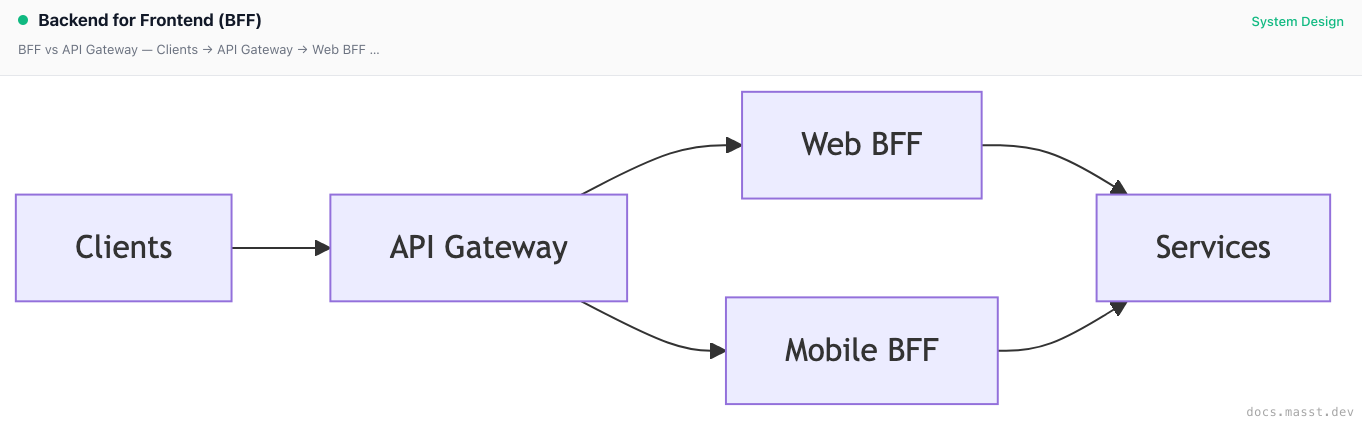
They can work together:
When to Use BFF
Good fit:
- Multiple client types with different needs
- Frontend teams want autonomy
- Significant response shaping per client
- Different authentication per platform
Avoid when:
- Single client type
- Clients have similar data needs
- Small team (overhead not justified)
- GraphQL already solves data shaping
Trade-offs
| Pros | Cons |
|---|---|
| Optimized per client | More services to maintain |
| Frontend team ownership | Potential code duplication |
| Independent deployments | Increased infrastructure cost |
| Simpler client code | Need clear service boundaries |
Interview Tips
- Explain why a single API is problematic for diverse clients
- Describe how BFF aggregates and shapes data
- Compare with API Gateway (they complement each other)
- Mention that GraphQL can sometimes replace BFF
- Discuss ownership: frontend teams own their BFF
Finished reading?
Mark it done to track your progress in Concepts.