
Fundamentals
Gossip Protocol
Understanding gossip protocols for information dissemination in distributed systems.
2 min readConcepts · System Design
What is Gossip Protocol?
The Gossip Protocol (or epidemic protocol) is a peer-to-peer communication mechanism where nodes periodically exchange state information with random peers. Like rumors spreading in a group, information eventually reaches all nodes.
How It Works
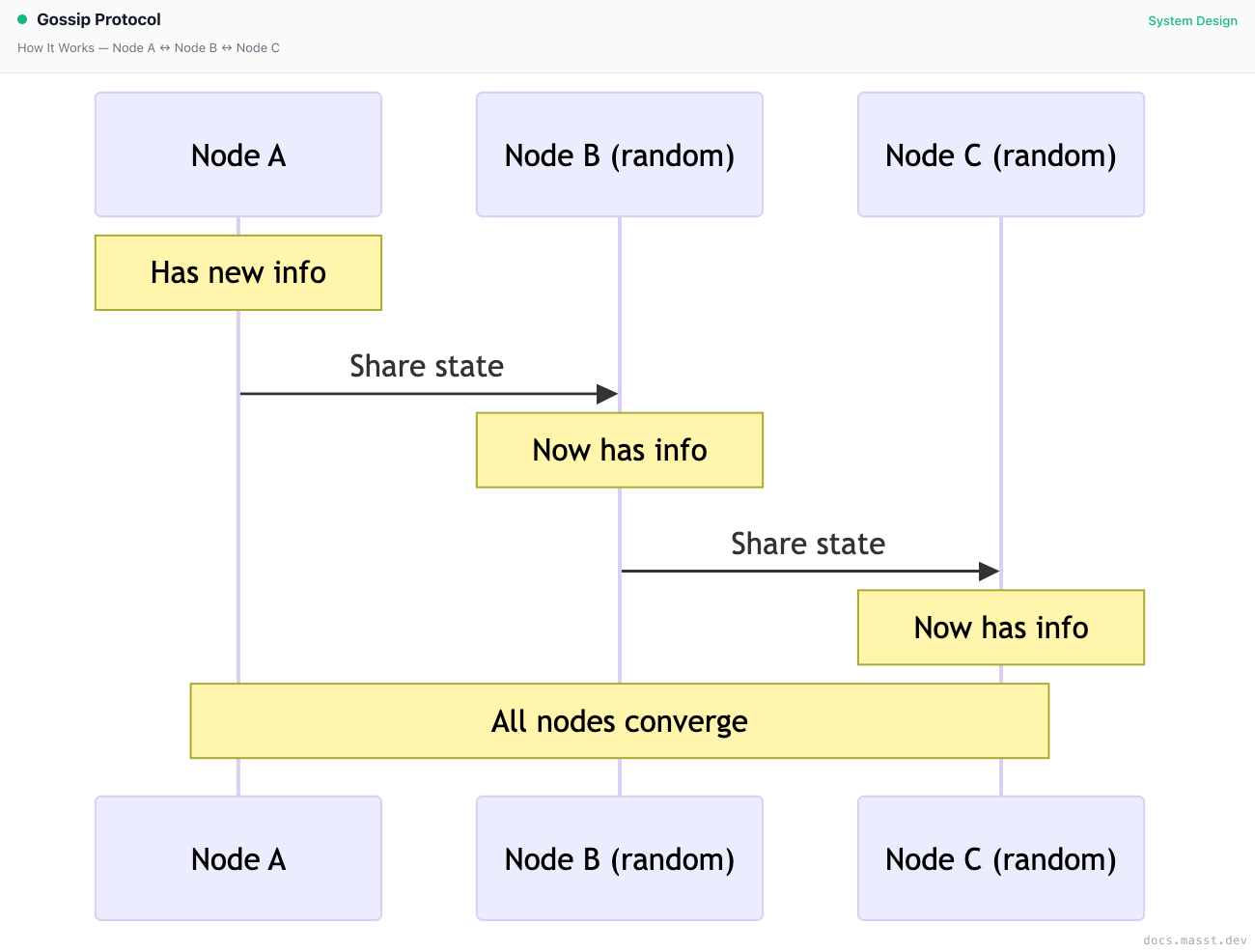
Each round, every node:
- Selects a random peer
- Exchanges state information
- Merges received state with local state
Dissemination Styles
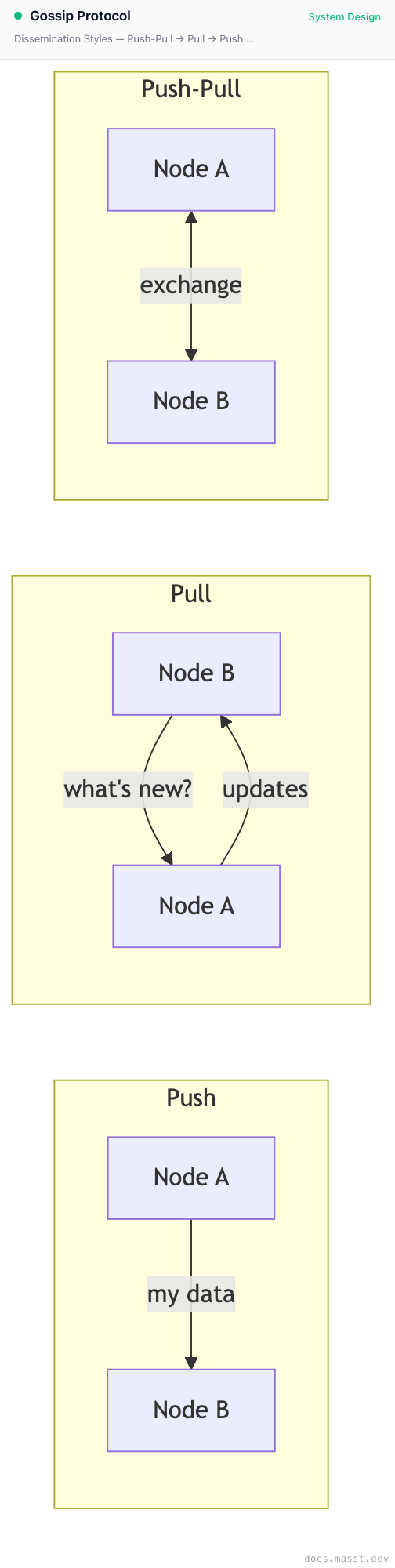
| Style | How | Use Case |
|---|---|---|
| Push | Send my updates to peer | Fast initial spread |
| Pull | Ask peer for their updates | Catching up |
| Push-Pull | Exchange updates both ways | Most efficient |
Convergence Speed
With N nodes and push-pull gossip:
Rounds to reach all nodes ≈ O(log N)

Example:
100 nodes   → ~7 rounds
1,000 nodes → ~10 rounds
10,000 nodes → ~14 rounds
Information spreads exponentially — like a virus.
Use Cases
Failure Detection
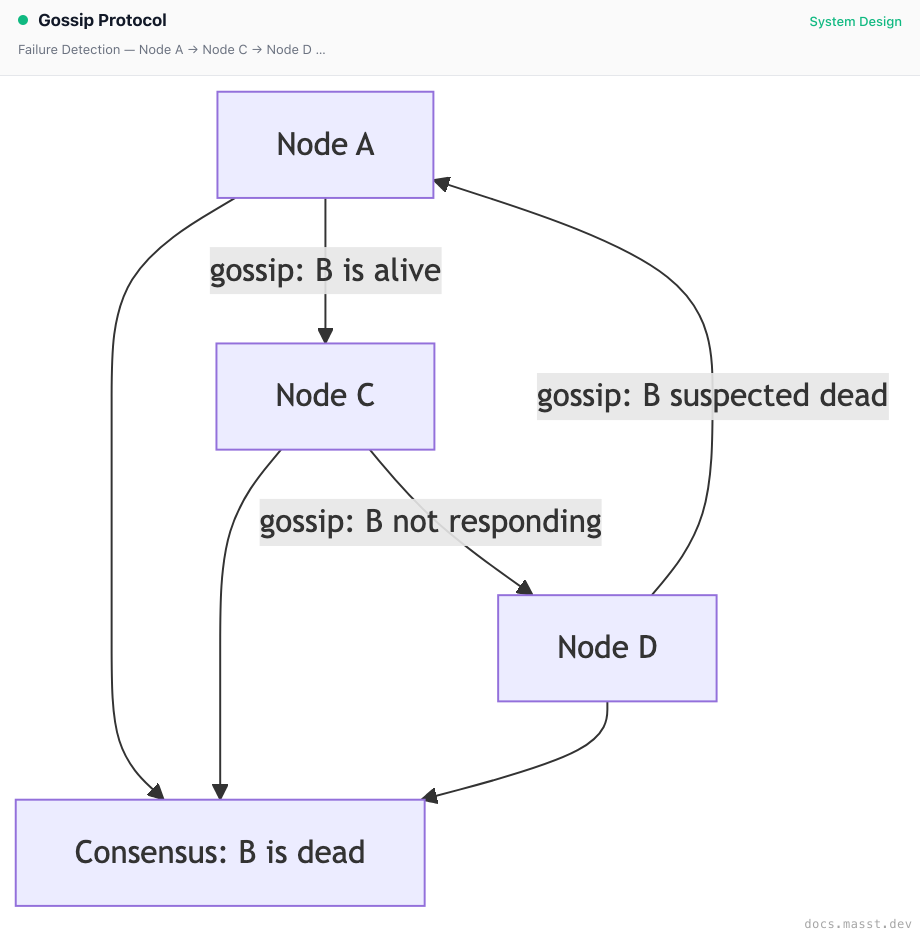
Nodes share heartbeat counters. If a node's counter stops incrementing across multiple gossip rounds, it's marked as failed.
Membership Management
Track which nodes are in the cluster:
| Event | Gossip Action |
|---|---|
| Node joins | Spreads join announcement |
| Node leaves | Spreads leave announcement |
| Node fails | Failure detection via heartbeats |
Data Dissemination
Spread configuration updates, schema changes, or routing tables without a central coordinator.
Gossip in Real Systems
| System | Uses Gossip For |
|---|---|
| Cassandra | Cluster membership, failure detection |
| DynamoDB | Ring membership, reachability |
| Consul | Membership (Serf protocol) |
| Redis Cluster | Node discovery, failover |
| CockroachDB | Node liveness, range metadata |
Properties
| Property | Value |
|---|---|
| Consistency | Eventual |
| Scalability | O(log N) convergence |
| Fault tolerance | No single point of failure |
| Bandwidth | O(N) per round |
| Reliability | Probabilistic (not guaranteed) |
Trade-offs
| Pros | Cons |
|---|---|
| Decentralized (no coordinator) | Eventual consistency only |
| Scalable to thousands of nodes | Bandwidth grows with cluster size |
| Tolerates network partitions | Non-deterministic convergence |
| Simple to implement | Redundant message delivery |
Interview Tips
- Explain the rumor-spreading analogy
- Know convergence speed: O(log N) rounds
- Discuss push vs pull vs push-pull
- Give examples: Cassandra, Consul, DynamoDB
- Compare with broadcast (gossip is more scalable)
Finished reading?
Mark it done to track your progress in Concepts.