
Fundamentals
Vector Clocks
Understanding vector clocks for tracking causality in distributed systems.
3 min readConcepts · System Design
What are Vector Clocks?
Vector Clocks are a mechanism for tracking causality and detecting concurrent events in distributed systems. Each node maintains a vector of logical timestamps — one entry per node in the system.
The Problem with Physical Clocks
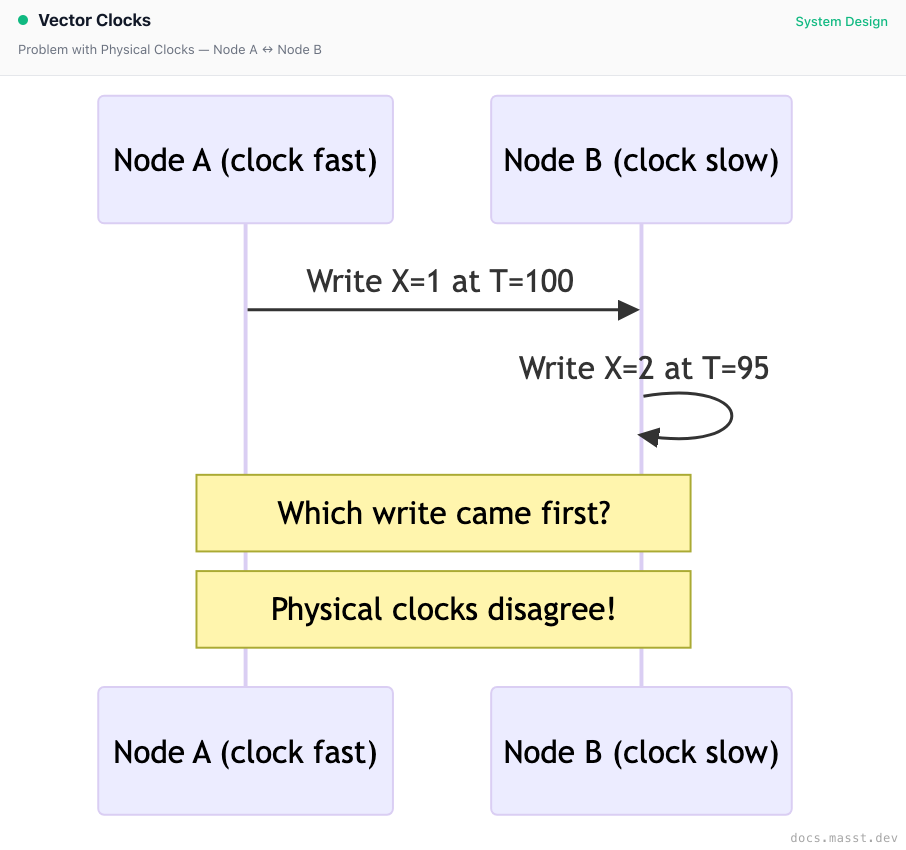
Physical clocks drift and can't reliably determine event ordering across nodes.
How Vector Clocks Work
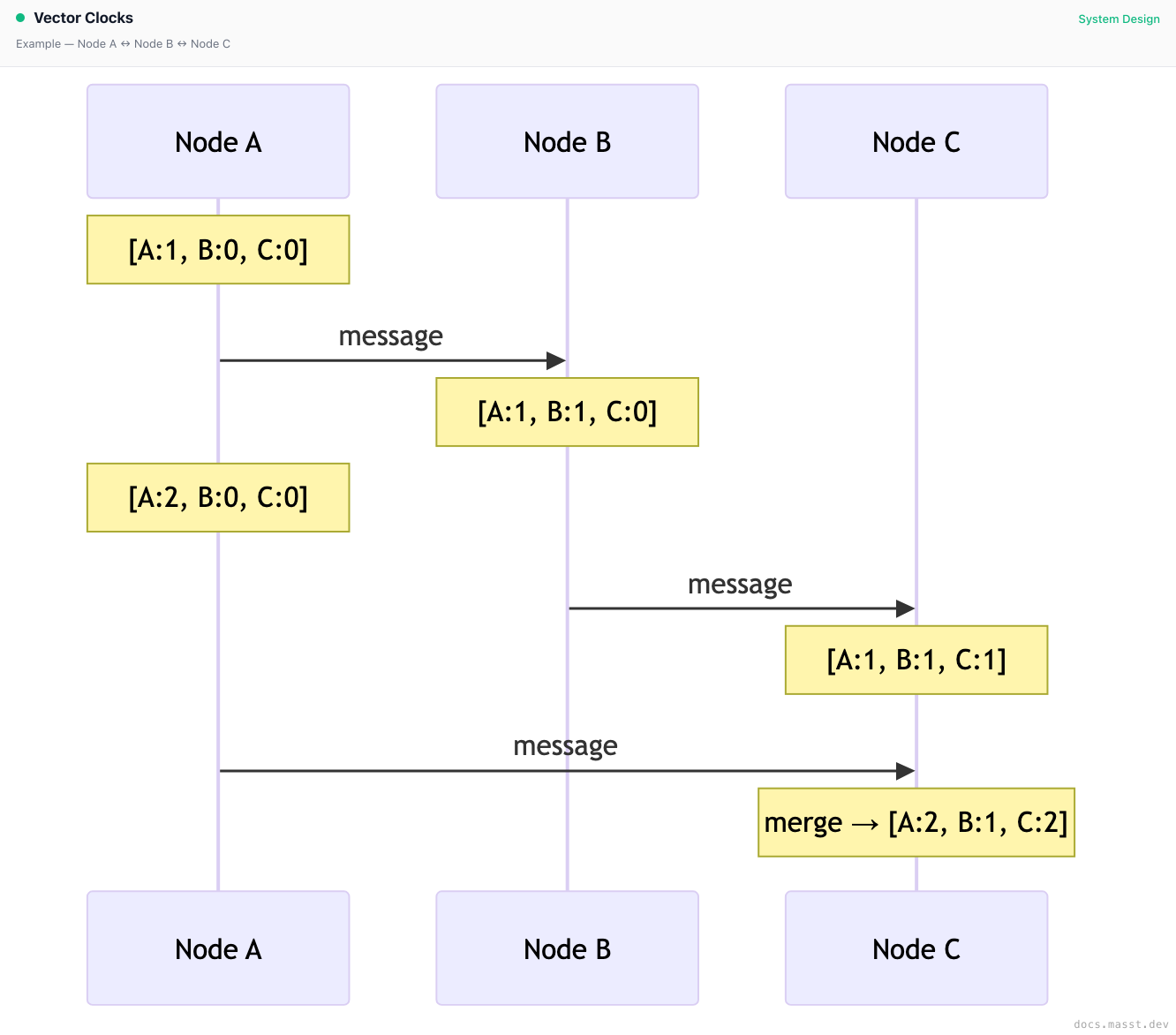
Each node maintains a vector: [A:count, B:count, C:count]
Rules
- Before sending: Increment own entry
- On receive: Merge vectors (take max of each entry), then increment own entry
Example
Comparing Events
Given vectors V1 and V2:
| Relationship | Condition | Meaning |
|---|---|---|
| V1 < V2 | All entries in V1 ≤ V2, at least one strictly less | V1 happened before V2 |
| V1 > V2 | All entries in V1 ≥ V2, at least one strictly greater | V1 happened after V2 |
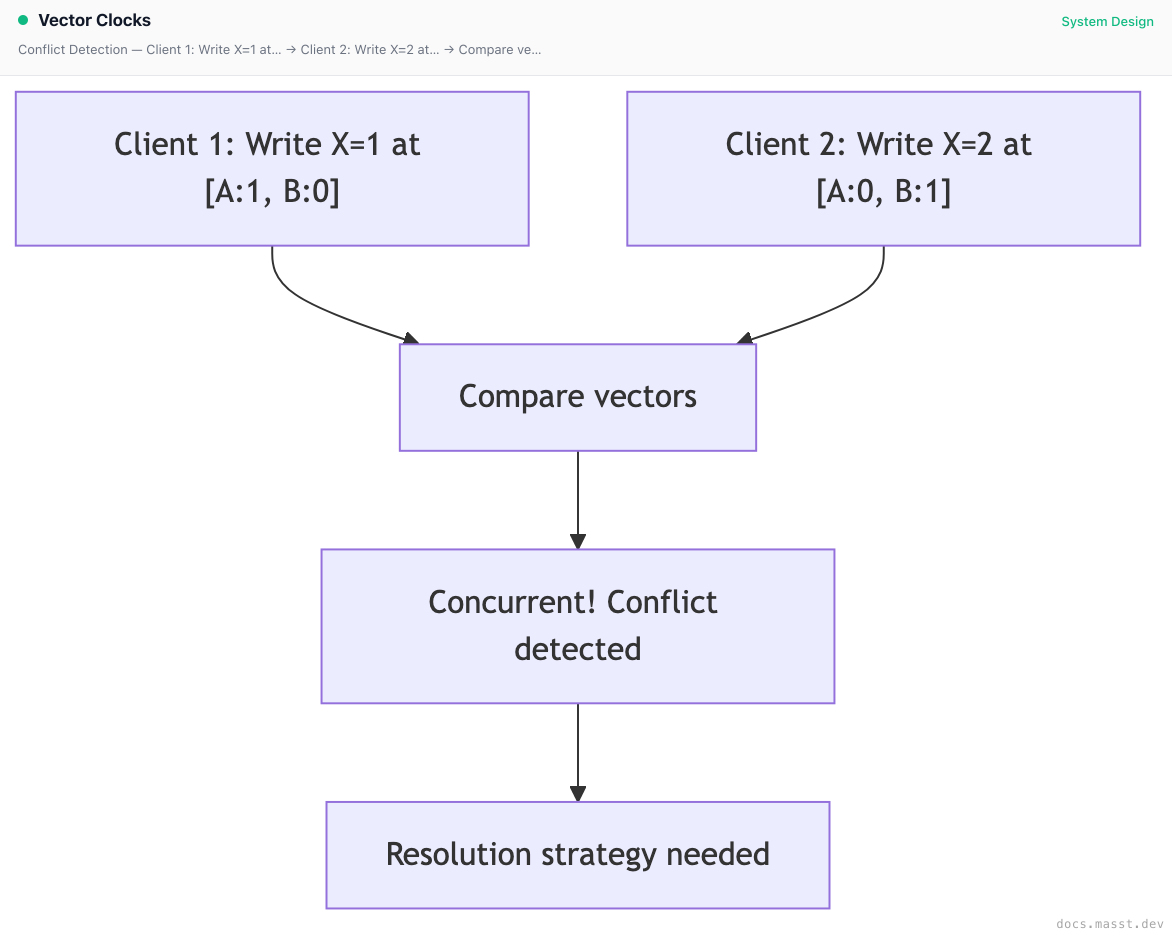
| V1 ‖ V2 | Neither ≤ nor ≥ | Concurrent (conflict!) |
Example
Event X: [A:2, B:1, C:0]
Event Y: [A:1, B:2, C:0]

X[A]=2 > Y[A]=1, but X[B]=1 < Y[B]=2
→ Neither dominates → Concurrent!
→ Application must resolve conflict
Conflict Detection
Resolution Strategies
| Strategy | How | Used By |
|---|---|---|
| Last-Write-Wins | Use wall clock as tiebreaker | Cassandra |
| Keep both | Return siblings to client | Riak |
| Application logic | Domain-specific merge | Shopping carts |
| CRDTs | Auto-mergeable data types | Redis, Riak |
Vector Clocks vs Lamport Clocks
| Aspect | Lamport Clock | Vector Clock |
|---|---|---|
| Structure | Single counter | Vector of counters |
| Detect causality | If L(a) < L(b), maybe a→b | If V(a) < V(b), definitely a→b |
| Detect concurrency | Cannot | Can |
| Space | O(1) | O(N) per event |
Lamport clocks tell you "a might have happened before b." Vector clocks tell you "a definitely happened before b" or "a and b are concurrent."
Real-World Usage
| System | How Used |
|---|---|
| DynamoDB | Detects conflicting writes |
| Riak | Sibling detection and resolution |
| Voldemort | Conflict detection |
| CockroachDB | Hybrid logical clocks (related) |
Limitations
| Issue | Mitigation |
|---|---|
| Vector grows with nodes | Use dotted version vectors |
| Space overhead O(N) | Prune old entries |
| Complex merge logic | Use CRDTs instead |
| Clock comparison cost | Optimize for common case |
Interview Tips
- Explain why physical clocks fail in distributed systems
- Know the increment and merge rules
- Demonstrate how to detect concurrent events
- Compare with Lamport clocks (vector clocks detect concurrency)
- Mention use in DynamoDB and Riak
Finished reading?
Mark it done to track your progress in Concepts.