
Factory Method
Define an interface for creating an object, but let subclasses decide which class to instantiate.
Intent
Encapsulate object creation behind a method, so callers don't depend on concrete classes.
Use when:
- The class to instantiate is decided by runtime data (input string, config, type code).
- You want to decouple construction from use so adding a new type doesn't change every caller.
Two Variants
The "Factory" name covers two related-but-distinct patterns:
| Pattern | What it returns | Selected by |
|---|---|---|
| Simple Factory (idiom, not GoF) | One class with a static method that returns a product | A parameter (string, enum) |
| Factory Method (GoF) | An abstract method overridden by subclasses | The subclass type |
Most interviews say "factory" and mean the simple factory. Know both.
Simple Factory
public enum NotificationType { EMAIL, SMS, PUSH }

public interface Notification {
    void send(String to, String message);
}

public class NotificationFactory {
    public static Notification create(NotificationType type) {
        switch (type) {
            case EMAIL: return new EmailNotification();
            case SMS:   return new SmsNotification();
            case PUSH:  return new PushNotification();
            default: throw new IllegalArgumentException("Unknown: " + type);
        }
    }
}

// Usage
Notification n = NotificationFactory.create(NotificationType.EMAIL);
n.send("alice@example.com", "Welcome!");
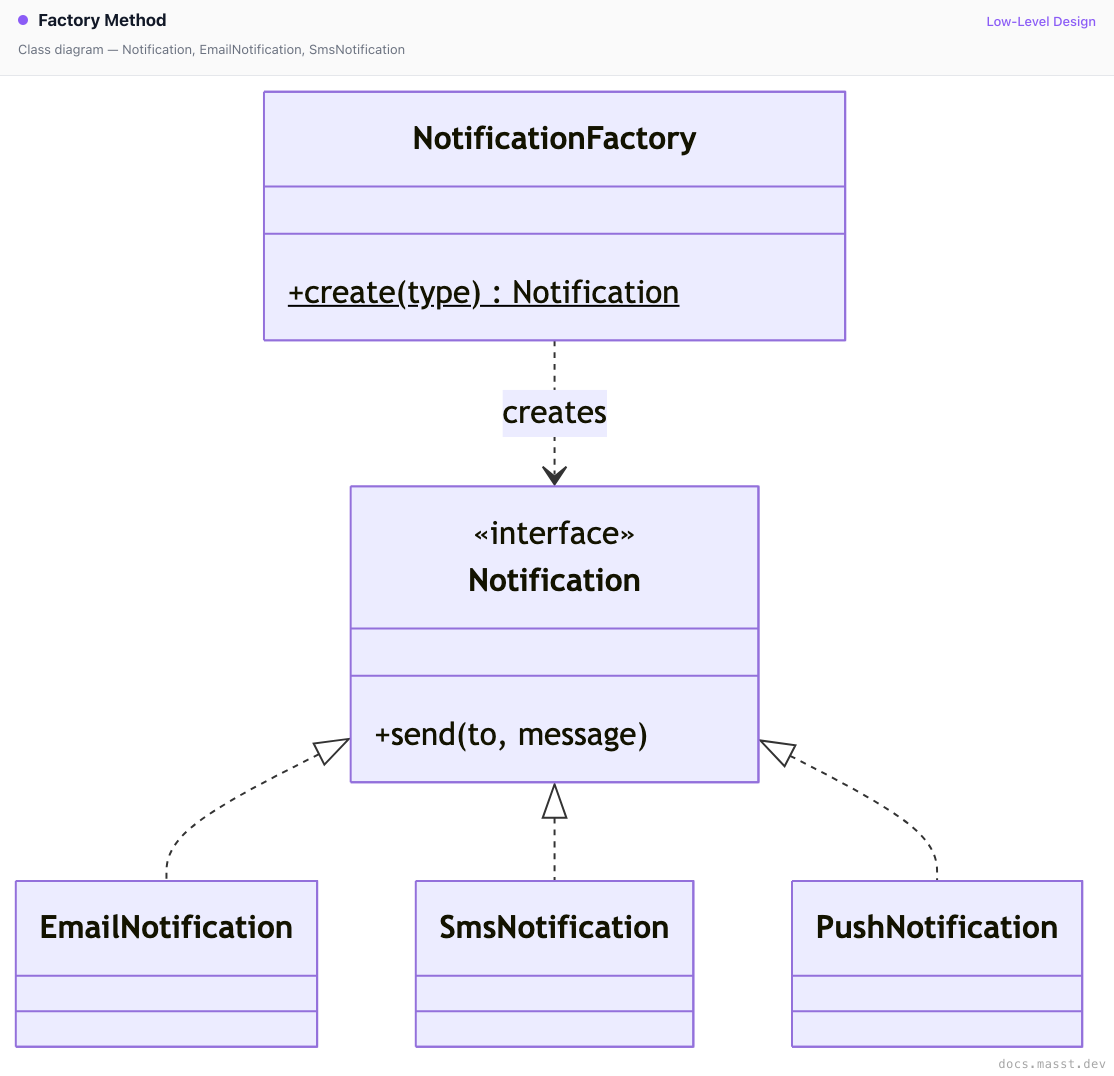
The caller doesn't import EmailNotification. Adding WhatsappNotification is one new case in the factory.
Class diagram
Factory Method (GoF)
The decision of which class to instantiate is deferred to subclasses, not a parameter.
public abstract class Dialog {
    // Template method
    public void render() {
        Button button = createButton();   // factory method
        button.draw();
    }

    protected abstract Button createButton();
}

public class WindowsDialog extends Dialog {
    @Override
    protected Button createButton() { return new WindowsButton(); }
}

public class MacDialog extends Dialog {
    @Override
    protected Button createButton() { return new MacButton(); }
}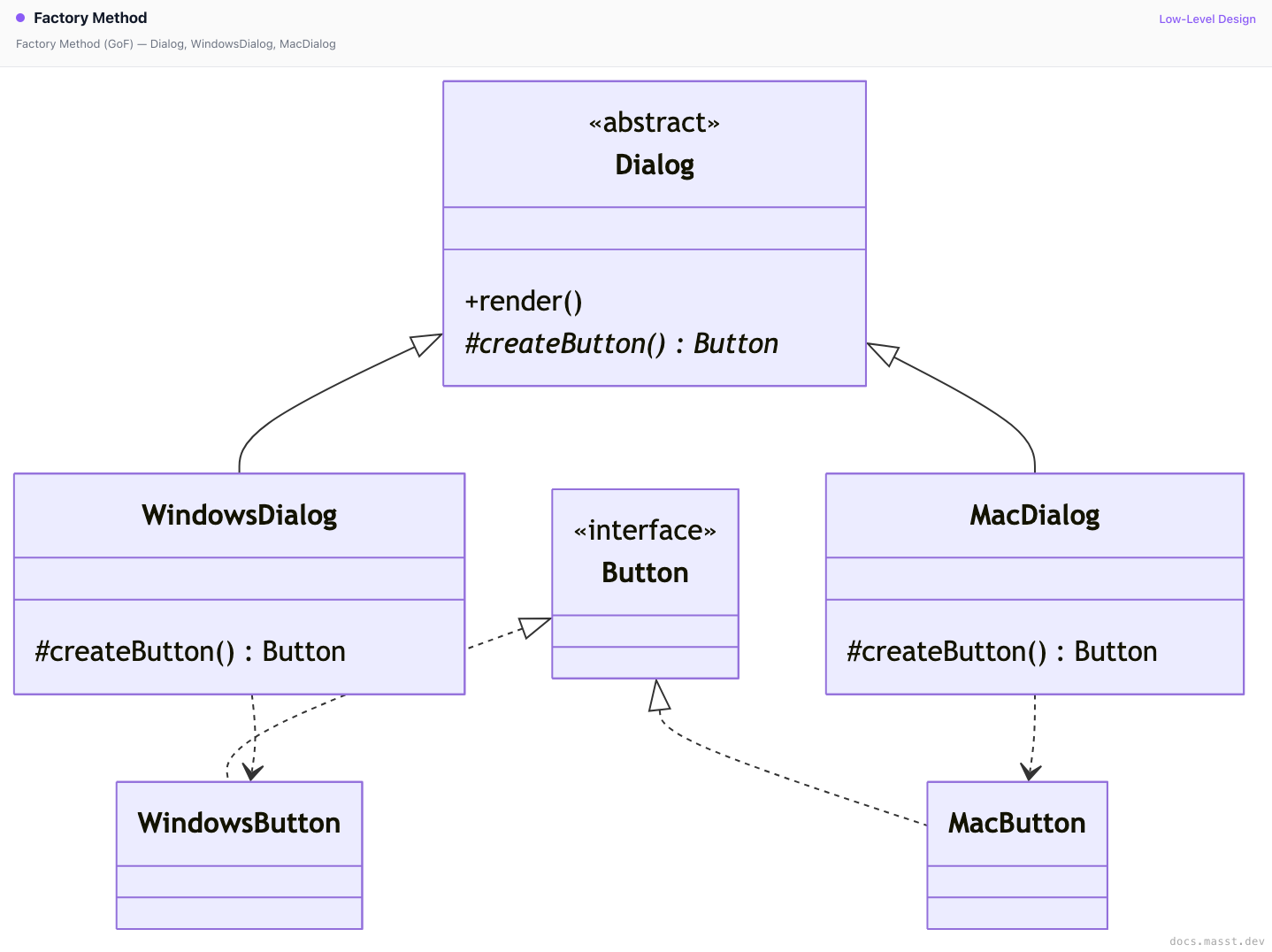
The Dialog base class drives the algorithm; the subclass plugs in the right Button.
When to Use Which
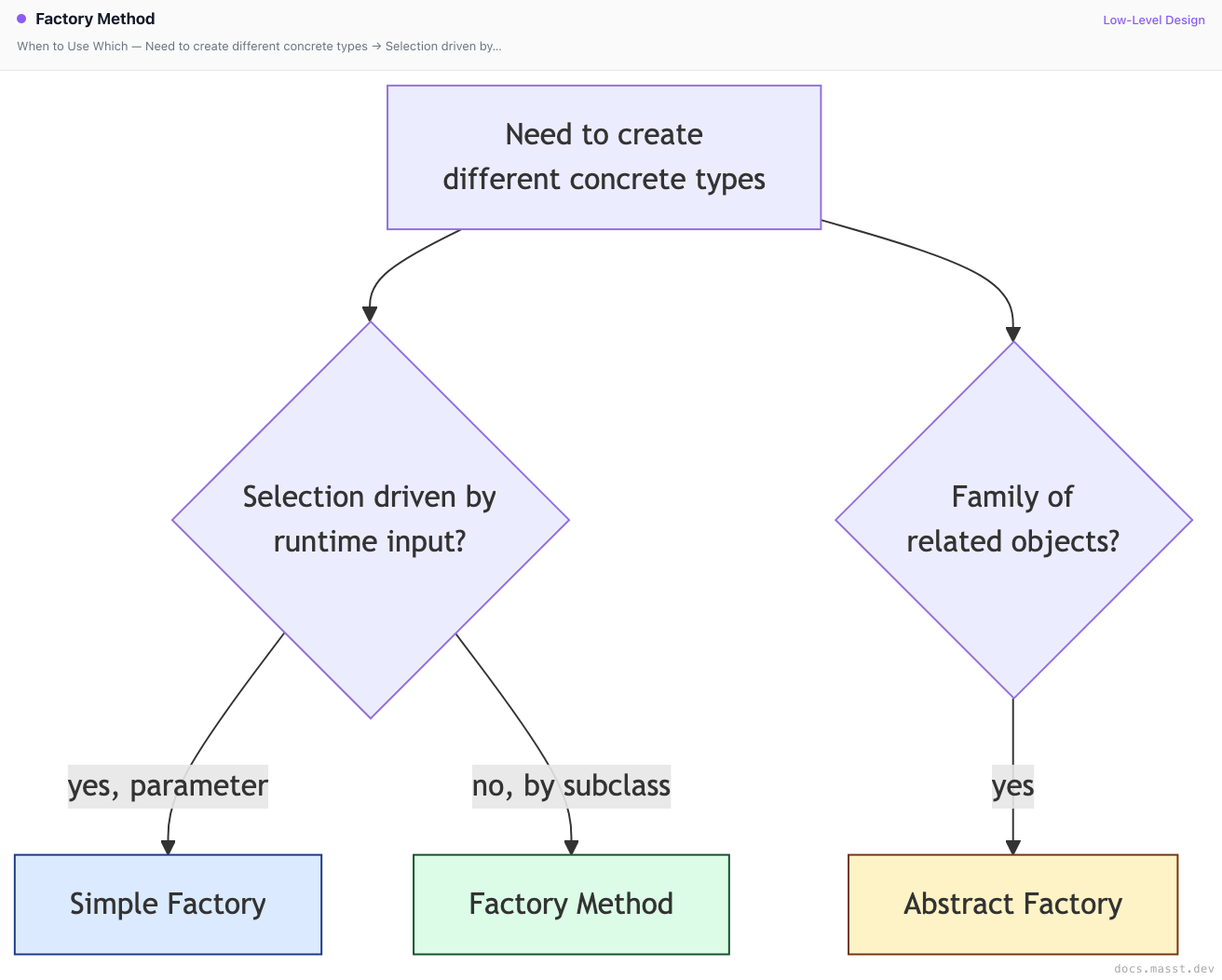
Comparison
| Factory variant | Adds new type means... | Coupling |
|---|---|---|
| Simple factory | Edit the switch statement | Centralized |
| Factory method | Add a new subclass | Distributed |
| Abstract factory | Add a new factory subclass + product family | Distributed |
Simple factory violates Open/Closed (you edit existing code). Factory method satisfies it (add a new subclass).
Real-world Examples
| Library | Factory |
|---|---|
Calendar.getInstance() | Returns locale-appropriate calendar |
NumberFormat.getInstance() | Locale-appropriate number format |
LoggerFactory.getLogger() | SLF4J logger wired to the active backend |
Connection.createStatement() | JDBC statement matching the driver |
ThreadFactory | Customize thread creation in pools |
Anti-patterns
- God factory — one class that creates 50 unrelated types. Split by domain.
- Factory of one — if you only have one product, you don't need a factory; just call
new. - Reflective factory —
Class.forName(name).newInstance()defeats compile-time safety. Use a registered map of suppliers instead.
Interview Tips
- Distinguish simple factory from factory method when asked.
- Justify with "the caller shouldn't know about concrete subclasses" — that's the real reason, not "encapsulation" buzzword.
- Mention that dependency injection is often a better answer for "where do objects come from?" in modern code.
Finished reading?
Mark it done to track your progress in Designs.