
Thread Safety
Make objects safe to use from multiple threads — atomicity, visibility, ordering.
What "Thread Safe" Means
A class is thread-safe when accessing it from multiple threads — concurrently, in any order, without external synchronization — produces correct results.
Three concerns:
| Concern | Question |
|---|---|
| Atomicity | Does an operation happen all-or-nothing? |
| Visibility | Will thread B see thread A's writes? |
| Ordering | Will operations execute in the order I wrote them? |
If any one is broken, you have a race condition.
Race Condition Example
class Counter {
    private int count = 0;

    public void increment() {
        count++;   // NOT atomic: read, add, write
    }
}
Two threads each calling increment() 1,000,000 times. Final value? Anywhere from ~1 million to ~2 million. The count++ decomposes into:
- Read
countinto register - Add 1
- Write back
Two threads can interleave at any of these steps and lose updates.
Fix 1: synchronized
class Counter {
    private int count = 0;

    public synchronized void increment() { count++; }
    public synchronized int get() { return count; }
}synchronized:
- Atomicity: only one thread holds the lock at a time
- Visibility: acquiring/releasing the lock flushes/refreshes thread-local caches
- Ordering: prevents reordering across the lock boundary
Fix 2: AtomicInteger (lock-free)
class Counter {
    private final AtomicInteger count = new AtomicInteger(0);

    public void increment() { count.incrementAndGet(); }
    public int get() { return count.get(); }
}
Backed by hardware compare-and-swap (CAS). Faster under low contention, no thread parking.
| Method | Use |
|---|---|
synchronized | Compound operations, multi-field invariants |
Atomic* | Single-field counters, flags |
Fix 3: volatile (visibility only)
class Flag {
    private volatile boolean stop = false;

    public void stop() { stop = true; }

    public void run() {
        while (!stop) { /* work */ }
    }
}
volatile guarantees:
- Visibility: writes are seen by other threads immediately
- Ordering: no reordering across volatile reads/writes
volatile does NOT give atomicity. volatile int x; x++; is still racy — read and write are separate volatile ops.
When to Use Which
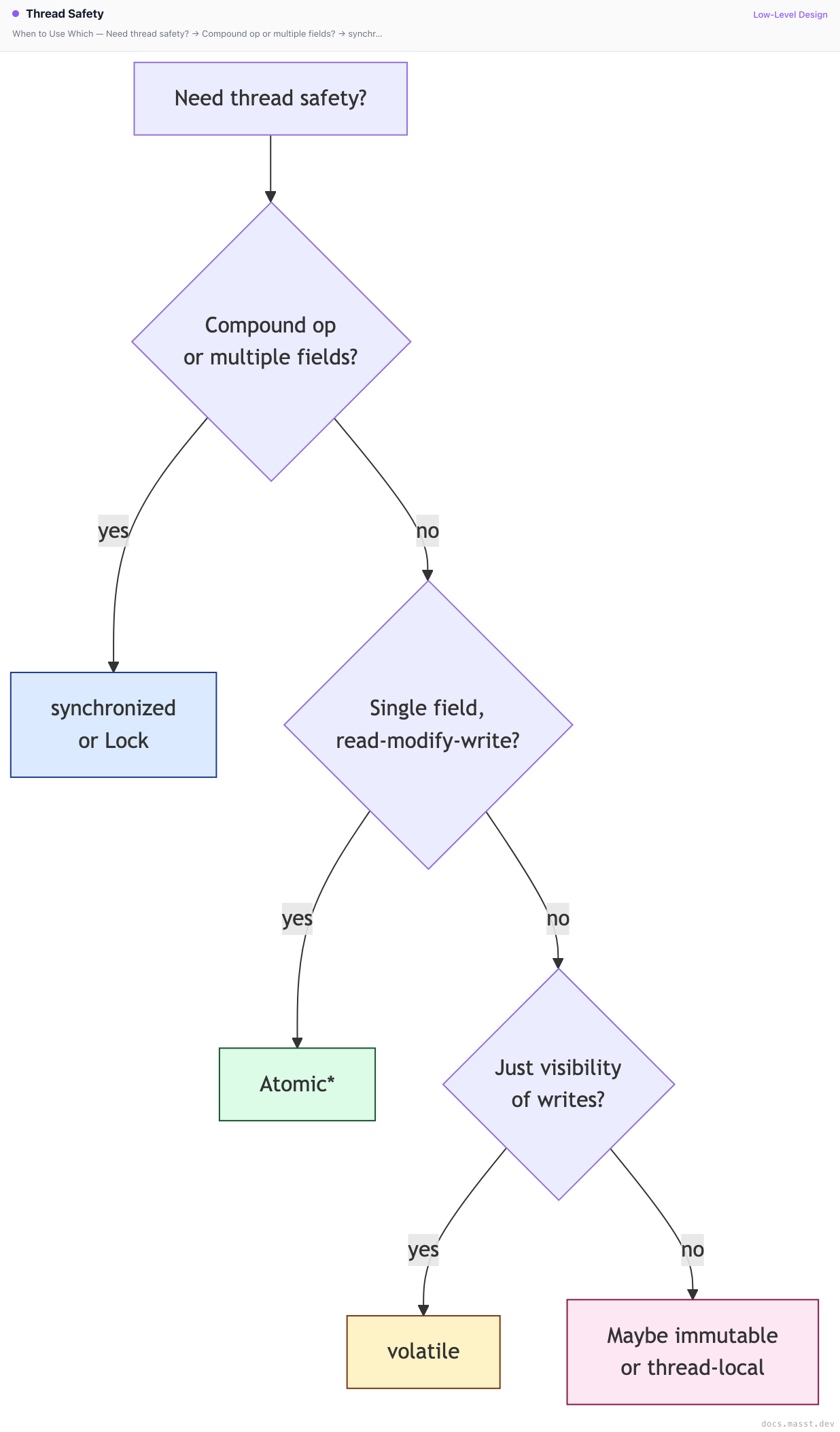
Strategies for Thread Safety
1. Immutability — the gold standard
public final class Money {
    private final long amountCents;
    private final Currency currency;

    public Money(long c, Currency cur) { this.amountCents = c; this.currency = cur; }
    public Money add(Money other) {
        if (!currency.equals(other.currency)) throw new IllegalArgumentException();
        return new Money(amountCents + other.amountCents, currency);   // new instance
    }
}
Immutable objects need no synchronization — they can't change. Make all fields final, don't expose mutable internals.
2. Thread confinement
Keep state inside a single thread. ThreadLocal<T> is the explicit form:
private static final ThreadLocal<DateFormat> FORMAT =
    ThreadLocal.withInitial(() -> new SimpleDateFormat("yyyy-MM-dd"));
SimpleDateFormat is famously not thread-safe. ThreadLocal gives each thread its own.
3. Synchronization (locks)
Already covered. Reach for it when state is shared and mutable.
4. Concurrent collections
Don't use Collections.synchronizedMap(new HashMap<>()) for high-concurrency code. Use ConcurrentHashMap — it locks per bucket, not globally.
ConcurrentHashMap<String, AtomicLong> counts = new ConcurrentHashMap<>();
counts.computeIfAbsent("foo", k -> new AtomicLong()).incrementAndGet();
Visibility Without Locks: Happens-Before
The Java Memory Model defines happens-before edges that guarantee visibility:
| Action A happens-before B if... |
|---|
| A and B in the same thread, A is earlier in program order |
| A unlocks a monitor, B locks the same monitor |
A writes a volatile, B reads the same volatile |
| A starts thread T, B is the first action in T |
A is the last action in T, B is t.join() returning |
If there's no happens-before, thread B may see stale values for arbitrarily long.
Common Bugs
1. Lost update
Two threads read, modify, write — last writer wins:
balance = balance + 100; // racyFix: synchronize, atomic, or compare-and-set loop.
2. Inconsistent state across fields
synchronized void setName(String first, String last) {
    this.firstName = first;
    this.lastName = last;
}

// But the getters aren't synchronized!
String firstName() { return firstName; }    // can see updated first, old last
Fix: synchronize getters too, or make fields immutable.
3. Double-checked locking without volatile
See Singleton — volatile is mandatory.
4. Mutable static state
public static List<X> items = new ArrayList<>() — anyone, anywhere, mutating from any thread. Avoid mutable statics; use a properly-encapsulated singleton or DI.
Verification
- Stress tests: run with many threads for many iterations.
- JCStress (Java Concurrency Stress test harness) — built for spotting JMM bugs.
- Static analysis:
Lint, IntelliJ inspections, Error Prone. - Code review: look for shared mutable state, lock scope, and field visibility.
Trade-offs
✅ Pros:
- Correct concurrent behavior
- Predictable invariants
❌ Cons:
- Locks → contention → throughput drops
- Wrong granularity → deadlocks
- Hard to test (heisenbugs)
Interview Tips
- When asked "is this thread-safe?" answer in terms of atomicity, visibility, ordering — not just "yes/no."
- Lead with immutability when designing — it's the cheapest thread safety.
- Mention
ConcurrentHashMap,Atomic*, and the JMM happens-before to demonstrate depth.
Finished reading?
Mark it done to track your progress in Designs.