
Notification System
System design for a scalable notification service.
3 min readDesigns · HLD Case Studies
Interview practice: try designing this yourself before reading. Go to the exercise ↓
Problem Statement
Design a notification system that:
- Sends notifications via multiple channels (push, SMS, email)
- Handles millions of notifications per day
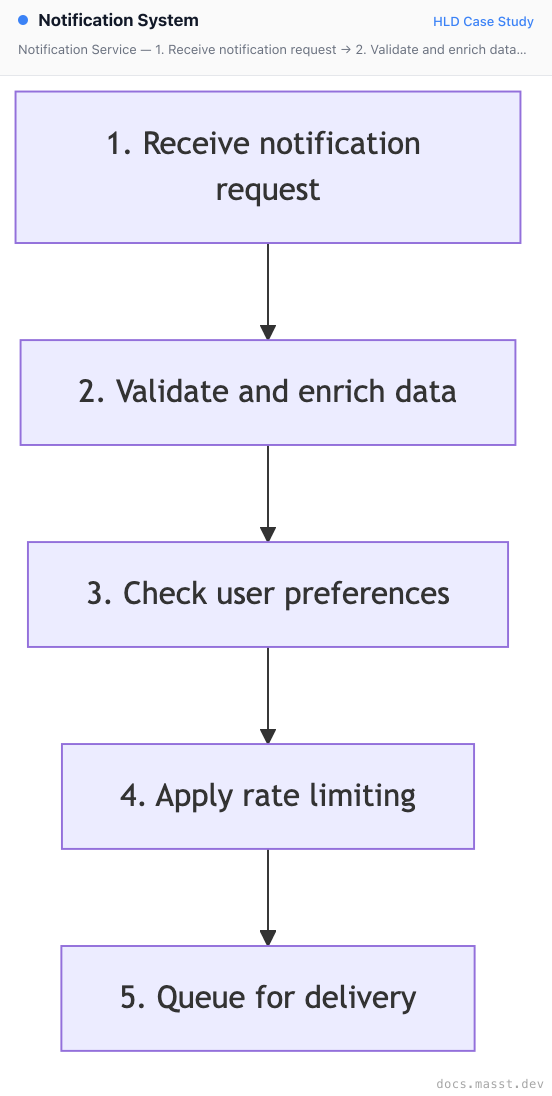
- Supports user preferences
- Provides delivery tracking
Requirements
Functional
- Send notifications via push, SMS, email
- User notification preferences
- Rate limiting per user
- Notification templates
- Delivery status tracking
Non-Functional
- High availability
- Low latency for real-time notifications
- Exactly-once delivery (or at-least-once)
- Scalable to millions of users
Capacity Estimation
Assumptions:
- 100M users
- 10 notifications per user per day
- 1 billion notifications per day

QPS:
1B / 86,400 ≈ 12,000 notifications/second
Peak: ~30,000/second
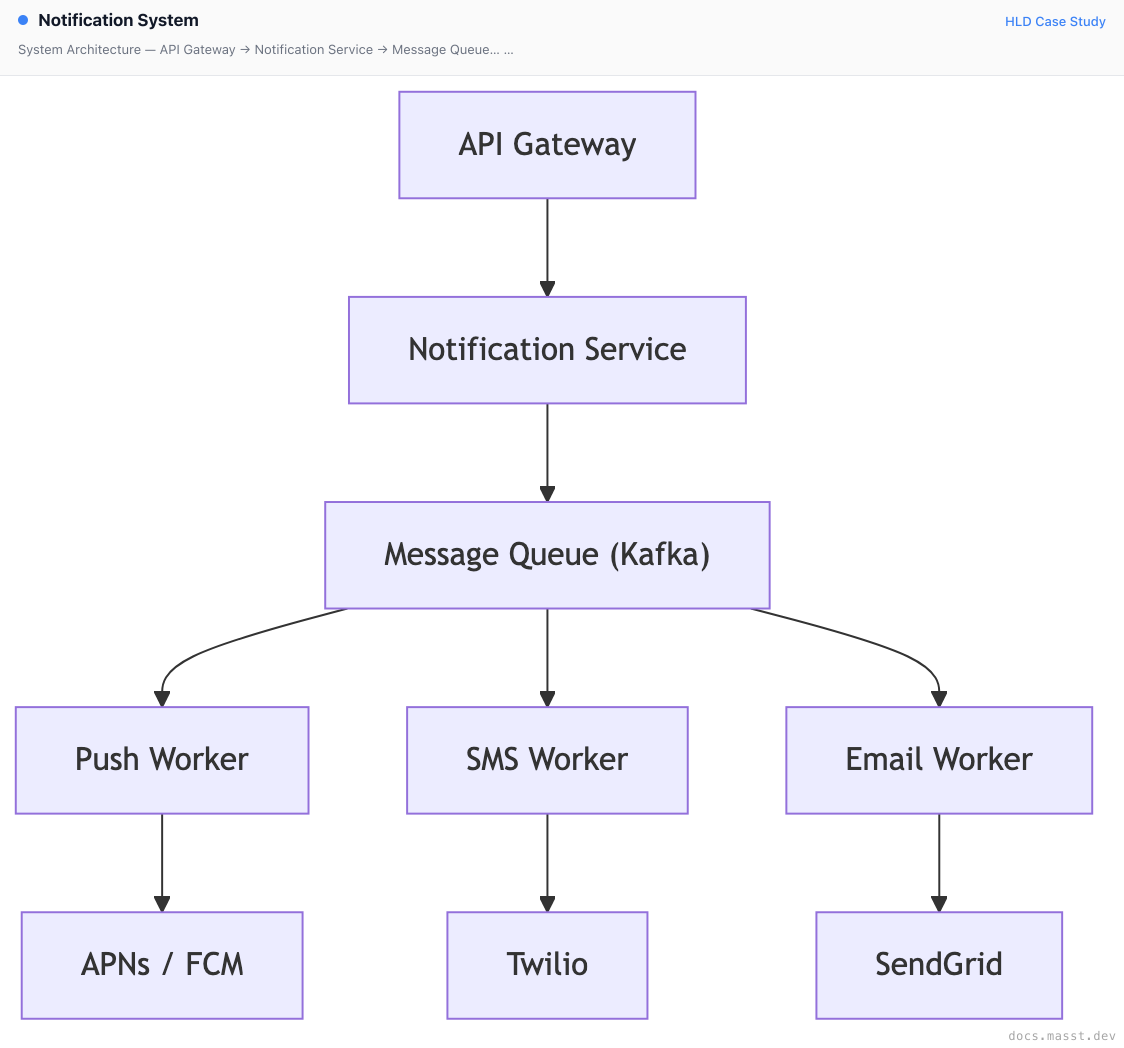
System Architecture
Component Design
Notification Service
Message Queue Topics
notifications.push
notifications.sms
notifications.email

Partitioned by user_id for ordering
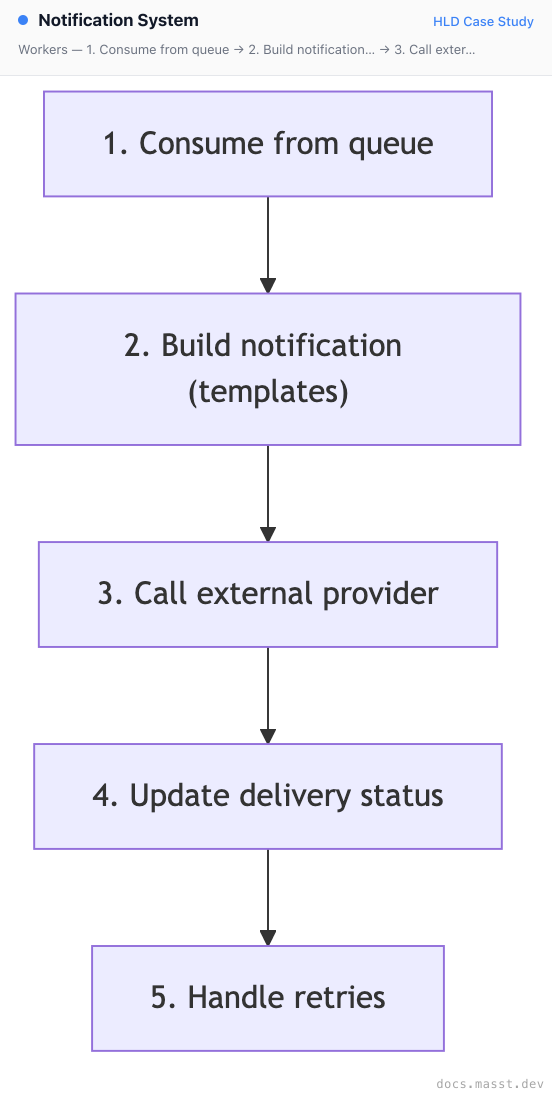
Workers
Database Schema
-- User preferences
CREATE TABLE notification_preferences (
    user_id BIGINT PRIMARY KEY,
    push_enabled BOOLEAN DEFAULT true,
    sms_enabled BOOLEAN DEFAULT true,
    email_enabled BOOLEAN DEFAULT true,
    quiet_hours_start TIME,
    quiet_hours_end TIME
);

-- Notification log
CREATE TABLE notifications (
    id UUID PRIMARY KEY,
    user_id BIGINT,
    type VARCHAR(20),
    channel VARCHAR(20),
    content TEXT,
    status VARCHAR(20),
    created_at TIMESTAMP,
    sent_at TIMESTAMP,
    delivered_at TIMESTAMP
);

-- Templates
CREATE TABLE notification_templates (
    id VARCHAR(50) PRIMARY KEY,
    channel VARCHAR(20),
    subject TEXT,
    body TEXT
);
API Design
Send Notification
POST /api/notifications
{
    "user_id": "123",
    "type": "order_update",
    "channels": ["push", "email"],
    "data": {
        "order_id": "456",
        "status": "shipped"
    }
}
Get Preferences
GET /api/users/123/notification-preferences

Response:
{
    "push_enabled": true,
    "sms_enabled": false,
    "email_enabled": true
}
Delivery Guarantees
At-Least-Once
1. Queue message
2. Worker processes
3. On success: ACK message
4. On failure: Retry (message redelivered)

Risk: Duplicate notifications
Deduplication
Store notification ID in cache
Before sending: Check if already sent
TTL: 24 hours
Rate Limiting
Per user limits:
- Push: 50/hour
- SMS: 5/day
- Email: 10/day

Implementation:
- Redis counters per user per channel
- Check before queueing
Handling Failures
Retry Strategy
Attempt 1: Immediate
Attempt 2: After 1 minute
Attempt 3: After 5 minutes
Attempt 4: After 30 minutes
Attempt 5: After 2 hours

After max retries: Dead letter queue
Circuit Breaker
If provider fails repeatedly:
- Open circuit
- Fail fast
- Queue for later retry
Real-Time vs Batch
| Type | Use Case | Approach |
|---|---|---|
| Real-time | Order updates, security alerts | Direct queue processing |
| Batch | Marketing, digests | Scheduled jobs |
Interview Tips
- Cover all notification channels
- Discuss queuing for reliability
- Mention user preferences and opt-outs
- Explain retry and deduplication
- Consider rate limiting and quiet hours
Practice
Try it yourself
Design a notification service that other teams use to send push, SMS and email notifications.
Your design should cover
- One API to send a notification through push (iOS and Android), SMS and email
- Respect user preferences and opt-outs
- Millions of notifications a day, with spikes during campaigns
- At-least-once delivery without spamming users with duplicates
- Track delivery status and retry failures
0 / 8,000 characters · saved in this browser
Finished reading?
Mark it done to track your progress in Designs.