
Rerankers & context engineering
Cross-encoder rerankers (Cohere, BGE, Jina), lost-in-the-middle attention failures, context packing, deduplication, and citation hints — the last 20% of RAG quality.
TL;DR
Add a cross-encoder reranker to any retrieval pipeline serving more than ~100K docs. Cohere rerank-v3.0 ($1 / 1K queries, ~100ms p50 over top-50) or self-hosted BGE-reranker-large (~50ms on a single L4 GPU) routinely add +5 to +12 nDCG@10 over a dense+BM25 baseline. Then engineer the context: pack the top-3 to top-5 chunks with the strongest hit at the start and end (mitigates lost-in-the-middle), prepend chunk metadata, deduplicate, and budget for ~3K tokens of retrieved context, not 30K.
The problem this solves
You've shipped chunking, picked a great embedder, fused dense + BM25 with RRF. nDCG@10 is 0.82. You're feeling good. Then production traffic comes in:
- A user asks "summarize last week's incidents." You retrieve top-10 chunks. Three of them are the same paragraph from the same incident postmortem, duplicated across chunk overlap regions. The LLM ignores the unique chunks and over-weights the repeated one.
- A user asks "what does our SLA say about uptime credits?" You retrieve a 4000-token context with the answer at chunk #5 (in the middle of the prompt). The model returns "I couldn't find specific information" — even though the chunk is right there. This is the lost-in-the-middle failure (Liu et al. 2023).
- A user asks a question whose answer requires combining two facts from two chunks. The top-10 contains both, but ranked at positions 1 and 8. The LLM picks up the first one, ignores the eighth, and gives a partial answer.
Retrieval got the right candidates into the top-20. Reranking and context engineering decide which 3-5 of those candidates actually reach the model, and in what order. This is the last 20% of RAG quality, and it's where most teams leave free uplift on the table.
This page covers:
- Bi-encoder vs cross-encoder fundamentals.
- The shipping rerankers (Cohere, BGE, Jina, mxbai) with prices and latencies.
- Lost-in-the-middle and how to mitigate it.
- Contextual compression (LLMLingua, Anthropic's contextual chunks).
- Context-pack engineering: metadata, dedup, instruction placement, citation hints.
The core insight
Bi-encoders are fast and approximate; cross-encoders are slow and accurate. Use the bi-encoder to filter to a candidate set, then use the cross-encoder to rank within it.
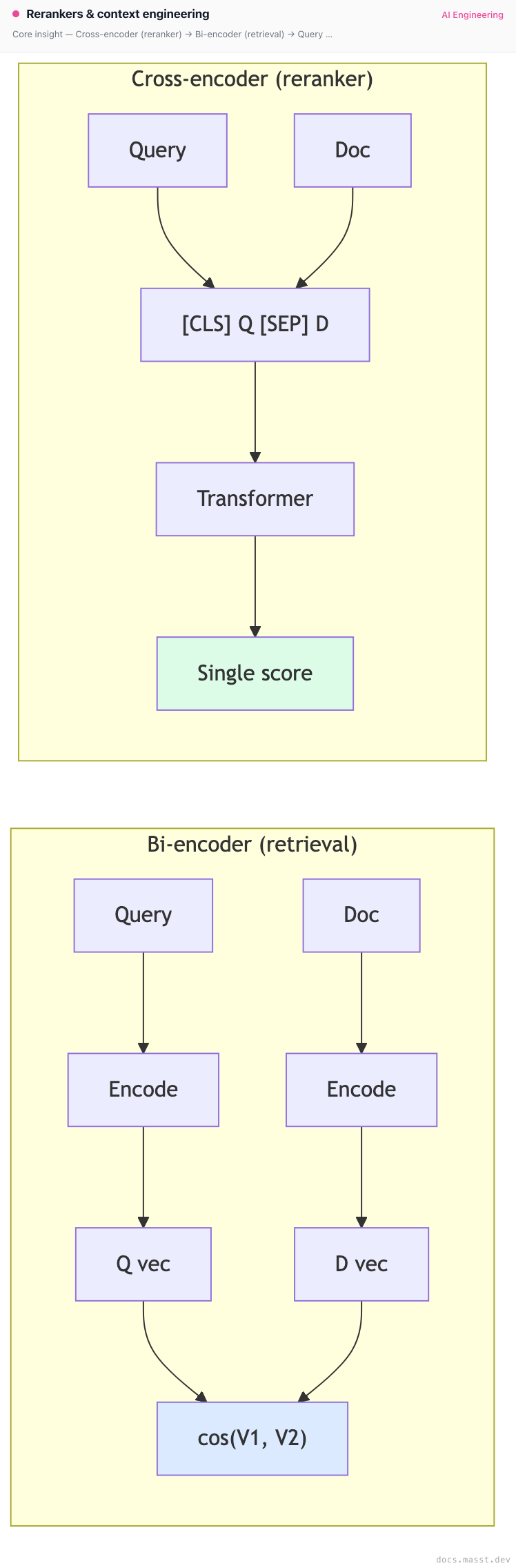
The bi-encoder embeds query and document separately — vectors can be precomputed and indexed. The cross-encoder embeds the concatenation [query, doc] in one transformer forward pass — every (query, doc) pair is a fresh inference, no caching possible. For N documents and one query: bi-encoder is N vector lookups (fast), cross-encoder is N transformer passes (slow).
Cross-encoders are dramatically more accurate because attention can flow between query and document tokens. Bi-encoders compress each side to a vector before they meet; the cross-encoder lets them interact at every transformer layer.
Use the bi-encoder to get from 10M docs to top-50. Use the cross-encoder to get from top-50 to top-5. That's the rerank pattern.
Visual: the full retrieval stack
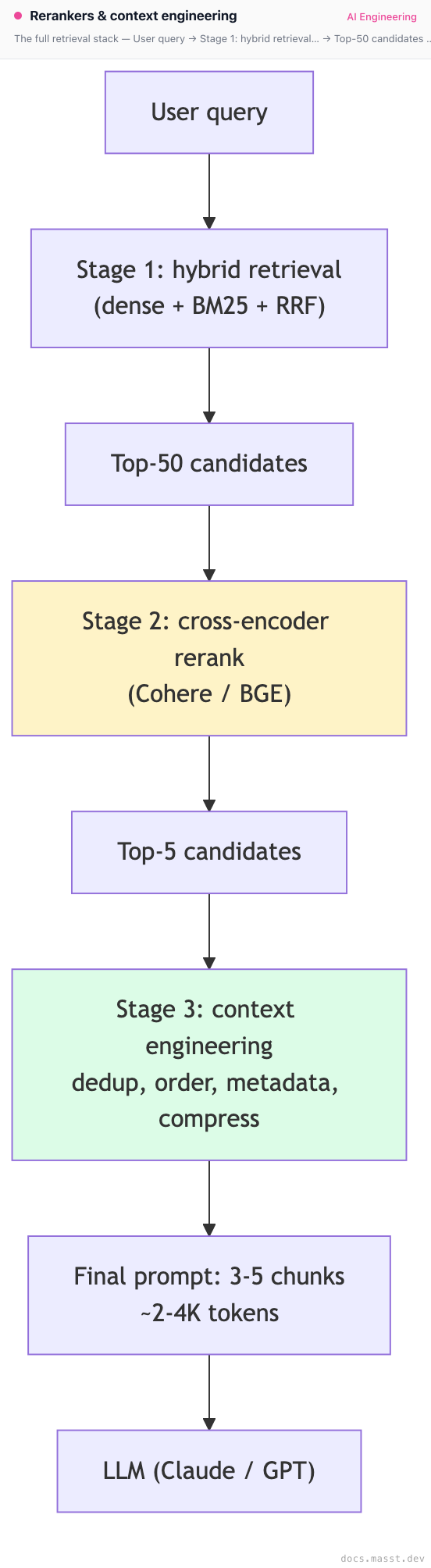
The bi-encoder gives you 10M → 50 in ~10ms. The cross-encoder gives you 50 → 5 in ~50-150ms. Context engineering is free (CPU work on a handful of strings) but pays back enormously.
Variants and strategies
1. Cohere rerank-v3.0 — the API default
import cohere
co = cohere.Client(api_key="...")

results = co.rerank(
    model="rerank-v3.0",                       # or "rerank-multilingual-v3.0"
    query="what does our SLA say about uptime credits?",
    documents=[chunk.text for chunk in top_50_chunks],
    top_n=5,
    return_documents=False,
)
# results.results is sorted by relevance_score, highest first
reranked = [top_50_chunks[r.index] for r in results.results]| Variant | Multilingual | Context | Price | Latency p50 |
|---|---|---|---|---|
rerank-english-v3.0 | English | 4096 tokens | $1 / 1K queries | ~80ms (top-50) |
rerank-multilingual-v3.0 | 100+ langs | 4096 tokens | $1 / 1K queries | ~100ms (top-50) |
Why it's the API default:
- One line of code. No GPU to manage.
- Trained on a massive proprietary mix of retrieval data — better out-of-domain generalization than most OSS rerankers.
- 4096-token context per (query, doc) — accommodates long chunks. (For longer docs, Cohere chunks internally and aggregates.)
Watch out for:
- $1/1K queries adds up. At 10 QPS sustained, that's ~$2.6K/month just for rerank.
- The API charges per query but accepts arbitrary numbers of documents per query (up to 1000). Always batch — sending 50 docs per query is the same price as sending 5.
- Latency is dominated by network + serverside batching. Self-hosted is faster if you have GPU.
Recall@10 uplift over a dense+BM25 baseline: typically +5 to +12 nDCG points on real corpora. Cohere's own published numbers show +10-15 on BEIR.
2. BGE rerankers — the self-hosted workhorse
from sentence_transformers import CrossEncoder

# Pick a size for your latency budget
model = CrossEncoder(
    "BAAI/bge-reranker-large",     # 560M params, ~50ms top-50 on L4
    device="cuda",
    max_length=512,
)

# Score pairs in batch
pairs = [(query, chunk.text) for chunk in top_50_chunks]
scores = model.predict(pairs, batch_size=32)

# Sort and take top-5
top_5_idx = scores.argsort()[::-1][:5]
reranked = [top_50_chunks[i] for i in top_5_idx]
The BGE reranker family from BAAI:
| Model | Params | Max length | Approx GPU latency (top-50) | Notes |
|---|---|---|---|---|
bge-reranker-base | 278M | 512 | ~20ms (L4) | Fast, weakest accuracy |
bge-reranker-large | 560M | 512 | ~50ms (L4) | Default OSS choice |
bge-reranker-v2-m3 | 568M | 8192 | ~80ms (L4) | Long context, multilingual |
bge-reranker-v2-gemma | 2B | 8192 | ~200ms (A100) | Highest OSS accuracy |
bge-reranker-v2-minicpm-layerwise | 2.7B | 8192 | ~150ms (A100) | Skip-layer inference for speed |
Why pick BGE:
- Free, Apache 2.0 / MIT licensed.
bge-reranker-largeis roughly on par with Coherererank-english-v3.0on BEIR (within 1-2 nDCG).- Lower latency than the Cohere API in many setups (no network hop).
- Cost: a single L4 GPU ($0.50/hr on most clouds) handles ~10 QPS reranking comfortably.
Watch out for:
- 512-token limit on the older variants. If your chunks are longer, you'll silently truncate. Use
bge-reranker-v2-m3for 8K context. - Batching matters a lot. Sending pairs one-at-a-time is 10× slower than batching 32. Use a request queue + micro-batcher (Triton, Ray Serve, BentoML).
3. Jina reranker
import requests

resp = requests.post(
    "https://api.jina.ai/v1/rerank",
    headers={"Authorization": f"Bearer {JINA_API_KEY}"},
    json={
        "model": "jina-reranker-v2-base-multilingual",
        "query": query,
        "documents": [c.text for c in top_50_chunks],
        "top_n": 5,
    },
).json()
jina-reranker-v2-base-multilingual (278M, multilingual, 1024-token context) is the main one. Pricing: ~$0.02 / 1M tokens of input (cheaper than Cohere on long documents; comparable on short ones). Quality: BEIR nDCG within 0.5-1.5 of Cohere rerank-v3.0 and BGE-large.
Why pick Jina: cheaper than Cohere at long-document workloads; same one-line API; native multilingual.
4. mxbai-rerank, MS MARCO MiniLM, and others
| Model | Why you'd pick it |
|---|---|
mixedbread-ai/mxbai-rerank-large-v1 | Apache 2.0, competitive with BGE-large on BEIR, easy to fine-tune |
cross-encoder/ms-marco-MiniLM-L-6-v2 | 22M params, 5ms latency — great for ultra-cheap dev or edge |
castorini/monoT5-3b-msmarco | LLM-based reranker, top-of-BEIR but slow |
OpenAI omni-moderation-rerank (rumored, 2026) | Not GA at time of writing — watch for it |
5. LLM-as-reranker (use sparingly)
You can also use a small LLM to rerank by prompting it to score relevance:
prompt = f"""Score the relevance of each document to the query on a 0-10 scale.
Query: {query}
Documents:
1. {doc1}
2. {doc2}
...
Respond with JSON: [{{"id": 1, "score": 7}}, ...]"""
This is what RankGPT (Sun et al. 2023) and several research systems do. It works but it's slow and expensive — typically 5-50× the cost of a cross-encoder rerank for marginal gain. Use only when you need to explain the rerank, or for offline/eval workloads where latency doesn't matter.
Lost-in-the-middle
Liu et al. (Stanford, July 2023, "Lost in the Middle: How Language Models Use Long Contexts") showed that LLMs systematically underuse information placed in the middle of their context window. Recall accuracy as a function of the relevant info's position is U-shaped — best at the start, second-best at the end, much worse in the middle.
Replicated in dozens of follow-up studies:
- GPT-3.5: accuracy drops from ~75% (start) to ~50% (middle) on multi-document QA.
- Claude 2 / Claude 3: less affected than GPT but still U-shaped. Claude 3.5 Sonnet drops ~10 points middle vs ends.
- GPT-4o / GPT-4 Turbo: improved but not solved. Anthropic's "needle in a haystack" eval shows the issue persists at 100K+ contexts.
The implication for RAG: the order in which you concatenate retrieved chunks matters. Don't dump top-5 chunks in rerank order if rerank-rank-1 happens to land in the middle of the prompt.
Two mitigations:
Mitigation A: re-order chunks "start-end-middle" after rerank
def reorder_for_attention(chunks_in_rerank_order: list) -> list:
    """Place strongest hits at the start and end; weakest in the middle.
    Effectively reverses the lost-in-the-middle curve."""
    n = len(chunks_in_rerank_order)
    reordered = [None] * n
    # Pop strongest from front, alternate placing at start and end
    left, right = 0, n - 1
    for i, chunk in enumerate(chunks_in_rerank_order):
        if i % 2 == 0:
            reordered[left] = chunk
            left += 1
        else:
            reordered[right] = chunk
            right -= 1
    return reordered

# Example: rerank order [A, B, C, D, E]
# → reordered [A, C, E, D, B]   (A at start, B at end, middle gets the weakest)
LlamaIndex ships this as LongContextReorder. Reported gains: 2-5 points on multi-hop QA with GPT-3.5; smaller (1-2 points) on Claude 3.
Mitigation B: don't over-pack the context
The lost-in-the-middle effect is worst when the prompt is huge. If you pack 30K tokens of retrieved context, the middle 20K is mostly wasted. Most production RAG works best with 2-4K tokens of retrieved context — top 3-5 chunks at ~800 tokens each — regardless of model context window.
The temptation is to "give the model everything." Resist it. Smaller, better-ranked context outperforms larger, dilute context.
Contextual compression
When you have many high-quality candidates and a tight token budget, compress the context. Two approaches:
LLMLingua / LongLLMLingua (Microsoft Research, 2023-24)
LLMLingua uses a small LLM (a 7B model) to identify and remove tokens that contribute least to the downstream task. Compression rates of 2-20× with minimal accuracy loss on Q&A benchmarks.
from llmlingua import PromptCompressor

llm_lingua = PromptCompressor(model_name="microsoft/llmlingua-2-xlm-roberta-large-meetingbank")

compressed = llm_lingua.compress_prompt(
    context=concatenated_chunks,
    instruction="Answer the user's question.",
    question=query,
    target_token=1500,   # compress down to ~1500 tokens
    rank_method="longllmlingua",
)
# compressed["compressed_prompt"] is the shorter context
When it pays off: corpora with redundant or verbose chunks (legal docs, regulatory filings, transcripts), tight cost constraints. Compression ratio 3-5× typically loses <1 nDCG of downstream accuracy.
When it doesn't: short, dense chunks where every token matters (code, structured data). The compressor strips meaningful information.
Anthropic "Contextual Retrieval" preamble (Sept 2024)
A generative compression-in-reverse: prepend a Claude-generated 50-100 token contextual summary before each chunk at index time that gives the chunk its document context. The chunk then both retrieves better (more context in the embedding) and reads better (LLM understands what document the chunk is from).
preamble_prompt = f"""<document>{full_doc}</document>
<chunk>{chunk_text}</chunk>
Please give a short, 50-100 token context describing what the chunk is about
in the context of the full document, to improve retrieval and grounding."""

context = claude.messages.create(
    model="claude-3-haiku-20240307",   # cheap; chunked at index time
    messages=[{"role": "user", "content": preamble_prompt}],
).content[0].text

embedding_input = f"{context}\n\n{chunk_text}"
# Then embed and store. Use the SAME concatenation at query time.
Anthropic's published numbers: combining contextual embeddings + contextual BM25 + RRF + Cohere rerank reduced retrieval-failure rate from 5.7% (baseline) to 1.9% (contextual + rerank) on their evals. Cost: ~$1.02 per million tokens of doc with prompt caching. Comparable to embedding cost.
Other compression patterns
- Summarization fallback: when retrieved context exceeds your budget, replace overflow with a 1-paragraph LLM summary. Useful for "show me everything about X" queries.
- Selective dropping: rank chunks by reranker score, drop the lowest-scoring ones until under budget. Simple and works.
- Tree summarization (LlamaIndex
TreeSummarize): recursively summarize pairs of chunks bottom-up. Good for "summarize everything" intent.
Context window engineering
The "free uplift" most teams miss. Beyond rerank and compression, these CPU-cheap moves consistently move metrics:
1. Deduplicate
Your top-5 reranked chunks often include 2 chunks from the same document with overlapping content (because of chunk overlap, or because the document repeats itself). Dedup by:
def dedup(chunks, sim_threshold: float = 0.85):
    keep = []
    for c in chunks:
        if all(jaccard(c.text, k.text) < sim_threshold for k in keep):
            keep.append(c)
    return keep
Use Jaccard on token sets for speed. Or embed each chunk and use cosine; threshold 0.85-0.92 catches most overlap. Drops one chunk on average per query, freeing a slot for genuinely new information.
2. Prepend metadata
Each chunk should ship with the breadcrumbs the LLM needs to ground its answer:
def format_chunk(chunk) -> str:
    return f"""[Source: {chunk.doc_title} | Section: {chunk.heading} | Updated: {chunk.updated_at}]
{chunk.text}"""
Costs ~30-50 tokens per chunk. Buys:
- The LLM can cite which source it's quoting (huge for trust and observability).
- For multi-tenant or multi-product corpora, the LLM can tell which product an answer is about.
- "Updated" lets the LLM prefer recent info when chunks conflict.
3. Place the instruction after the context (for Claude/GPT)
Both Anthropic and OpenAI have published that placing the user's query after the retrieved context — not before — improves grounding:
# Less effective
prompt = f"""Answer this question: {query}

Context:
{context}"""

# More effective
prompt = f"""<context>
{context}
</context>

Based on the context above, answer: {query}"""
Anthropic's docs explicitly recommend the latter pattern. Reported gains: 2-5 points on grounded-QA benchmarks. Claude 3.5/4 especially benefits from XML-tag delineation.
4. Add citation hints
If you want the model to cite sources inline, instruct it explicitly and give chunks numeric IDs:
formatted = "\n\n".join(
    f"[{i+1}] [Source: {c.doc_title}]\n{c.text}"
    for i, c in enumerate(chunks)
)

prompt = f"""<context>
{formatted}
</context>

Answer the question. When making a claim, cite the source by its number, e.g. [2].
If the context doesn't contain the answer, say so.

Question: {query}"""
This dramatically improves citation accuracy (Perplexity, Notion AI, and most enterprise RAGs use this pattern).
5. Negative-evidence instruction
Tell the model it's allowed to say "I don't know":
If the context doesn't contain the answer, respond exactly with:
"I don't have that information in the provided sources."
Do not speculate or use external knowledge.
Reduces hallucination on out-of-coverage queries by 30-60% in published benchmarks. Pair it with retrieval-quality monitoring (if you see "I don't know" rates rising, your retrieval has regressed).
Pitfalls
Pitfall 1: reranking on the wrong field
You retrieved chunks that include a prepended metadata header ([Source: ...] [Section: ...]). You pass the full chunk including the header to the reranker. The reranker scores partially on the metadata text, which is noise. Either:
- Strip metadata before reranking, re-add it before sending to the LLM, or
- Train a reranker that knows to ignore the header (Cohere's API handles this implicitly because they trained on metadata-prefixed chunks; most OSS rerankers don't).
Pitfall 2: not pre-filtering with retrieval
You ship a reranker and feed it your top-1000 retrieval candidates. Latency explodes to 2+ seconds. Reranker latency scales linearly with candidates. Always pre-filter to top-50 to top-100 with the bi-encoder before reranking.
# WRONG
candidates = vector_db.query(qv, top_k=1000)
reranked = reranker.rerank(query, candidates, top_n=5)   # 2s latency

# RIGHT
candidates = vector_db.query(qv, top_k=50)
reranked = reranker.rerank(query, candidates, top_n=5)   # 80ms latency
50-100 is the sweet spot for most rerankers. If you find yourself wanting to rerank 1000+, the bug is upstream — your retrieval recall is poor and you're papering over it with brute force.
Pitfall 3: silently truncating long chunks
bge-reranker-large has a 512-token limit on the concatenated (query, doc) pair. If your chunks are 800 tokens, the reranker sees only the first ~480 tokens of each doc. The most relevant sentence might be in the tail and you'd never know.
Either:
- Chunk smaller (so each chunk fits in the reranker's limit), or
- Use a long-context reranker (
bge-reranker-v2-m3is 8K).
Always assert chunk length against your reranker's context at index time.
Pitfall 4: forgetting that rerankers are query-dependent
You cache embeddings. You cache the retrieval result. You try to cache the rerank score. But the rerank score is a function of (query, doc) — there's nothing to cache across queries. Don't bother caching rerank; cache retrieval.
Pitfall 5: stuffing the prompt
You have a 200K-token Claude context window. You retrieve top-50 chunks. "Why not just send all of them?" Because:
- Lost-in-the-middle gets worse with prompt size.
- Cost scales with input tokens (Claude 3.5 Sonnet: $3/M input, $15/M output — 50 chunks × 800 tokens × $3/M = $0.12 per query just for retrieval input).
- Most rerankers' top-5 carry 90%+ of the useful signal; positions 6-50 are mostly noise.
- The LLM gets distracted by tangentially-relevant chunks.
Production RAGs converge on 3-5 chunks regardless of context window. Use the context window for system prompt, user turn history, and tool definitions — not for retrieved chunks.
Pitfall 6: ignoring chunk order after rerank
You rerank, get [A, B, C, D, E] in score order, then concat them as-is. The LLM gives more weight to A and E, less to C (lost-in-the-middle). Either reorder ("start-end-middle" pattern) or — even simpler — return only top-3, where positional effects are negligible.
Pitfall 7: forgetting to revisit your reranker as the corpus drifts
Your corpus was 1M docs when you picked bge-reranker-large. It's now 50M docs. The reranker was trained on data with a different domain distribution, and over time its calibration drifts. Re-benchmark rerankers every 6 months against a refreshed eval set.
Complexity and cost
For a single query with hybrid retrieval (10ms) + rerank (50-150ms) + LLM (~1500ms) on a 10M-chunk corpus:
| Stage | p50 latency | Per-query cost (10M chunks, 1K QPS) |
|---|---|---|
| Hybrid retrieve (top-50) | 10-20ms | <$0.0001 (vector DB amortized) |
| Cohere rerank (top-50 → top-5) | 80-100ms | $0.001 |
| BGE rerank self-hosted (top-50 → top-5) | 50-80ms (L4) | ~$0.0001 amortized |
| Context engineering (dedup, reorder, format) | <5ms | $0 |
| LLM call (Claude 3.5 Sonnet, ~3K input tokens) | ~1500ms | $0.009 input + output |
| Total | ~1700ms | ~$0.01 |
A Cohere-based rerank stack adds about $0.001/query and ~100ms over no rerank. For typical retrieval gains (+5-12 nDCG), that's almost always worth it.
Self-hosting BGE on a single L4 (~$300/month on AWS/GCP) handles ~10-20 QPS sustained. At higher load, batch across multiple GPUs.
When NOT to use a reranker
-
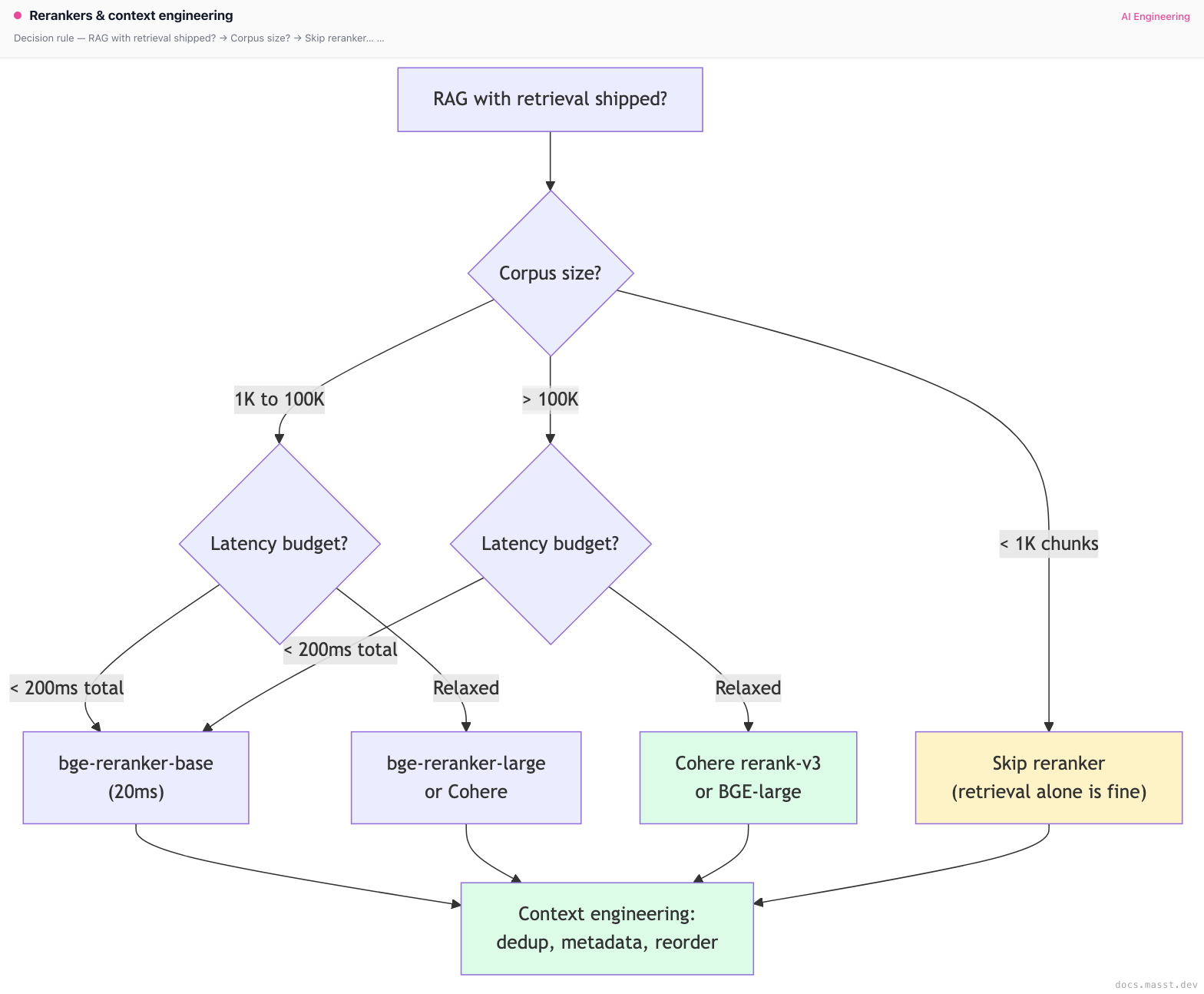
Very small corpora (< 1000 chunks). Just retrieve top-K from a good bi-encoder. The marginal nDCG gain doesn't justify the latency.
-
Hard-real-time UX (< 200ms total budget). Some autocomplete or in-IDE retrieval flows can't afford a 50ms reranker. Use a strong bi-encoder + tight tokenization + carefully tuned k.
-
Pure exact-match workloads. If your top hits from BM25 are already "the answer" (ID lookup, citation search), reranking is wasted compute. The retriever has already won.
Decision rule
Real-world stacks
- Anthropic Contextual Retrieval (Sept 2024): Voyage embeddings + BM25 (contextual) + RRF + Cohere
rerank-v3.0. Reduced top-20 retrieval-failure rate from 5.7% to 1.9% on their evals. - Perplexity: dense + BM25 + custom transformer reranker (in-house, distilled from a larger teacher). They've shared in talks that their reranker is the highest-leverage component in their pipeline.
- Notion AI: dense retrieval + Cohere
rerank-multilingual-v3.0+ chunk-metadata-aware prompt formatting. Public engineering blog (2024) details the move from no-reranker to reranker, citing a ~30% reduction in "wrong-answer" CSAT complaints. - Glean: in-house cross-encoder reranker fine-tuned per-tenant on click-through data (clicks treated as positive signal). They claim +10-15 nDCG on tenant-tuned models over off-the-shelf.
- Cursor: ColBERT-style late interaction acts as both retriever and reranker for codebase search. They additionally apply a context-packing step that prioritizes (a) the function the user's cursor is in, (b) imports, (c) recently-edited files.
- GitHub Copilot Workspace: retrieval + reranker over the active repo. Uses a custom code-specific cross-encoder. Public docs describe lost-in-the-middle mitigations: imports always at the top of the context window, current file context always at the bottom (closest to the generation point).
- OpenAI ChatGPT Retrieval (Knowledge files): rerank step is undocumented but observed in latency profiles. Public guidance emphasizes context-window discipline: ~3-5 chunks is the sweet spot even with GPT-4o's 128K window.
- Stripe Docs Search: hybrid retrieval + Cohere rerank + an engineered prompt with strict citation requirements. Their published "good chunk" guidelines: 400-800 tokens, metadata header, dedup at query time.
- LinkedIn search: published in 2024 that they use a multi-stage rerank — first a small cross-encoder (fast), then a larger LLM-based reranker for the top-20. Cascading rerankers is a common pattern at very high QPS.
Curated questions to practice
- Your nDCG@10 with hybrid retrieval is 0.79. You add Cohere rerank-v3 and it becomes 0.83. P95 latency went from 200ms to 320ms. A PM asks if it's worth shipping. What additional measurements would you bring to that meeting?
- A user reports the model answered "I couldn't find that" but the right chunk is in your top-5 retrieved list. Walk through the failure modes between "chunk retrieved" and "chunk used." Where would you instrument to localize the issue?
- You're considering a self-hosted BGE reranker vs Cohere's API. Your traffic is 50 QPS sustained, peak 200 QPS. Walk through the cost / latency / operational trade-off. What's your decision and why?
- Your context contains the top-5 reranked chunks, in score order. The LLM consistently misses information in chunk #3 even when it's clearly the answer. Diagnose and propose two fixes.
- You're shipping Anthropic-style contextual retrieval. Indexing cost (the per-chunk LLM preamble) is $4K for the initial run. The PM wants to know what gain to expect. What's your honest answer based on published numbers, and what would you measure post-launch to validate?
Quick-reference card
| Question | Answer |
|---|---|
| Default API reranker? | Cohere rerank-v3.0 ($1 / 1K queries) |
| Default self-hosted reranker? | BAAI/bge-reranker-large on a single L4 GPU |
| How many candidates to rerank? | Top-50 from retrieval; never more than 100 |
| How many chunks to send to LLM? | 3-5 for almost all production cases |
| Best chunk ordering? | "Start-end-middle" reorder (LlamaIndex LongContextReorder) — or just top-3 |
| Lost-in-the-middle mitigation? | Smaller context (2-4K tokens), place query after context, reorder strongest to ends |
| Should I add citation hints? | Yes — number chunks [1], [2], ... and ask the model to cite |
| Killer pitfall #1 | Reranking too many candidates (> 100) |
| Killer pitfall #2 | Silently truncating long chunks at the reranker context limit |
| Killer pitfall #3 | Stuffing the full context window — quality drops |
| Killer pitfall #4 | Ignoring chunk order after rerank (LITM effect) |
| What to read next | Inference — model serving, batching, KV cache, structured output |
Next page: Inference — once retrieval is solid, the next bottleneck is generation: KV cache, batching, structured output, and the latency/cost knobs that actually move the dial.
Finished reading?
Mark it done to track your progress in Concepts.
Hybrid search
Why dense embeddings miss product codes and version numbers, how BM25 + dense + ColBERT fuse with Reciprocal Rank Fusion, and where each signal earns its weight in real RAG stacks.
Inference internals
Why your tokens-per-second is what it is — sampling, KV cache, batching, quantization, and serving stacks. The mechanics behind TTFT, throughput, and the cost-per-million math.