
Retrieval depth
RAG that actually works in production — chunking trade-offs, embedding choice, hybrid search, rerankers, and the context engineering that turns 60% accuracy into 92%.
The honest truth about RAG
"Just embed your docs and stick it in a vector DB" gets you to a demo. It does NOT get you to production. Real RAG systems at companies like Perplexity, Notion AI, Glean, and Cursor are layered: smart chunking → multiple retrievers in parallel → fusion → reranking → context packing. This tier walks each layer end-to-end with the numbers that actually matter.
The retrieval problem in one paragraph
Your LLM has a ~200K token context window (or maybe 1M with Gemini). Your knowledge base has 50 million tokens. You need to surface the right 5-20K tokens for each query so the model has enough context to answer correctly without getting lost in noise. That's the retrieval problem. Every page in this tier is about a sharper tool for solving it.
The five pages
Chunking
Why fixed-size chunking destroys recall. Recursive, semantic, sentence-window, parent-document, late-chunking — when each wins and what they cost.
Embedding models
OpenAI text-embedding-3 vs Cohere embed-v3 vs Voyage vs open-source. MTEB scores, dimensionality, domain fit, fine-tuning when it actually helps.
Hybrid search
Dense retrieval misses exact-match queries; BM25 misses semantic ones. RRF, reciprocal rank fusion, weighted fusion, ColBERT — the recipes that beat either alone.
Rerankers & context engineering
Cross-encoder rerankers (Cohere rerank-v3, BGE, Jina). Context packing, lost-in-the-middle, contextual compression. Where 20% of your accuracy gains live.
A typical production retrieval stack
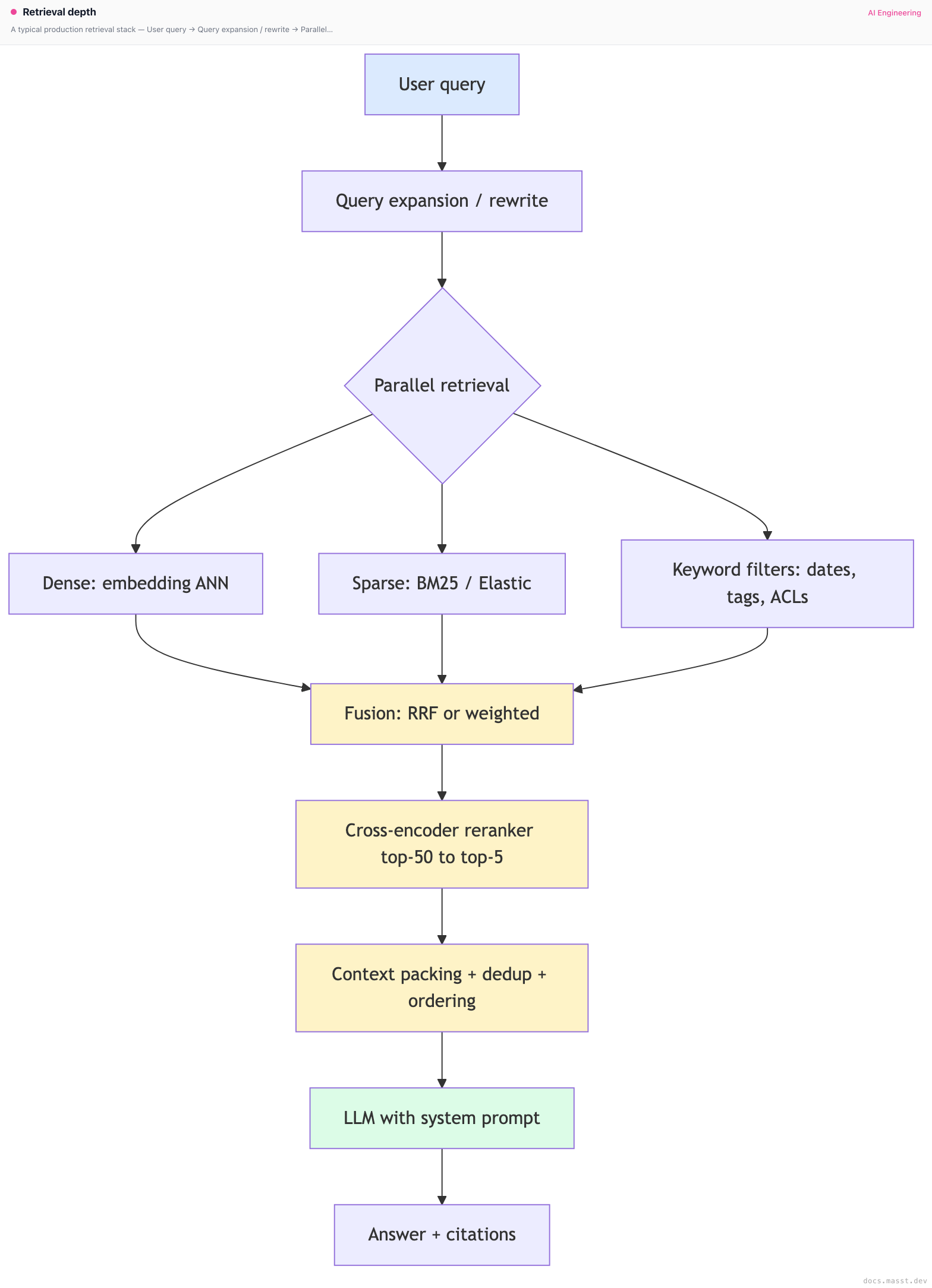
The yellow boxes — fusion, rerank, pack — are where the accuracy gains live. Most "we built RAG" tutorials skip all three. That's why they don't work.
The metrics that actually matter
Forget cosine similarity on the validation set. The numbers production teams track:
| Metric | What it measures | What to target |
|---|---|---|
| Recall@K | % of queries where the right doc is in top-K | 90%+ at K=20 before reranking; 95%+ at K=5 after reranking |
| MRR (Mean Reciprocal Rank) | How high the right doc ranks on average | 0.7+ after reranking |
| Answer faithfulness | % of generated claims grounded in retrieved context | 95%+ (use LLM-as-judge) |
| End-to-end latency p95 | Total time from query to first token | 800ms for chat; 200ms for autocomplete |
| Retrieval cost per query | $ on embeddings + vector DB + reranker | Track separately — reranker is often the dominant cost |
If you don't track these, you can't improve. See Eval & observability for the harness that makes this tractable.
The progression
Start with Chunking — the cheapest win and the single biggest lever. Most teams ship with 512-token fixed chunks and never revisit. Moving to recursive or semantic chunking alone often gives +10-15 points of Recall@10.
Then Embeddings — picking the right model for your domain. Generic OpenAI embeddings vs Cohere domain-tuned vs Voyage code-specific can swing Recall@10 by 20 points on technical content.
Then Hybrid search — adding BM25 in parallel with dense retrieval. This step alone tends to add another 5-10 points of recall and is the single biggest accuracy win for exact-keyword queries (product codes, person names, legal references).
Then Rerankers & context engineering — cross-encoder reranking on the top-50 from hybrid search, then careful context packing. This is where you go from "decent" to "this is actually good".
Each page tells you the cost of every step (in $/query and latency p50/p95) so you can decide what to skip.
Finished reading?
Mark it done to track your progress in Concepts.
AI Engineering
Production patterns for building LLM systems — retrieval, inference, agents, eval, safety, cost, and the 2026 edges. Written for engineers shipping, not papers.
Chunking
The first and most important RAG decision. Fixed-size, recursive, semantic, sentence-window, parent-document, late chunking — when each wins, what it costs, and the Recall@10 numbers from real production systems.